Denim Fabric Classifications

Denim Fabric Classifications: The Ultimate Factory Guide

Picture of Helen

Helen

I am the founder of China fabric supply chain, with 20 years of fabric manufacturing experience. Our mill holds ISO 9001, OEKO-TEX Standard 100, and GOTS certifications, and we were awarded China Best Fabric Manufacturer Award for quality and reliability.

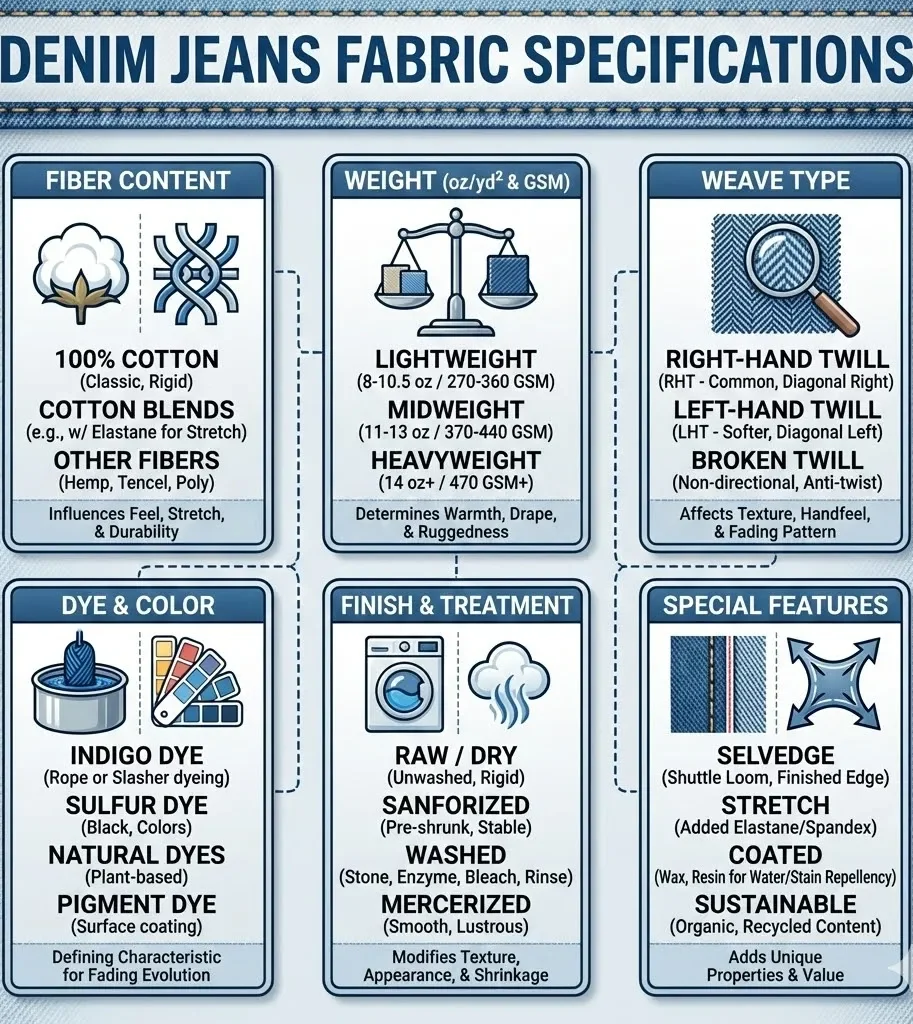
What are the denim fabric classifications? Our 20-year factory guide classifies denim by fiber, weight, dyeing, weave, and washing methods.

Table of Contents

👖 Introduction: The Language of Denim Sourcing

In my 20 years of managing denim production, I’ve seen thousands of purchase orders land on my desk.

⚠️ The “Blue Denim” Trap

Some buyers simply ask for “Blue Denim Fabric,” not realizing that this request is as vague as asking a chef for “Food.”

🤔 The Questions You Must Answer

  • Is it 100% cotton denim or stretch denim fabric?
  • Is it rope dyed indigo denim or sulfur dyed denim?
  • Do you need a rigid heavyweight denim fabric for workwear or a soft lightweight denim fabric for shirts?

Denim fabric classification is the language of our industry. Understanding the nuances of types of denim fabric is the difference between launching a best-selling jean and sitting on a warehouse of unsellable stock.

📘 Your Definitive Manual

This guide is your definitive denim fabric classifications manual. We will break down every category—from fiber and weight to dyeing and finishing—giving you the pros, cons, and exact specifications (width, gsm, yarn count) you need to source like a pro.

👖 Denim Fabric Classification (Brief Definition)

Denim fabric classification organizes denim into specific categories based on its physical properties and manufacturing processes.

While traditionally defined as a sturdy cotton warp-faced twill textile, modern denim has evolved into a complex family of fabrics.
Denim Fabric Classifications

🏗️ What Elements Does “Classification” Include?

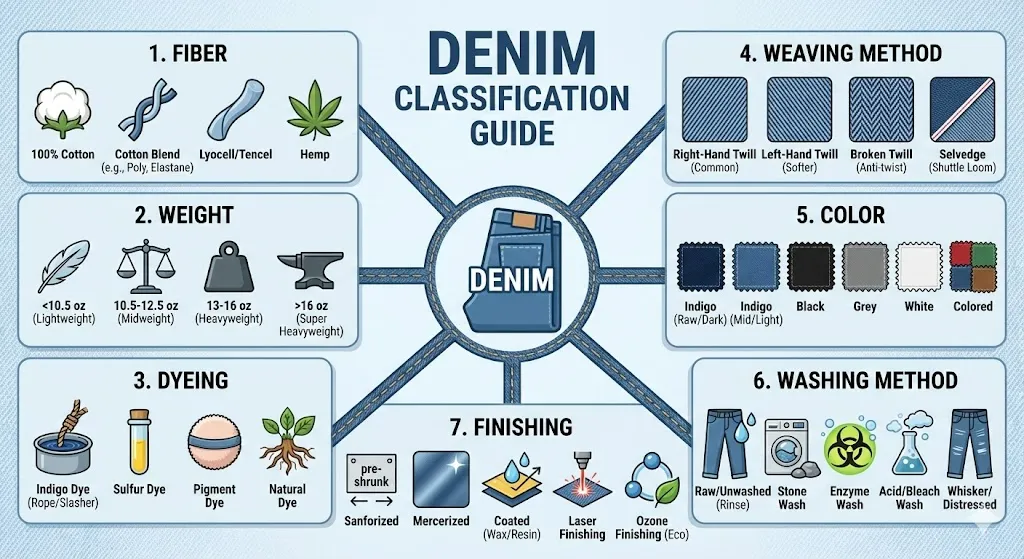
When we talk about how is denim fabric classified, we look at seven distinct pillars:

1. Fiber Composition 🌿

What is it made of? (e.g., Cotton vs Blends)

2. Fabric Weight ⚖️

How heavy is it? (e.g., Denim Oz vs GSM)

3. Dyeing Method 🎨

How is the color applied? (e.g., Indigo vs Sulfur)

4. Weaving Structure 🧶

How is it constructed? (e.g., Twill vs Plain)

5. Color 🌈

What is the visual shade? (e.g., Blue, Black, Ecru)

6. Washing Method 🌊

How is it treated post-sewing? (e.g., Stone Wash, Acid Wash)

7. Finishing Process 🧥

What surface treatments are applied? (e.g., Coated, Printed)

🧵 Denim Fabric Types by Fiber Composition

The soul of the fabric lies in its fiber. This determines the handfeel, stretch, and durability.
1. 100% Cotton Denim 🏛️

Definition:

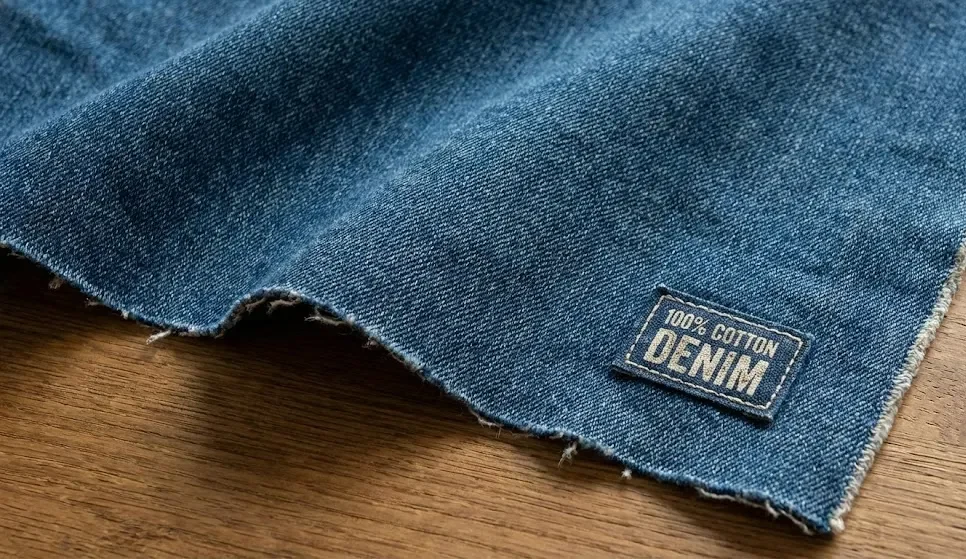
The purist’s choice. Made entirely from cotton yarns in both warp and weft. It has zero elasticity (rigid) and forms the backbone of the vintage and heritage market. Traditionally, denim is made of 100% cotton.

100% Cotton Denim
100% Cotton Denim
✅ Pros:

  • Extremely breathable and hypoallergenic.
  • Develops beautiful, high-contrast fades (whiskers/honeycombs).
  • Biodegradable and recyclable.
❌ Cons:

  • Rigid and stiff initially; requires a “break-in” period.
  • No stretch means less comfort for tight fits.
  • Prone to shrinkage if not Sanforized.
🛠️ Specs & Use:

  • Ideal Use: Jeans (Vintage 501 style), Trucker Jackets.
  • Width: 150cm (standard) or 75-80cm (Selvedge).
  • Weight: 340-475gsm (10-14 oz).
  • Yarn Count: 7s x 7s or 10s x 10s (Open End or Ring Spun).

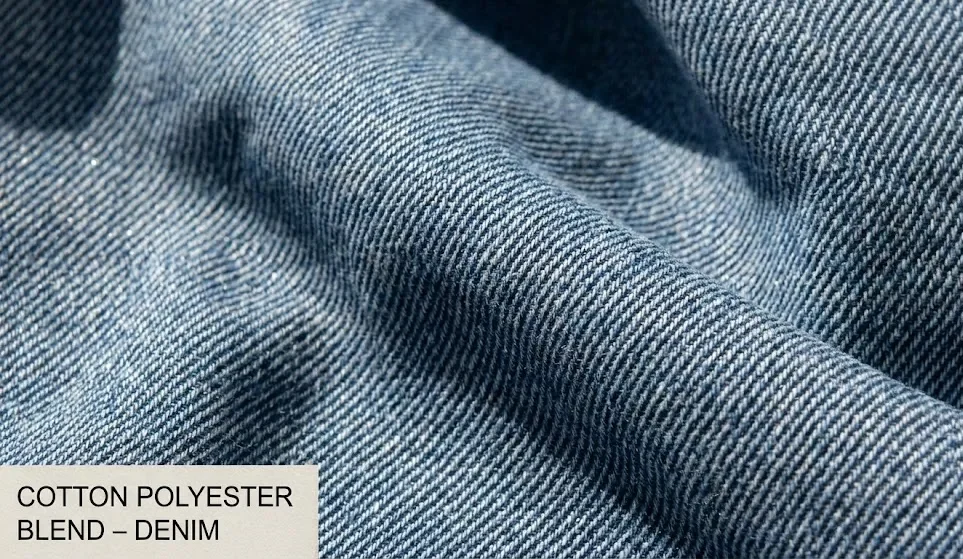
2. Cotton Polyester Denim Blend ⚒️

Definition:

A blend where polyester fibers are mixed with cotton (usually in the weft or core-spun) to increase strength and reduce cost. Also known as poly cotton denim fabric.

Cotton Polyester Denim Blend
✅ Pros:

  • Significantly stronger and more durable than 100% cotton.
  • Resists wrinkles and shrinks less.
  • Cheaper to produce.
❌ Cons:

  • Less breathable; can feel “hot” or “plastic-y”.
  • Fades are often “flat” and lack character.
  • Prone to pilling if low-quality spun poly is used.
🛠️ Specs & Use:

  • Ideal Use: Workwear, Uniforms, Budget Jeans.
  • Width: 150-160cm.
  • Weight: 300-400gsm (9-12 oz).
  • Yarn Count: 10s x 300D (Poly Filament) or 10s x 16s (Blend).

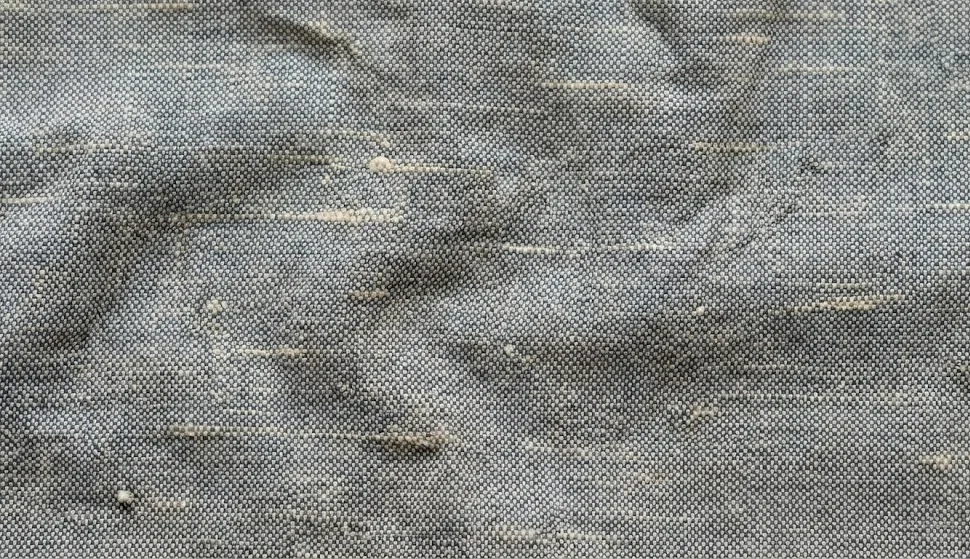
3. Cotton Linen Denim 🌾

Definition:

A premium blend incorporating linen fibers (flax) for texture and cooling properties. Often called linen blend denim.

Cotton Linen Denim
Cotton Linen Denim
✅ Pros:

  • Exceptional breathability and moisture-wicking (summer ready).
  • Unique “slubby” texture and irregular handfeel.
  • Stronger than cotton when wet.
❌ Cons:

  • Wrinkles very easily.
  • Can feel rough or scratchy initially.
  • More expensive due to linen fiber cost.
🛠️ Specs & Use:

  • Ideal Use: Summer shirts, Loose-fit trousers, Dresses.
  • Width: 145-150cm.
  • Weight: 200-300gsm (6-9 oz).
  • Yarn Count: 21s x 21s (Linen blend weft).

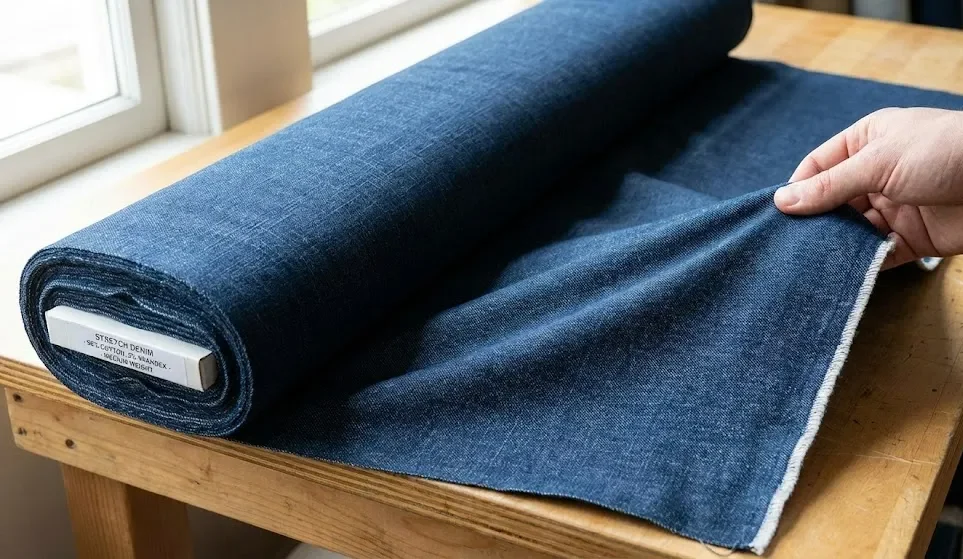
4. Stretch Denim Fabric (Cotton + Spandex) 🤸

Definition:

The modern standard. Contains a small percentage (1-3%) of elastane (Spandex/Lycra) in the weft yarn to provide elasticity. Also known as cotton spandex denim.

Stretch Denim Fabric (Cotton + Spandex)
✅ Pros:

  • Superior comfort and range of motion.
  • Allows for skinny/tight fits without restricting movement.
  • Better shape retention (if recovery is good).
❌ Cons:

  • Spandex degrades over time with heat (dryer/ironing).
  • Can suffer from “bagging out” (knees loose).
  • Less durable than rigid denim.
🛠️ Specs & Use:

  • Ideal Use: Skinny Jeans, Jeggings, Skirts.
  • Width: 130-150cm (Width shrinks due to elasticity).
  • Weight: 270-375gsm (8-11 oz).
  • Yarn Count: 10s x 40D/40s (Core Spun Spandex).

⚖️ Denim Fabric Types by Weight (Oz/GSM)

Denim weight classification is critical for determining the end-use. Buyers often search for a denim oz chart or denim gsm guide.

📜 Industry Standard Data

According to Standard D3776 for Mass Per Unit Area, fabric weight is a primary determinant of performance. In the denim industry, weight is universally traded in Ounces per Square Yard (oz/yd²), even in metric countries.

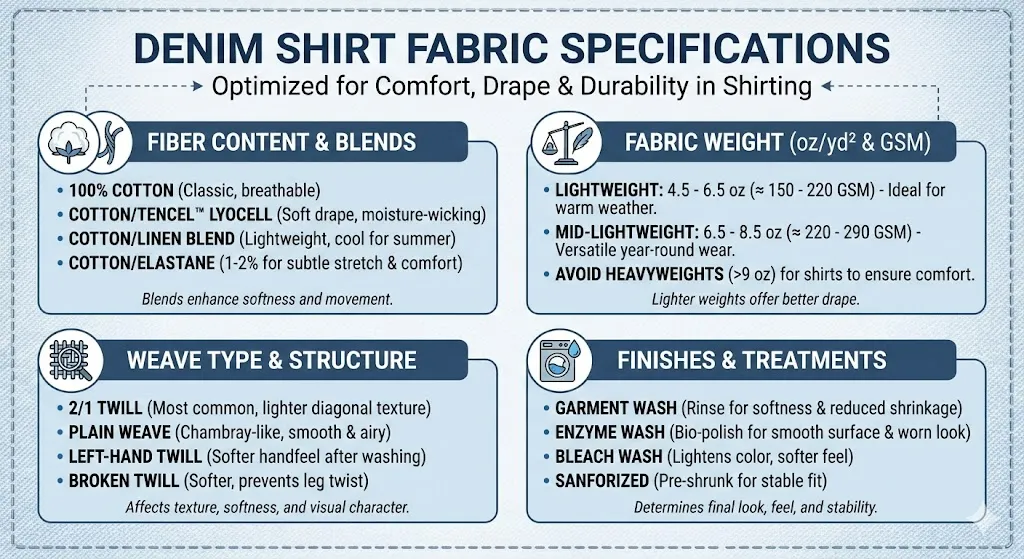
1. Lightweight Denim Fabric (4oz – 8oz) ☁️

Definition:

Denim weighing under 8 oz (approx. <270gsm). It is soft, fluid, and often uses finer yarns.

Light Weight Denim(6Oz)
✅ Pros:
Drapes well, very breathable, comfortable for summer.
❌ Cons:
Low durability, tears easily, not suitable for pants.
🛠️ Specs & Use:

  • Ideal Use: Denim fabric for shirts (Chambray style), Summer Dresses.
  • Specs: Width 150cm | Weight 135-270gsm | Yarn 32s x 32s or 40s x 40s.

2. Midweight Denim Fabric (8oz – 12oz) 👖

Definition:

The most versatile category. Covers 80% of the fashion market. What oz denim for jeans? Usually 10-12oz.

Midweight Denim Fabric(10 Oz)
✅ Pros:
Balances durability with comfort. Ideal for all-season wear.
➖ Cons:
None significant; it’s the “Goldilocks” weight.
🛠️ Specs & Use:

  • Ideal Use: Standard 5-pocket jeans, Denim fabric for jacket (lighter styles).
  • Specs: Weight 270-400gsm | Yarn 10s x 10s or 12s x 12s.

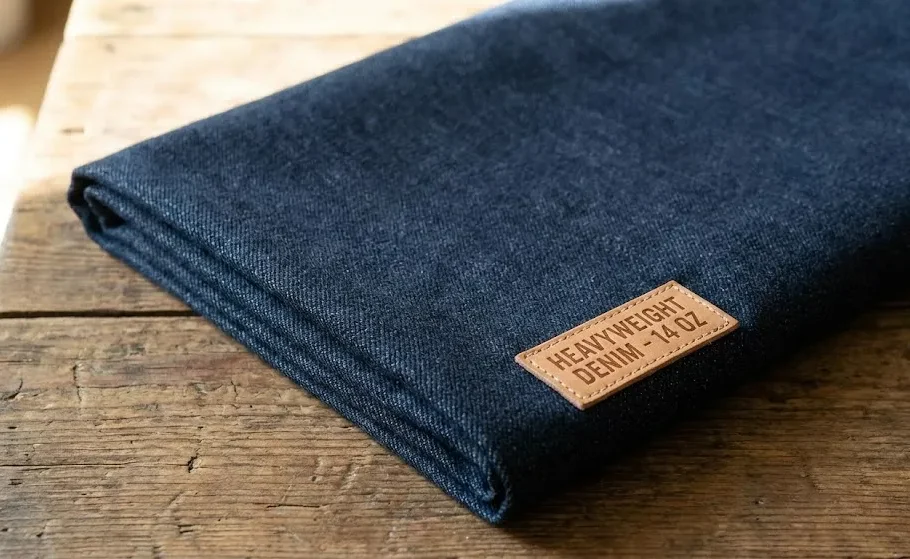
3. Heavyweight Denim Fabric (12oz – 16oz) 🛡️

Definition:

Sturdy, thick denim used for authentic workwear and premium heritage jeans.

Heavyweight Denim Fabric (14Oz)
✅ Pros:
Extremely durable, forms deep distinct creases (fades), very warm.
❌ Cons:
Stiff, hard to break in, heavy to wear in summer.
🛠️ Specs & Use:

  • Ideal Use: Winter jeans, Denim fabric for workwear, Trucker Jackets.
  • Specs: Weight 400-540gsm | Yarn 7s x 6s or 7s x 7s.

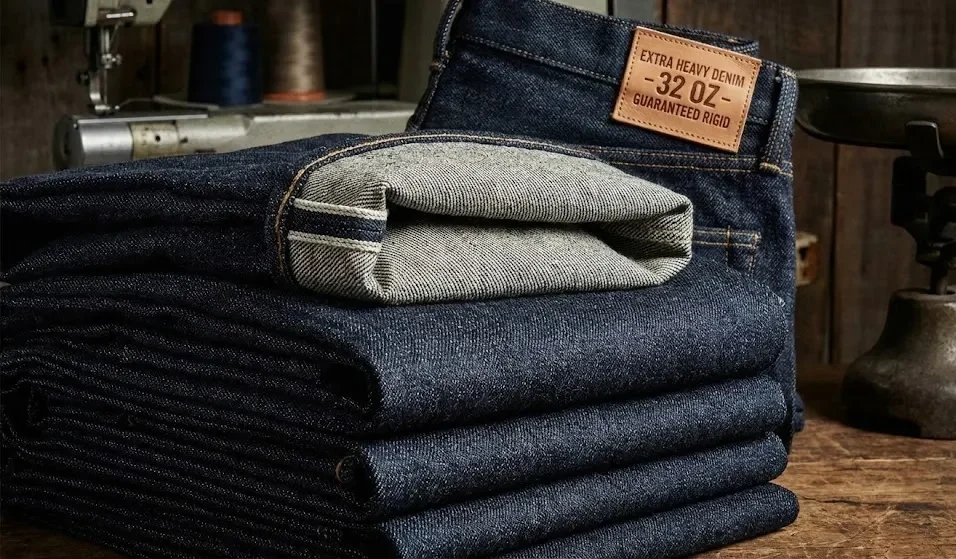
4. Extra Heavy Denim (16oz – 32oz) 🦍

Definition:

Niche category for “Denimheads.” Can stand up on its own. 20 oz denim falls here.

Extra Heavy Denim (32Oz)
✅ Pros:
Bulletproof durability, ultimate fading potential.
❌ Cons:
Can be painful to wear initially (chafing), hard to sew (requires heavy machinery).
🛠️ Specs & Use:

  • Ideal Use: Collector’s Jeans, Motorcycle Gear.
  • Specs: Weight 540-1000+gsm | Yarn 5s x 4s (Very coarse).

🎨 Denim Fabric Types by Dyeing Method

How is denim fabric classified by color application determines its fading behavior.

1. Indigo Denim Fabric (Rope Dyed) 👖

Definition:

The yarn is dipped into indigo baths and oxidized in the air multiple times. The core of the yarn remains white (Ring Dyeing). This is rope dyed indigo denim.

✅ Pros:
Creates the classic “fading” effect as the blue surface wears off to reveal the white core.
❌ Cons:
Color bleeds/crocks easily (Blue hands!). Low colorfastness is a “feature,” not a bug.
🛠️ Specs & Use:

  • Ideal Use: Premium Blue Jeans.
  • Specs: Requires denim crocking test awareness (usually Grade 2-3).

2. Sulfur Dyed Denim (Black/Colors) ⚫

Definition:

Uses sulfur dyes, primarily for sulfur black denim and earth tones. The dye penetrates deeper than indigo.

✅ Pros:
Better colorfastness than indigo (doesn’t fade to white quickly). Cost-effective.
❌ Cons:
Environmental concerns (sulfur waste). Can smell like “rotten eggs” if not washed properly.
🛠️ Specs & Use:

  • Ideal Use: Black Jeans, Grey Denim.

3. Garment Dyed Denim 🧥

Definition:

The fabric is woven undyed (Ecru) and the finished garment is dyed in a drum.

✅ Pros:
Softer handfeel (pre-washed), unique “lived-in” look. Infinite color options for small batches.
❌ Cons:
High shrinkage risk (shrinks during dyeing). Color can be uneven.
🛠️ Specs & Use:

  • Ideal Use: Fashion jeans in trend colors (Pink, Green, etc.).

4. Reactive Dyed Denim 🧪

Definition:

Uses reactive dyes that form a covalent bond with the cellulose. Used for colored denim fabric that needs to stay bright.

✅ Pros:
Excellent colorfastness (doesn’t fade). Bright, flat colors.
❌ Cons:
Does not develop “whiskers” or fades like indigo. Looks more like twill pants.
🛠️ Specs & Use:

  • Ideal Use: Corporate uniforms, Color-block denim.

5. Clean Indigo / Foam Dyeing 🌿

Definition:

Sustainable methods like foam dyed denim use foam instead of water baths to apply indigo, or low water denim dyeing.

✅ Pros:
Saves massive amounts of water and chemicals.
❌ Cons:
Technology investment is high; shade depth can be harder to control.
🛠️ Specs & Use:

  • Ideal Use: Eco-conscious collections.
🏭 Factory Experience (Case Study): The “Sulfur Smell”

We had a client complain about “Sulfur Smell” on a batch of sulfur black denim. The smell comes from residual sulfur compounds not being neutralized.

🔧 The Solution

We implemented a strict oxidizing wash protocol using Hydrogen Peroxide at the end of the dyeing line to neutralize the sulfur.

✅ The Result

We invited the client to verify the scent on the next batch. The problem was solved, and we now include “Odor Free” as a standard QC check for black denim.

🕸️ Denim Fabric Types by Weave/Structure

The weave determines the surface texture and drape.

1. Twill Denim Fabric (Common) 👖

Definition:

The standard denim twill weave. The weft thread passes under two or more warp threads (e.g., 3/1 twill denim or 2/1 twill denim).

✅ Pros:
Durable, hides stains, drapes better than plain weave.
❌ Cons:
Has a “direction” (diagonal line) which can cause leg twist if not cut properly.
📐 Types of Twill:

Right Hand Twill (RHT):
Diagonal goes up to the right. Most common (Levi’s style).
Left Hand Twill (LHT):
Diagonal goes up to the left. Softer handfeel (Lee style).
Broken Twill:
Zig-zag pattern. Prevents leg twist.

2. Plain Weave Denim (Rare) ⬜

Definition:

One-over-one-under structure. Plain weave denim is technically “Chambray” if lightweight.

✅ Pros:
Same appearance on face and back. Very stable.
❌ Cons:
Less durable than twill; doesn’t look like “jeans.”
🛠️ Specs & Use:

  • Ideal Use: Lightweight Shirts.

3. Satin Weave Denim (Rare) ✨

Definition:

A structure that creates a smooth, lustrous surface.

✅ Pros:
Very soft, high sheen/luster.
❌ Cons:
Snags easily, less durable.
🛠️ Specs & Use:

  • Ideal Use: Fashion stretch jeans for women.

🎨 Denim Fabric Types by Color

1. Blue Denim Fabric 🔵

Definition:

Indigo warp + White weft. The classic.

✅ Pros:
Versatile, fades beautifully.
🛠️ Ideal Use:
Everything.

2. Black Denim Fabric ⚫

Definition:

Black denim fabric can be “Black x White” (Black warp/White weft) or “Double Black” (Black warp/Black weft).

✅ Pros:
Slimming effect, rock-n-roll aesthetic. Double black denim stays black longer.
🛠️ Ideal Use:
Skinny jeans, Jackets.

3. Grey Denim Fabric 🌫️

Definition:

Usually achieved by washing down black denim or using grey sulfur dyes.

✅ Pros:
Neutral, sophisticated.
🛠️ Ideal Use:
Casual office wear.

4. Ecru / Natural Denim 🌾

Definition:

Ecru denim fabric is undyed cotton. Contains natural flecks of cotton seed.

✅ Pros:
Sustainable (no dyeing), vintage summer look.
❌ Cons:
Shows dirt easily.

5. Colored Denim (Non-Indigo) 🌈

Definition:

Colorful denim fabric dyed in red, green, yellow, etc.

✅ Pros:
Trend-driven.
❌ Cons:
Harder to inventory (fashion colors change fast).

🌊 Denim Fabric Types by Washing Method

Raw denim vs washed denim is a major consumer choice, but for factories, it’s a finish.

1. Raw Denim (Dry Denim) 🛑

Definition:

Raw denim fabric meaning is unwashed fabric directly from the loom. It is stiff and dark.

✅ Pros:
Custom fades to the wearer’s body. Maximum durability.
❌ Cons:
Shrinks up to 10% (if unsanforized), bleeds dye everywhere.

2. Rinse Wash Denim 💧

Definition:

One quick wash to remove starch and prevent shrinkage.

✅ Pros:
Dark look but softer feel. Size is stable.

3. Enzyme Wash Denim 🧪

Definition:

Uses cellulase enzymes to eat away surface cellulose, simulating age.

✅ Pros:
Eco-friendlier than stone wash. Soft handfeel.

4. Stone Wash Denim 🗿

Definition:

Washed with pumice stones to abrade the surface.

✅ Pros:
Classic vintage contrast look.
❌ Cons:
Stones damage the fabric and machine; sludge waste.

5. Acid Wash Denim ⚡

Definition:

Stones soaked in bleach (chlorine) create high-contrast mottling.

✅ Pros:
80s retro look.
❌ Cons:
Weakens fabric significantly.

6. Bleach Wash Denim 🧊

Definition:

Uses bleach to lighten the entire shade to “Ice Blue.”

✨ Denim Fabric Types by Finishing Process

The denim fabric finishing process adds value and function, transforming the textile’s surface.

1. Coated Denim Fabric 🧥

Definition:

A layer of acrylic, PU, or wax is applied. Includes wax coated denim (leather look) and resin coated denim (retains color).

✅ Pros:
Water resistance, unique leather-like aesthetic.
❌ Cons:
Breathability is reduced. Coating can wear off.
🛠️ Ideal Use:
Fashion Jackets, Moto Jeans.

2. Printed Denim Fabric 🎨

Definition:

Patterns are printed via laser, screen, or roller. Denim fabric pattern variety is endless (camo, floral).

✅ Pros:
Unlimited design potential.
❌ Cons:
Print can crack or fade if not high quality.

3. Embossed Denim 🗿

Definition:

Heat and pressure stamp a 3D texture (like snakeskin) onto the fabric.

4. Flocked Denim 🎭

Definition:

Velvet-like fibers are glued to the surface in a pattern.

🎯 Conclusion: Matching Spec to Story

Mastering denim fabric classifications is about matching the spec to the story.

🏛️ If you want “Heritage”

Choose 100% Cotton, Heavyweight, Ring Spun, Indigo.

☁️ If you want “Comfort”

Choose Cotton/Spandex, Midweight, Enzyme Washed.

🛠️ If you want “Budget Workwear”

Choose Poly/Cotton, Heavyweight, Sulfur Dyed.

“As a factory, we don’t just sell ‘denim.’ We sell the specific combination of fiber, weight, dye, and finish that makes your product succeed.”

Ready to source?

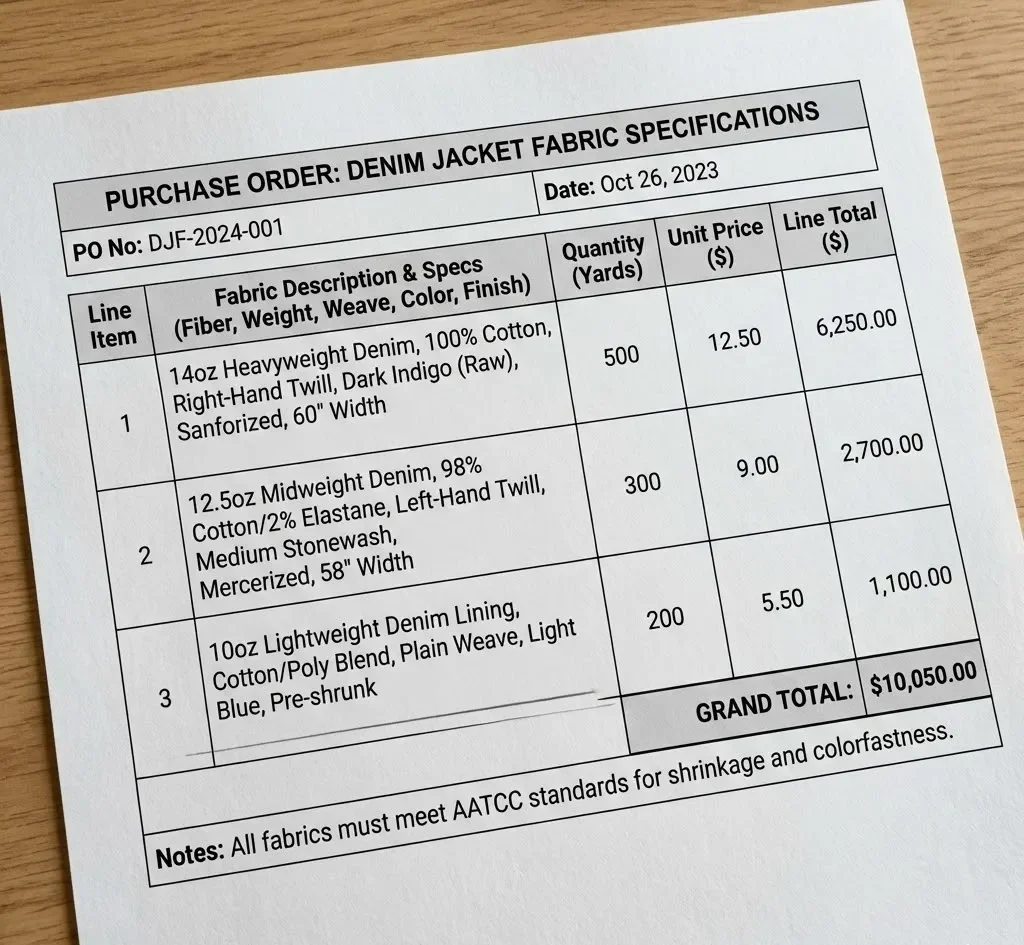
📥 Download Free Denim Fabric Spec Sheet Template

Use this template to write your PO correctly.

❓ FAQ: Common Questions

1. How many types of denim are there?

There are hundreds of combinations, but they fall into 4 main groups: 100% Cotton, Stretch, Poly-Cotton, and Selvedge. Variations come from weight (oz), color, and wash.

2. What is the difference between 10 oz and 14 oz denim?

  • 10 oz denim: Lightweight/midweight, suitable for summer jeans or comfort stretch styles.
  • 14 oz denim: Heavyweight, stiff, and durable, used for classic rigid jeans and workwear.

3. How is denim fabric classified?

It is classified by:

  • Fiber: Cotton vs Stretch
  • Weight: Light vs Heavy
  • Dye: Indigo vs Sulfur
  • Weave: Right/Left Twill
  • Selvedge: Edge finish

4. What is coated denim?

Coated denim has a surface treatment (like wax, resin, or PU) that gives it a shiny, leather-like, or water-resistant finish. It is popular in high-fashion.

5. Which denim is best for jackets?

  • Classic Trucker Jacket: 12 oz to 14 oz 100% Cotton is standard.
  • Fashion Jacket: 10-11 oz Stretch Denim provides more comfort.
Related Articles

Like this article? Share it on:
Table of Contents
Like this article? Share it on:

We are at your disposal for any technical or commercial information?

Latest Insights From Our Experts

en_USEnglish

Contact Us

Who Are You