I am the founder of China fabric supply chain, with 20 years of fabric manufacturing experience. Our mill holds ISO 9001, OEKO-TEX Standard 100, and GOTS certifications, and we were awarded China Best Fabric Manufacturer Award for quality and reliability.
combed cotton vs carded cotton: What's the difference? Our factory expert guide compares 9 key factors: softness, pilling, cost & specs to help you source smarter.
Introduction: Combed Cotton vs Carded Cotton
As a textile professional who works with fabric mills and apparel brands every day, I can tell you that one of the most fundamental—and most critical—decisions in cotton sourcing boils down to a single question: combed cotton vs carded cotton?
Combed Cotton Vs Carded Cotton
To a buyer, this choice directly impacts the hand-feel, durability, appearance, and final cost of your product. To a printer, it dictates the quality of your print. To us at the factory, it’s the difference between two distinct production processes.
Many guides online give simple definitions, but they rarely show you the data behind the differences or provide a clear framework for when to pay more for combed. This guide is different. We’re going to open our factory playbook, share our in-house test data, and provide a clear, expert-level comparison to help you make the most profitable and product-appropriate decision.
(This guide is a deep dive into yarn processing. For a broader overview of all cotton types, we recommend starting with our pillar page, Pure Cotton Fabric Guide.)
What Is Combed Cotton?
Combed Cotton Makes High-End T-Shirts And Bed Sheets.
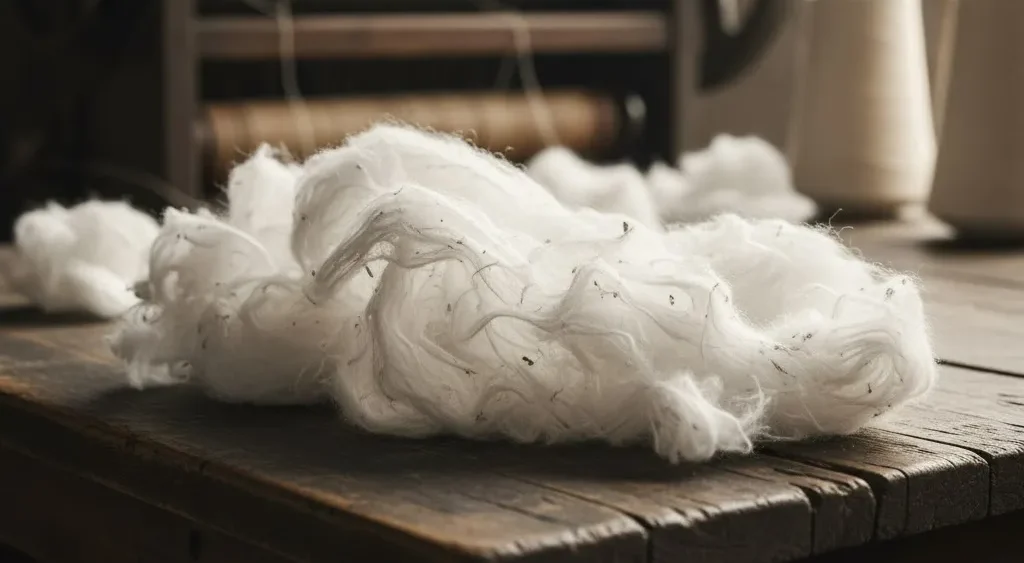
Combed cotton is a premium-grade cotton yarn made by carding and then using a fine-toothed combing machine to remove short fibers and neps, yielding smoother, stronger, combed ring-spun yarns ideal for premium T-shirts and sheets.
This extra combing step is the key. It’s an additional, costly process that filters out all the undesirable elements—the short, scratchy fibers and tiny impurities (neps)—that make a fabric feel rough and pill over time. What’s left is only the longest, straightest, and most uniform cotton fibers, which are then typically “ring-spun” into a 100 combed cotton yarn that is exceptionally smooth and strong.
Pros & Cons of Combed Cotton
Advantages (Pros)
Superior Softness: The removal of short, prickly fibers results in a much softer, smoother hand-feel. This is the primary reason brands choose combed cotton fabric.
Higher Durability & Strength: The remaining long fibers are aligned and twisted together tightly, creating a yarn that is less prone to breaking and tearing.
Excellent Pilling Resistance: Pilling is caused by short fibers migrating to the surface and tangling. By removing them, combed cotton is highly resistant to pilling.
Cleaner Appearance & Print Surface: The smooth, hairless surface has a higher luster and provides a perfect, clean canvas for high-resolution DTG printing on combed cotton.
Disadvantages (Cons)
Higher Cost: The combing process is time-consuming and creates significant fiber waste (called “noils”), often removing 15-20% of the initial fiber volume. This waste and the extra machine step increase the cost.
Less Rustic Feel: For some specific workwear or heritage brands, the clean, smooth look of combed cotton is less desirable than the “hairy,” authentic texture of carded cotton.
Why We Recommend Combed for Premium Tees?
Our Internal Staff Are Benchmarking Quality Against The Quality Control Personnel.
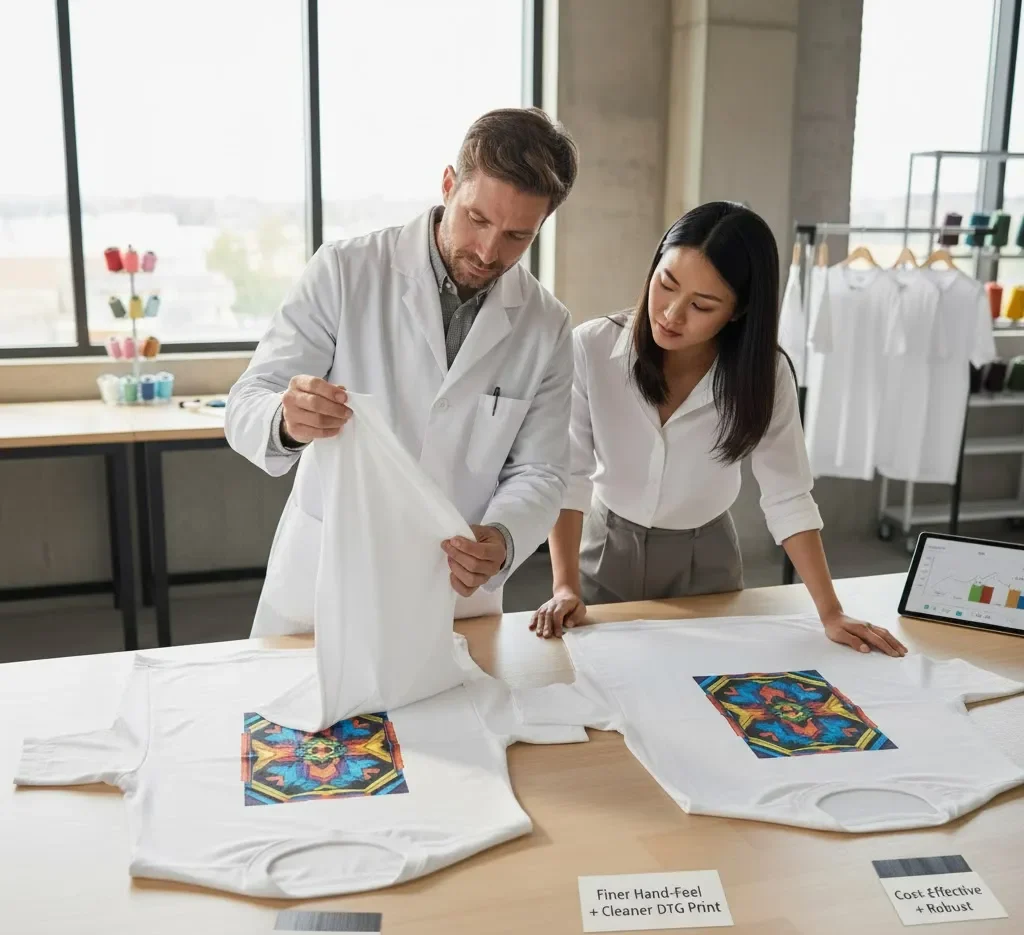
(In our T-shirt yarn production, if a client’s goal is a finer hand-feel + a cleaner surface for DTG printing, we default to recommending combed ring-spun yarn. The combing process removes more short fibers and neps, so the yarn surface has less hairiness, leading to more stable and crisp print edges. In contrast, carded open-end yarn is more robust for mass production and more cost-effective, but the fine details suffer. This is a trade-off we typically have clients decide for themselves after comparing hand-feel samples and print strike-offs.)
What Is Carded Cotton?
Carded cotton is the standard, most common type of cotton yarn. It is made by putting raw cotton through a “carding” process, which detangles, cleans (removes most large impurities), and aligns the fibers into a sliver (a loose rope) ready for spinning.
Carded Cotton
Crucially, what is carded cotton? It’s cotton that has not undergone the extra combing step. This means the resulting yarn is a mixture of both long and short staple fibers and still contains some minor impurities. While it’s often spun using the ring-spun method, it’s also commonly used in open-end spinning—a faster, more economical process that results in a slightly weaker, fuzzier yarn, but is very efficient for producing heavier fabrics like denim or hoodies.
Pros & Cons of Carded Cotton
Advantages (Pros)
Cost-Effective: This is its biggest advantage. Skipping the combing step saves on processing time and fiber waste, making carded cotton significantly cheaper.
Durable in a Rugged Way: While technically weaker than combed yarn, its fuller, hairier texture is very durable and suitable for workwear, heavy flannel, and denim.
Good for Authentic Look: The slight inconsistencies and neppy texture are often desired for vintage-style or heritage-inspired garments.
Disadvantages (Cons)
Rougher Hand-Feel: The presence of short, protruding fibers makes the fabric feel less smooth and slightly scratchy in comparison.
Prone to Pilling: Those short fibers will easily migrate to the surface and pill with abrasion and washing.
Less “Clean” Appearance: The fabric surface is fuzzier (hairier) and may show more tiny specks or impurities (neps).
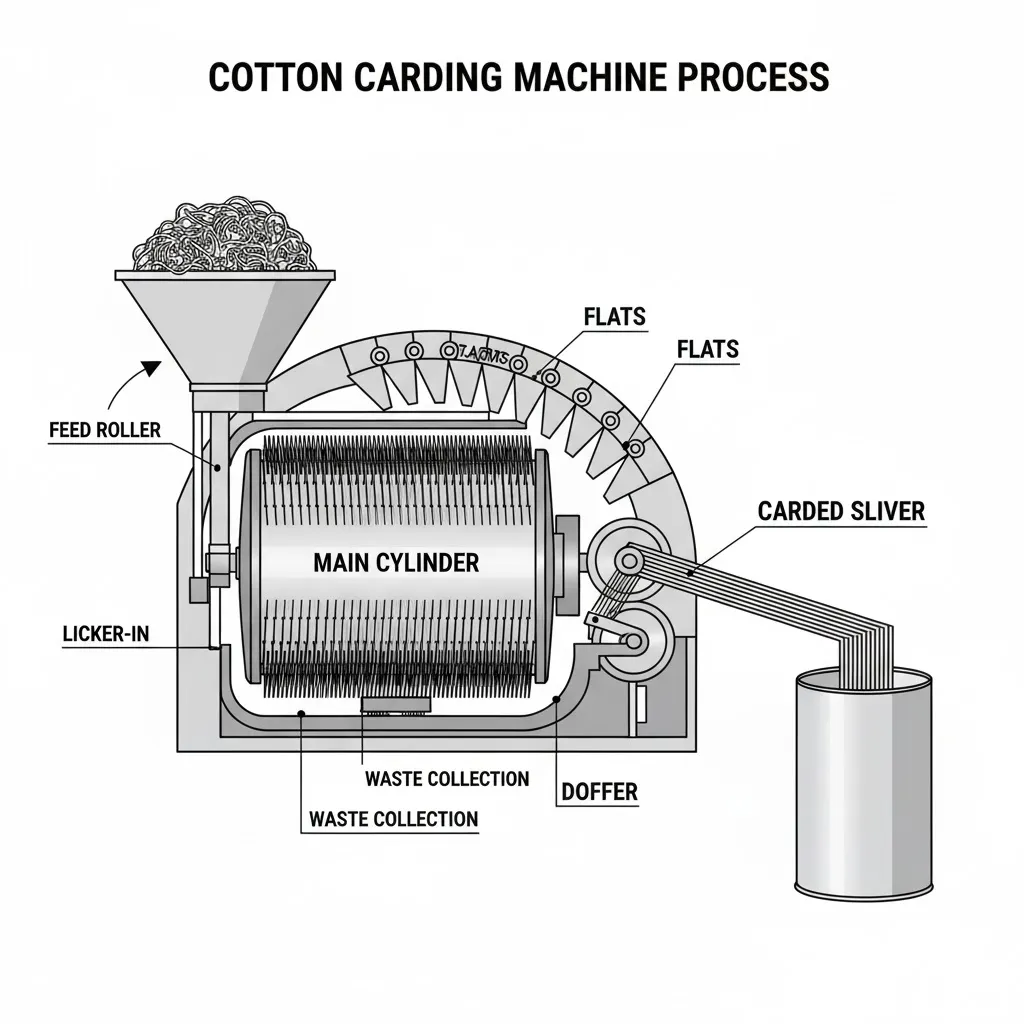
Diagram Of A Carding Cotton Machine Showing The Cylinder, Flats, And Doffer Processing Raw Cotton Into A Carded Sliver
Process Mini-Box: Carding of Cotton (Machine Basics)
To answer carding of cotton from a technical perspective: raw cotton laps (matted sheets) are fed into the carding cotton machine. Inside, a high-speed cylinder covered in wire flats opens, cleans, and individualizes the fibers. A doffer component then removes this web of fibers, which is condensed into a soft, rope-like strand called a carded sliver. This sliver is the basic building block that is then ready for the next stage of processing (either combing or directly spinning).
Combed Cotton vs Carded Cotton: Quick Comparison Table
For busy buyers, here is the at-a-glance comparison. This table is a crucial part of our cotton sourcing guide.
Property
Carded Cotton (Standard)
Combed Cotton (Premium)
Processing
Standard carding process
Carding plus an extra combing step
Fiber Structure
Mixture of long & short fibers, some impurities
Only long, uniform fibers, highly purified
Softness
Good, but slightly rough/hairy
Excellent, very smooth and soft
Pilling
Prone to pilling over time
Highly resistant to pilling
Shrinkage
Good stability, standard control
Excellent stability, easier to control
Breathability
Good
Excellent (yarns are more uniform)
Appearance
Fuzzier, more “rustic,” duller finish
Smoother, cleaner, slight luster
Cost
Baseline
+15-25% higher cost
Best Use
Mid-to-low cost items, workwear, hoodies
Premium tees, combed cotton sheets, babywear
Market Demand
Promotional, uniforms, mass-market
Premium basics, DTC brands, luxury retail
How We Test: In-house Data Snapshot (Fabric-Supplier, 2024)
To truly understand combed cotton vs cotton (regular carded), we pulled data from our in-house lab, comparing three representative fabrics we produce:
Fabric Spec
Shrinkage (ISO 5077 / AATCC 135)
Pilling (ISO 12945-2, 2000 revs)
Breathability (ASTM D737)
Woven Poplin, 120 gsm (Combed)
-2.0% (Warp) / -1.8% (Weft)
Grade 3.5–4.0
N/A
Woven Twill, 260 gsm (Carded)
-2.5% (Warp) / -2.0% (Weft)
Grade 3.0–3.5
N/A
Knit Jersey, 180 gsm (Combed)
-1.8% (Length) / -2.0% (Width)
Grade 3.5-4.0
120 cfm
Our internal tests show that combed yarns consistently deliver better stability. The pilling grade for combed cotton is reliably higher, and the shrinkage is more predictable. The breathability of combed cotton in knit forms is also excellent, hitting target ranges for summer apparel.
How we write this in a Purchase Order (PO):
“Combed ring-spun 30s, 180±5 gsm, ISO 12945-2 ≥3.5 (2000 rev), ISO 5077/AATCC 135 shrinkage ≤3%, DTG printing ready.”
Combed Cotton vs Carded Cotton: 10 Key Differences
A simple pros and cons list doesn’t tell the whole story. As a professional buyer, you need to understand the 10-point difference this choice makes. (Note: In this context, “cotton” is often used to mean standard carded cotton).
1. Processing
Combed Cotton: Undergoes two processes: carding and combing. The combing step uses fine-toothed combs to filter out short fibers.
Carded Cotton: Undergoes only the carding process. It is cleaned and detangled, but the short fibers remain.
2. Fiber Structure
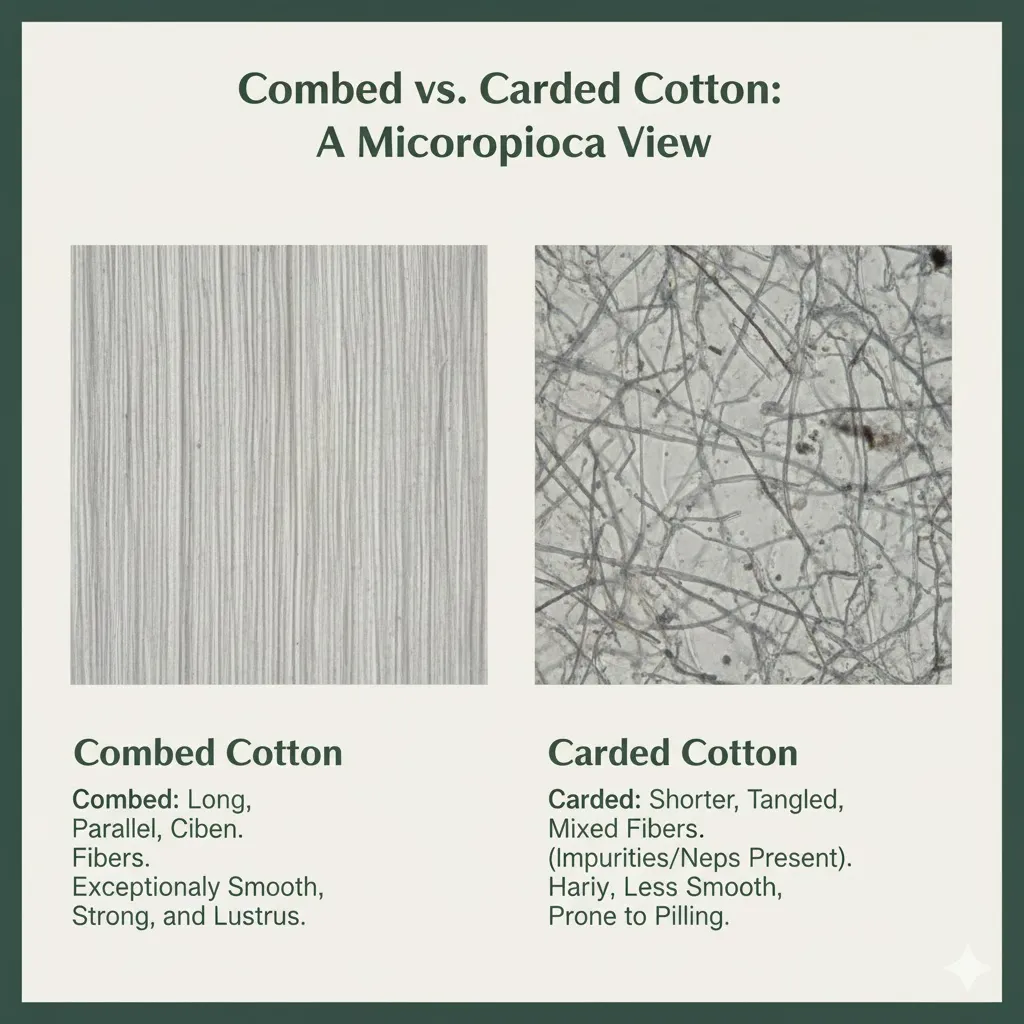
Combed Cotton: Composed almost entirely of long, straight, aligned fibers. This results in fewer neps (tiny knots) and less hairiness.
Carded Cotton: A mixture of long and short fibers. The yarn is fuzzier and has more fiber ends sticking out.
3. Softness
Combed Cotton:Exceptionally soft and smooth, as there are no short, prickly fiber ends to poke out of the yarn surface.
Carded Cotton: Has a rougher, more rustic hand-feel. It’s not necessarily “scratchy,” but it lacks the smooth, buttery feel of combed cotton.
4. Pilling Resistance
Combed Cotton:Highly resistant to pilling. The strong, long fibers are securely locked into the yarn.
Carded Cotton:More prone to pilling. The short fibers are the first to work their way loose and tangle into small balls (pills) on the fabric surface.
Combed Cotton Vs Carded Cotton Fiber Ends Under A Microscope, Showing The Smoothness Of Combed Yarn.
5. Shrinkage Rate
Combed Cotton: Generally shows slightly less shrinkage. The uniform, strong fibers create a more stable yarn structure that reacts more predictably to washing.
Carded Cotton: Can have slightly higher or more unpredictable shrinkage, as the mix of fibers may react differently to heat and agitation.
6. Breathability
Combed Cotton: Excellent breathability. The smoothness of the yarns allows for a very clean and consistent knit or weave structure, permitting air to pass through easily.
Carded Cotton: Good breathability, but the hairiness of the yarns can slightly impede airflow compared to an equivalent combed fabric.
7. Appearance
Combed Cotton: Cleaner, brighter, and has a slight natural luster or sheen. It provides a superior surface for DTG printing, resulting in crisp edges and vibrant colors.
Carded Cotton: More matte, duller, and fuzzier in appearance. Prints can sometimes look slightly less sharp.
Dtg Printing On Combed Cotton Sample Showing Crisp Edges, Contrasted With A Fuzzier Print On Carded Cotton.
8. Cost
Combed Cotton:15-25% more expensive. This is a direct result of the fiber loss (noils) and the additional, time-consuming combing process.
Carded Cotton: The baseline, more economical option.
9. Best Uses
Combed Cotton: Ideal for premium products where hand-feel is a key selling point: combed cotton sheets, premium combed cotton for t-shirts, babywear, socks, and underwear.
Carded Cotton: The workhorse for cost-sensitive products, uniforms, heavy-duty fabrics like canvas, flannel, and many mid-range hoodies.
10. Market Demand
Combed Cotton: Demand is strong and growing in the premium basics and direct-to-consumer (DTC) markets where quality and softness are heavily marketed.
Carded Cotton: Demand is stable and massive, especially in the promotional, workwear, and mass-market retail sectors.
Buyer’s Guide: 3 Steps to Choosing the Right Cotton
This is the process I walk my B2B clients through.
Step 1: Define Your Needs (Scene & Requirement)
First, define your product’s non-negotiables. Are you making brand shirts or work tees?
Brand Shirts / Premium Retail: Your primary need is hand-feel, pilling resistance, and a premium look. Lock in Combed Cotton as your standard. (e.g., Combed poplin 120–140 gsm).
Work Tees / Promotional: Your primary need is durability and cost-effectiveness. Lock in Carded Cotton (e.g., Carded OE 180–200 gsm).
Step 2: Verify Key Parameters
Once you’ve chosen a lane, get specific.
For Combed: Ask the supplier for the pilling grade (ISO 12945-2 ≥3.5 is a good target). Ask about the yarn count (30s-40s are common for tees/sheets). Ask if it’s optimized for DTG printing.
For Carded: Focus on shrinkage rate (demand ≤5% or lower) and color fastness.
Action: Request a small sample and test the abrasion resistance yourself with a simple scratch test and hand wash.
Trial Lot: For a small, new brand, the 15-25% extra cost for combed cotton is a smart investment to establish a reputation for quality.
Mass Order: For large-scale uniform contracts, that 15-25% cost saving from using carded cotton is a massive, margin-defining advantage.
Case Study: Upgrading a Workwear Shirting Spec
Four People Are Discussing Fabric Processing Solutions.
(A European workwear brand initially specified 100% cotton carded, 150-160 gsm. We noted that pilling and shrinkage tolerances were undefined, causing a 25% price variance between quotes. We revised the spec to: “Combed ring-spun, 2/1 twill, 155±5 gsm, ISO 12945-2 ≥3.5 (2000 rev), ISO 5077/ AATCC 135 shrinkage ≤3% (warp/weft), target breathability ASTM D737 ≥X.” After re-bidding, the variance shrank to 8%, and the client had zero complaints on the bulk order. This is the value of precise specs.)
The combed cotton vs carded cotton decision is a classic trade-off between a premium quality investment and a cost-effective workhorse. As a buyer, your job is to match the fabric’s properties to your product’s promise and price point.
Combed cotton offers superior softness and durability, justifying a higher price.
Carded cotton offers excellent value and is perfect for a wide range of everyday applications.
When you’re ready to source, use a clear spec template.
Example RFQ Template:
Need: Combed ring-spun 30s jersey, 180±5 gsm, ISO 5077/AATCC 135 shrinkage ≤3%, ISO 12945-2 ≥3.5 (2000 rev), DTG printing ready.
(This level of detail is key. For more on specs, see our Fabric Weight Guide. Or, if you’re ready to source, contact us and our experts will help you build the perfect spec sheet.)
FAQ
1. Which is better for T-shirts: combed or carded?
For premium retail/brand tees and clean DTG prints, choose combed ring-spun. For uniforms/promotional tees where cost and ruggedness matter most, carded (often OE/rotor) is fine.
2. Does combed cotton shrink? How should I specify shrinkage?
All cotton shrinks; combed is usually easier to control. In your PO, write: ISO 5077 / AATCC 135 shrinkage ≤3% (length/width) after 1 wash. (Cost-down specs may allow up to 5%—state it explicitly.)
3. What pilling grade should I target (ISO 12945-2)?
Premium tees/sheets: ≥3.5 at 2000 rev.
Work tees/cost-down carded: ≥3.0–3.5.
Put the method + revolution count + target grade in the PO.
4. Is combed cotton better for DTG printing?
Yes. Lower hairiness → crisper edges and more stable ink laydown. If DTG is critical, specify “DTG printing ready” and request a print strike-off before bulk.
5. What’s the cost difference between combed and carded?
Expect +15–25% for combed (extra process + noil waste). Many brands recoup this via better hand-feel, fewer complaints/returns, and stronger repeat purchase.
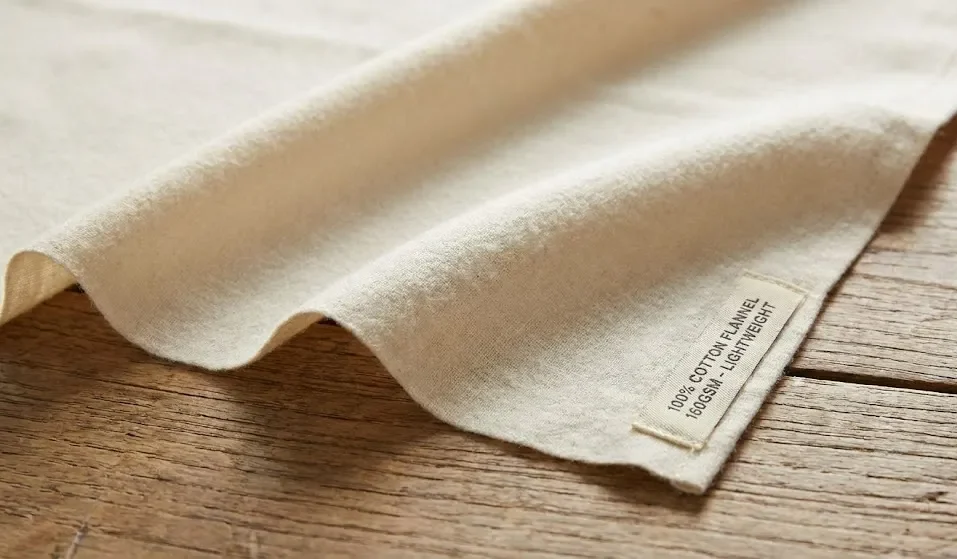
Don’t rely on GSM alone. Our factory guide explains how to read flannel specs (yarn count, density, brushing) to predict pilling, warmth, and durability.






 English
  Arabic
  Spanish
  French
  German
  Azerbaijani
  Vietnamese
  Bengali
  Japanese
  Hindi
Hindi  Turkish
  Russian