

👖 Introduction: The Great Denim Divide
In the denim industry, the divide is clear. On one side, you have the heritage purists who swear by the structural integrity of non stretch denim. On the other, you have the modern market that demands the comfort and body-contouring fit of stretchy jeans.
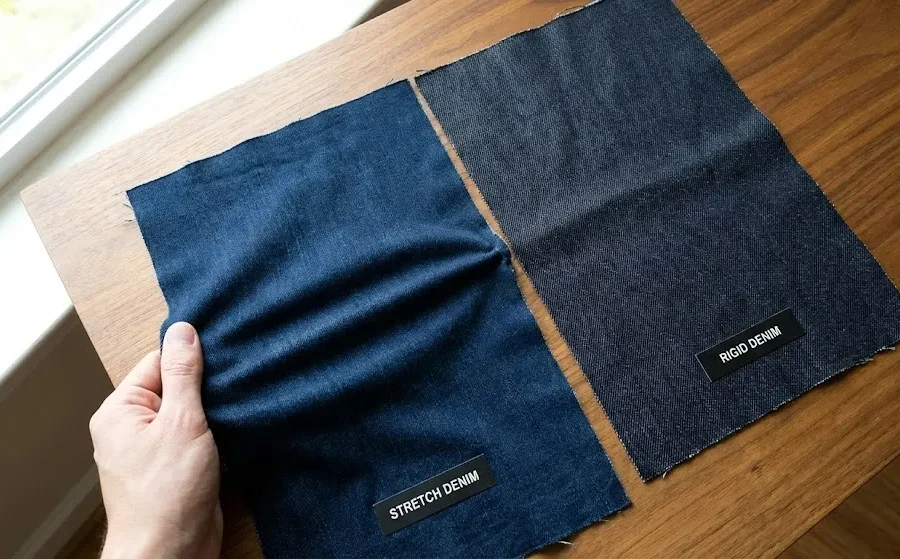
For a fashion brand or sourcing manager, choosing between stretch denim vs rigid denim is not just a style preference; it is a technical decision that dictates the entire production lifecycle—from the pattern making and sewing tension to the wash recipe and quality control standards.
⚠️ Factory Insight: The Consequence of Error
As a denim fabric manufacturer, we see the consequences of making the wrong choice daily.
- A rigid fabric pattern used for stretch denim will result in a garment that is two sizes too big.
- A stretch denim subjected to the high-heat drying process of rigid denim will lose its elasticity and suffer from “knee bagging” before it even reaches the store shelf.
This guide is your technical manual. We will move beyond the basics of “comfort” to explore the yarn structures (core-spun yarn), the physics of growth and recovery, and the critical testing standards like ASTM D3107 that ensure your jeans hold their shape.
👖 What Is a Stretch Denim?
Stretch denim is denim made by blending cotton with elastane, spandex, or engineered stretch fibers to provide flexibility, comfort, and body-hugging fit.
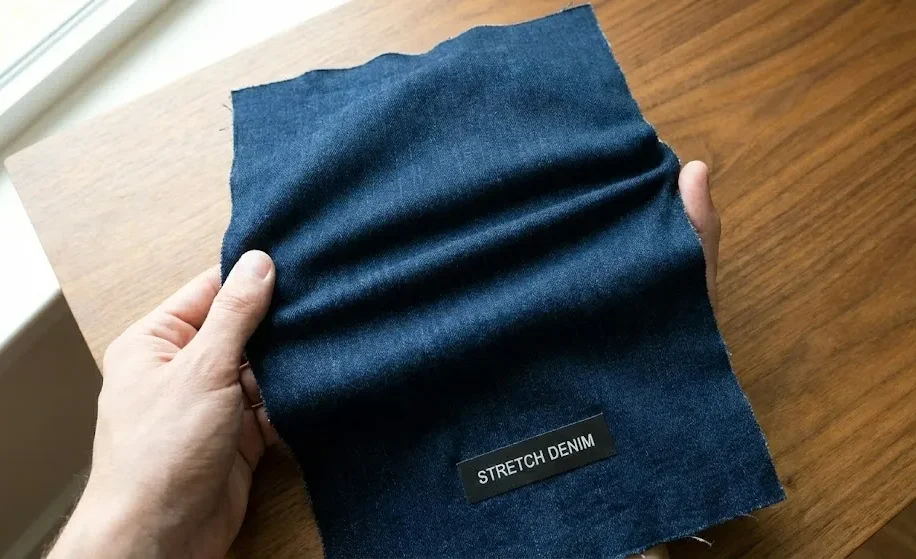
The Evolution of Flexibility
Historically, denim was purely workwear. But as jeans transitioned into fashion, the demand for a closer fit without restriction led to the invention of stretchy denim. Today, it dominates the women’s market and is increasingly standard in men’s flex jeans.
Composition & Variations
Standard stretch denim isn’t just “cotton and rubber.” It is a sophisticated blend.
- Standard Stretch: Typically 98% Cotton / 2% Spandex or 99% Cotton / 1% Elastane. This provides what we call “Comfort Stretch.”
- Super Stretch: Contains higher elastomer content (3-4%) or uses advanced polymers to achieve 40-50% elasticity.
- Poly-Cotton Stretch: Blends polyester with elastane and cotton to reduce cost and increase strength.
Pros & Cons
✅ Pros: Incredible comfort, high adaptation to different body shapes (reducing return rates for fit issues), and immediate softness.
⚠️ Cons: Prone to knee bagging (if recovery is poor), sensitive to heat (cannot be boiled or hot-dried), and generally has a shorter lifespan than 100% cotton.
🗿 What Is a Rigid Denim?
Rigid denim is a 100% cotton denim fabric with no elastic fibers, known for its firm structure, slow break-in period, and strong fading character.
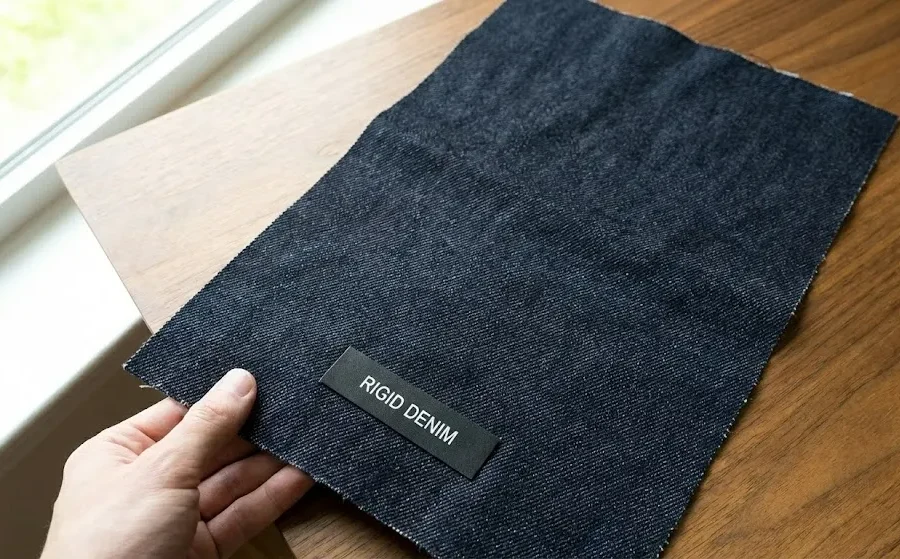
The Heritage Standard
When you search for non stretch denim or rigid denim, you are looking for the original soul of jeans. In the industry, we often refer to this simply as “100% Cotton.” There are no synthetic elastomers involved.
Applications
It is the foundation of the what-is-selvedge-denim-cost-manufacturing(Selvedge) market, vintage reproductions, and authentic workwear.
Pros & Cons
✅ Pros: Extremely durable (rigid denim 100% cotton creates a strong structural grid), develops high-contrast fades (whiskers/honeycombs) because creases set sharply, and keeps its shape for decades.
⚠️ Cons: Can be uncomfortable initially (the “break-in” period), offers zero forgiveness in fit (pattern must be precise), and feels heavy.
⚖️ What Is the Difference Between Stretch and Rigid Denim?
The primary difference between stretch and rigid denim is fiber composition—stretch denim includes elastane or engineered stretch fibers, while rigid denim is woven entirely from 100% cotton yarns.
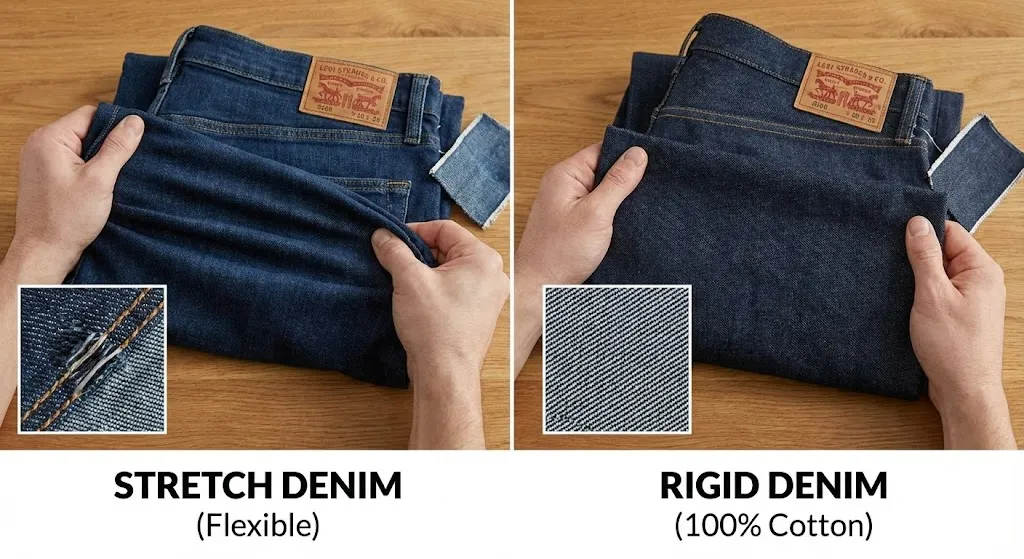
Behavioral Differences
Beyond the label, the stretch vs rigid denim difference is about behavior:
1. Fit Forgiveness
Stretchy jeans can stretch to accommodate a ½ inch fluctuation in waist size. Rigid denim cannot; if you gain weight, they don’t fit.
2. Draping
Rigid denim has “structure”—it stands away from the body, creating a silhouette. Stretch denim has “drape”—it clings to the body, revealing the shape underneath.
3. Sizing (Pattern Making)
A brand might need two different block patterns: one for low stretch vs high stretch jeans (negative ease) and one for denim non stretch jeans (positive ease).
🔬 Inside the Yarn: Composition Differences
Stretch denim and rigid denim differ at the yarn-structure level, where stretch denim uses core-spun or engineered stretch fibers, while rigid denim relies on traditional 100% cotton yarns.
To truly understand what are stretchy denim fabrics made of, we have to look under the microscope at the spinning process.
1. How Stretch Denim Is Built (Core-Spun Yarn)
Core-spun yarn is a yarn construction where an elastane filament sits in the center and is tightly wrapped by cotton fibers, giving stretch denim elasticity without losing a natural denim surface.
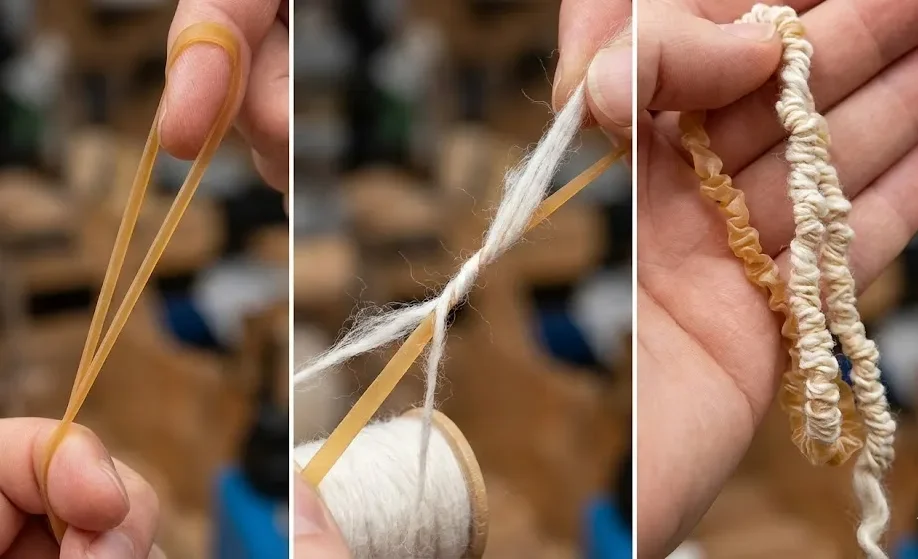
- The Architecture: Imagine a rubber band (the elastane/spandex) stretched out. Now, imagine spinning cotton fibers around that stretched rubber band until it is completely covered. When the tension is released, the rubber band retracts, pulling the cotton coils tight.
- The Result: When you look at spandex jeans womens styles, they look like cotton because the surface is cotton. The synthetic stretch core is hidden inside.
🚀 Advanced Fiber Tech:
For premium brands, we often substitute generic spandex with LYCRA® T400® technology. Unlike simple elastane, T400 is a multicomponent fiber with a self-crimping structure. Industry white papers show that T400-based denim retains its shape 2x longer than standard spandex and is highly resistant to chlorine bleach, solving the common “bagging” issue in womens white stretch jeans.
2. How Rigid Denim Is Built
Rigid denim uses pure cotton warp and weft yarns, giving the fabric a firm structure and allowing deep, high-contrast fading to develop over time.
- The Architecture: It uses Ring-Spun or Open-End spun cotton yarns. There is no synthetic core. The yarns are solid cellulose.
- The “Memory”: Because cotton fibers are relatively rigid, when they are creased (like behind the knee), they stay creased. This sets the abrasion pattern. This is why rigid denim is essential for creating authentic vintage washes.
📏 What Is Growth and Recovery in Denim?
Growth is how much denim permanently stretches during wear, while recovery is how well it returns to its original size after tension is removed.
High growth with low recovery is the main cause of knee bagging and seat sagging in stretch jeans. If you are sourcing stretchy denim, these two metrics are more important than weight or color.
What Causes Knee Bagging in Stretch Denim?
Knee bagging occurs when fabric growth exceeds fabric recovery, causing the denim to remain stretched out at stress points such as the knees and thighs.
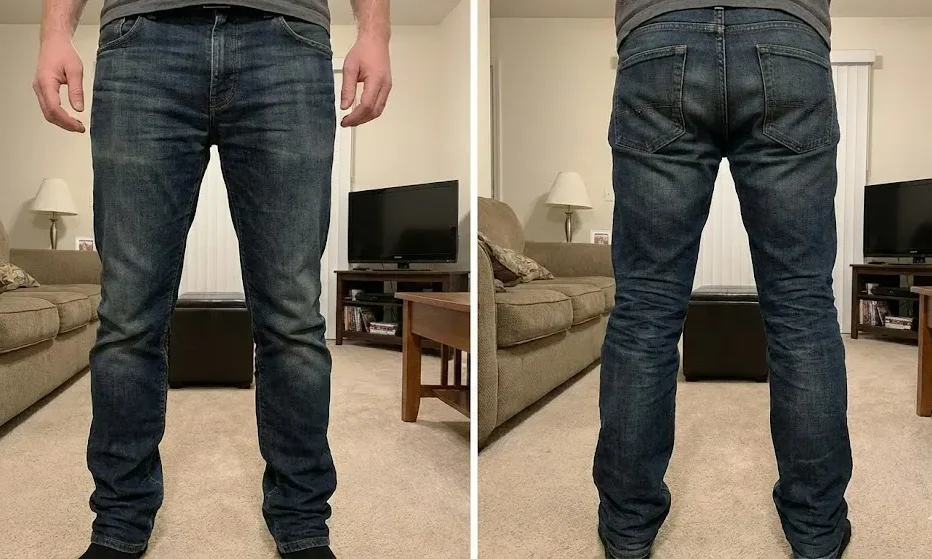
- Elastane Fatigue: Cheap spandex loses its elasticity over time (hysteresis). After being stretched 10,000 times as you walk, it simply stops snapping back.
- Heat Damage: If the consumer (or the commercial laundry) irons the jeans too hot, the elastane melts and loses its power.
- Lack of Dual-Core: Standard stretchy denim shorts or jeans using basic spandex often lack the power to pull heavy denim fabric back into place.
How Is Denim Recovery Tested? (ASTM D3107)
Denim recovery is commonly tested using ASTM D3107, where the fabric is stretched to a fixed percentage, held for a prescribed time, and then measured for how closely it returns to its original length.
This is the gold standard for your Quality Control (QC) team.
🏭 Factory Lab Data :
In our lab, we perform the ASTM D3107 test on every roll of stretch fabric. We reject any ‘Super Stretch’ denim with recovery < 95% after 30 minutes of relaxation.
For standard ‘Comfort Stretch’ (1-2% elastane), 90% is the baseline.
Anything lower guarantees customer complaints about bagging and sagging. We highly recommend brands set these thresholds in their supplier contracts.
📉 How Does Shrinkage Differ Between Stretch and Rigid Denim?
Rigid denim shrinkage comes mainly from cotton fiber relaxation, while stretch denim shrinkage is influenced by both cotton contraction and the thermal behavior of elastane.
Shrinkage management is the nightmare of every production manager.
1. Rigid Denim Shrinkage
- Mechanism: Cotton fibers swell when wet and relax from the weaving tension.
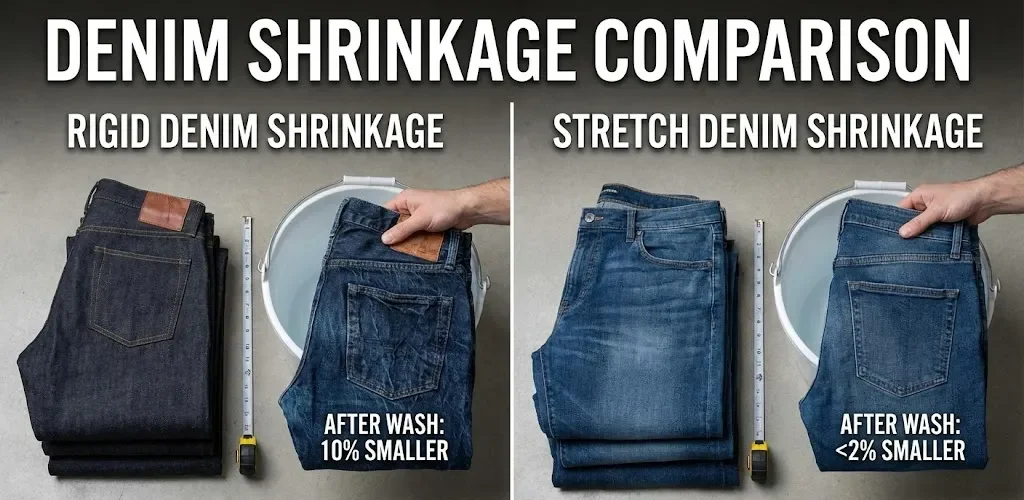
- Predictability: It is relatively consistent. Sanforized rigid denim shrinks 1-3%. Unsanforized shrinks 8-10%.
2. Stretch Denim Shrinkage
- Mechanism: Complex. The cotton shrinks, BUT the elastane also reacts to heat. If the heat-setting during fabric finishing wasn’t perfect, the elastane can continue to shrink in the dryer, leading to “progressive shrinkage” (jeans get smaller every wash).
- Weft Shrinkage: Rigid denim mostly shrinks in length (warp). Stretch denim can shrink significantly in width (weft) because the elastic yarn is usually in the weft. This makes sizing stretchy denim skirts or stretchy denim jackets tricky.
🔥 How Does Heat Affect Stretch Denim?
High heat can permanently damage elastane, reducing stretch, killing recovery, and causing stretch denim to feel stiff or brittle.
While rigid denim loves heat (it helps set the shrinkage), stretchy denim fears it.
🔬 Factory Notice (Microscope Observation):
Our recent observations under a microscope have revealed that overheated spandex breaks like a “burnt rubber band.” When exposed to temperatures above 180°C (356°F) for prolonged periods, the synthetic filament snaps or fuses.
This results in tiny “blisters” or wavy patterns on the fabric surface (often called “orange peel” effect). This is irreversible physical damage. We strictly control our stenter frame temperatures to protect the elastane integrity.
Care Tip: This is why labels on womens white stretch jeans or stretch jeans for men always say “Tumble Dry Low” or “Line Dry.”
⚖️ Stretch vs Rigid Denim Comparison Table
This table summarizes the key differences between stretch and rigid denim across composition, recovery, shrinkage, heat sensitivity, and market use.
| Feature | Rigid Denim (Non-Stretch) | Stretch Denim (Flex) |
|---|---|---|
| Composition | 100% Cotton | Cotton + Elastane/Spandex/Poly |
| Yarn Structure | Ring/Open-End Spun | Core-Spun (Cotton wrapping Elastane) |
| Comfort | Low initially (Break-in required) | High (Immediate softness) |
| Fit Type | Relaxed, Straight, Anti-Fit | Skinny, Slim, Body-Contouring |
| Shrinkage | Mainly Warp (Length) | Warp & Weft (Width) |
| Heat Tolerance | High (Can be boiled/hot dried) | Low (Heat kills elasticity) |
| Recovery | N/A (Does not stretch) | Critical Metric (Must be >90%) |
| Durability | Excellent (Long-lasting) | Moderate (Elastane degrades over time) |
| Key Defect | Seam twisting (Leg twist) | Knee Bagging, Wavy seams |
🤔 How to Choose Between Stretch and Rigid Denim (Sourcing Guide)
✅ The Rule of Thumb
Choose rigid denim when your design prioritizes structure, vintage character, and strong fading; choose stretch denim when comfort, flexibility, and shape retention are essential.
1. When Should You Choose Rigid Denim?
Rigid denim is ideal for heritage jeans, raw denim projects, and workwear where structure and long-term fading matter more than immediate comfort.
- Target Audience: Denim purists, workwear aesthetics, sustainable fashion consumers (100% cotton is easier to recycle).
- Styles: Vintage 501-style straight cuts, oversized jackets, denim non stretch jeans.
- Sourcing Tip: Look for heavier weights (12oz+) to maximize the structural benefits.
2. When Should You Choose High-Recovery Stretch Denim?
High-recovery stretch denim is the best choice for skinny fits, women’s wear, and body-contouring silhouettes that require both stretch and excellent shape retention.
- Target Audience: Women’s fashion, active lifestyle buyers.
- Styles: Jeggings, Skinny Jeans, stretchy denim shorts, denim jacket stretchy fits.
- Sourcing Tip: Specify “Dual-Core” or “T400” yarns to ensure the jeans don’t lose their shape after 2 hours of wear.
3. When Should You Choose Comfort Stretch Denim?
Comfort stretch denim with around 1–2% elastane is ideal for everyday jeans that balance comfort, stability, and cost.
- Target Audience: Mass market men’s and women’s straight/slim cuts.
- Styles: Stretch denim mens straight leg, standard “Mom Jeans.”
- Sourcing Tip: This is the most cost-effective option. It provides just enough “give” for sitting and walking without the high cost of super-stretch technology.
(Need help finding the right fabric? Check our denim-fabric-sourcing-guide for supplier vetting tips.)
🚀 Ready to source the perfect denim?
Whether you need a vintage 14oz rigid selvedge or a high-performance T400 stretch fabric, we have the manufacturing capability to meet your specs.
Contact-us today to request our “Stretch vs Rigid” comparison swatch kit.
❓ FAQ
Does stretch denim shrink more than rigid denim?
Stretch denim does not always shrink more than rigid denim, but its shrinkage and growth are harder to predict because elastane reacts strongly to heat and washing. Rigid denim shrinkage is purely mechanical (cotton relaxing), whereas stretch denim involves thermal retraction of the synthetic fiber.
Why do stretch jeans bag at the knees?
Knee bagging occurs when growth exceeds recovery, meaning the denim stretches out during wear and cannot fully return to its original shape. This usually happens because the fabric has low-quality elastane or lacks a “dual-core” structure to provide snap-back power.
Is rigid denim more durable than stretch denim?
Rigid denim generally offers better long-term abrasion resistance because it contains no elastane, while stretch denim prioritizes comfort and requires higher recovery standards to maintain shape. Elastane fibers can break over time, leading to fabric failure, whereas cotton fibers in rigid denim simply get softer.
What is T400 denim?
T400 denim uses a multi-component polyester fiber engineered for stretch and recovery, reducing bagging compared with traditional elastane blends. It is a specific branded technology (from The LYCRA Company) often used in without stretch fabric look-alikes that need hidden performance.
How much elastane should good stretch denim contain?
Most comfort-stretch denim uses 1–2% elastane, while super-stretch denim may contain 3–5% elastane or use dual-core yarns for higher recovery. There is no “best” amount; it depends on the desired fit. Skinny jeans need more; straight cuts need less.
 English
  Arabic
  Spanish
  French
  German
  Azerbaijani
  Vietnamese
  Bengali
  Japanese
  Hindi
Hindi  Turkish
  Russian