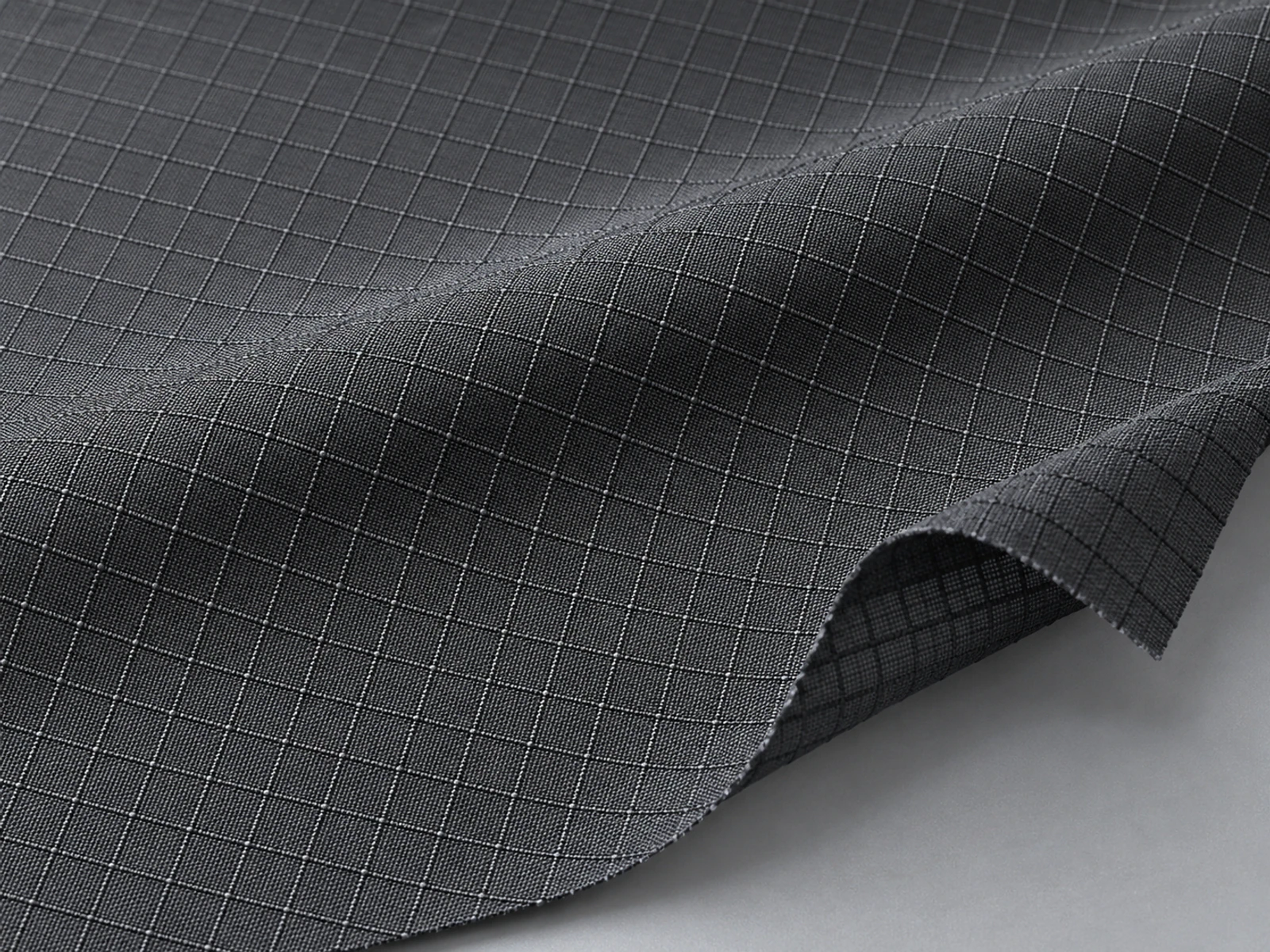

Short answer: choose the end use first, then write three numbers on the spec sheet: finished GSM, cuttable width and yarn count with density. The chart below gives working ranges for 14 cotton applications, from 70 g/m² voile to 500 g/m² canvas. Use them as a starting point, confirm them on a sample, and put tolerances and test methods on the PO.
Most cotton spec sheets fail at the same place: they describe the fiber but not the fabric. “100% cotton, 40s” does not tell a mill what to weave. Two fabrics can both be 40s cotton and still differ by 60 g/m², by 20 cm in width, and completely in hand-feel and price.
This guide is the reference chart we use when a buyer tells us the garment or home-textile item but not the construction. It covers the three variables that decide whether the fabric works: weight, width and yarn count. For the theory behind them, see our GSM and yarn count guide. For poplin shirting specifically, the poplin spec guide goes deeper than the summary here.
The Three Numbers That Define a Cotton Fabric
Every cotton spec we quote comes down to the same three measurements. Miss one and the mill has to guess.
- GSM (g/m²): how heavy the finished fabric is per square meter. It drives opacity, drape, warmth, tear strength and much of the price. GSM is a result of yarn count, density and finish, not an independent choice.
- Width (cm): the full width from selvedge to selvedge, and the cuttable width your marker can actually use. On woven cotton the cuttable width is usually 5–10 cm narrower than the full width.
- Yarn count (Ne) and density: how fine the yarn is, and how many ends and picks per inch hold it together. A count on its own says little; 40s × 40s / 133 × 72 and 40s × 40s / 100 × 80 are different fabrics.
Cotton Fabric Specifications by Application
The ranges below are for finished, pre-shrunk fabric. They cover the constructions we quote most often. A different weave, a different finish or a tighter density can move the weight by 10–20%, so use the chart to brief a supplier, then lock the final numbers on a sample.
| End use | Typical cotton fabric and construction | Finished GSM | Full width | Yarn count (Ne) |
|---|---|---|---|---|
| Dress shirt, blouse | Poplin or broadcloth; 40s×40s / 133×72, or 60s×60s / 140×100 | 100–140 | 145–150 cm | 40s–80s combed |
| Casual shirt | Oxford (often 40s×20s), chambray or light twill | 120–170 | 145–150 cm | 30s–60s |
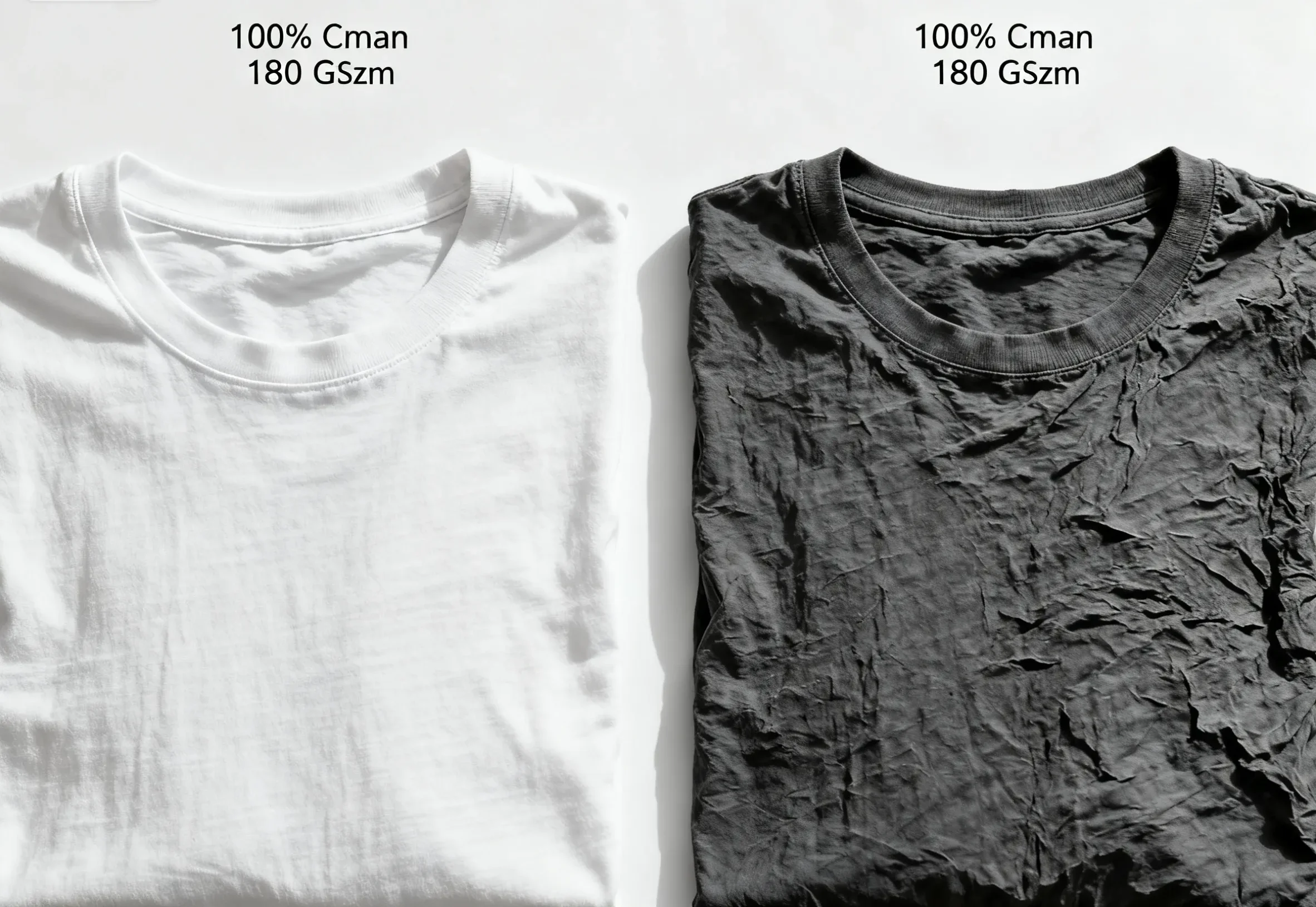
| T-shirt | Single jersey; 160–180 gsm is the basic retail weight | 150–220 | 160–180 cm open | 24s–40s |
| Polo shirt | Pique knit; combed or mercerized for retail | 180–240 | 160–180 cm | 24s–30s |
| Hoodie, sweatshirt | Fleece 300–450 gsm; French terry 240–320 gsm | 240–450 | 160–180 cm | 20s–32s |
| Underwear | Single jersey or 1×1 rib; combed compact yarn | 120–170 | 150–170 cm | 30s–40s |
| Summer dress, skirt | Voile (60s×60s / 90×88), lawn or light poplin | 70–130 | 145–150 cm | 60s–100s |
| Trousers, chinos | Twill; 20s×16s / 128×60 is about 250 gsm | 220–280 | 145–150 cm | 16s–30s |
| Workwear, uniform | Twill or light canvas; 2-ply yarn where tear strength matters | 240–320 | 150–160 cm | 16s–21s |
| Jacket, outerwear | Canvas or duck; 10s/2 × 10s/2 for 400 gsm and above | 300–450 | 150–160 cm | 10s/2–16s |
| Bedding, sheets | Percale 40s / 133×72, or sateen 60s×40s | 110–160 | 220–280 cm | 40s–80s |
| Curtains | Canvas or duck for body; voile for sheer panels | 150–300; sheer 60–90 | 150–300 cm; 280 cm for seamless | 20s–40s |
| Upholstery | Canvas or duck; abrasion performance matters more than yarn count | 300–500 | 140–160 cm | 10s/2–12s/2 |
| Bags, aprons | Canvas or duck; 12 oz canvas is about 400 gsm | 350–500 | 150–160 cm | 10s/2–12s/2 |
Indicative ranges for finished cotton fabric. Width is full width; cuttable width is normally 5–10 cm less. Confirm the final construction on a sample before you place a bulk order.
How to Choose GSM for Cotton
GSM is the fastest way to compare two cotton fabrics, but only if you compare like with like. A woven shirt fabric and a knit jersey at the same GSM do not behave the same way, and a greige weight is not a finished weight.
| Weight band | Woven cotton examples | Knit cotton examples |
|---|---|---|
| Light: under 140 g/m² | Voile 70–90; lawn 80–100; poplin 100–130; percale 110–130 | Underwear jersey 120–160 |
| Medium: 140–220 g/m² | Oxford 130–170; shirt twill 150–180 | Jersey 150–220; pique 180–240 |
| Heavy: 220–400 g/m² | Bottom-weight twill 220–300; canvas 300–400 | French terry 240–320; fleece 300–400 |
| Extra heavy: 400 g/m²+ | Duck and upholstery canvas 400–500 | — |
Three effects move the number after weaving:
- Finishing: washing, shrinking, mercerizing, calendering and brushing all change weight per square meter. Shrinkage concentrates the same yarns into a smaller area, so the finished fabric can be 5–10% heavier than the greige fabric.
- Moisture: cotton absorbs water. Weight is only comparable when the sample is conditioned to the standard atmosphere (20°C, 65% relative humidity). A damp sample can read several percent heavy.
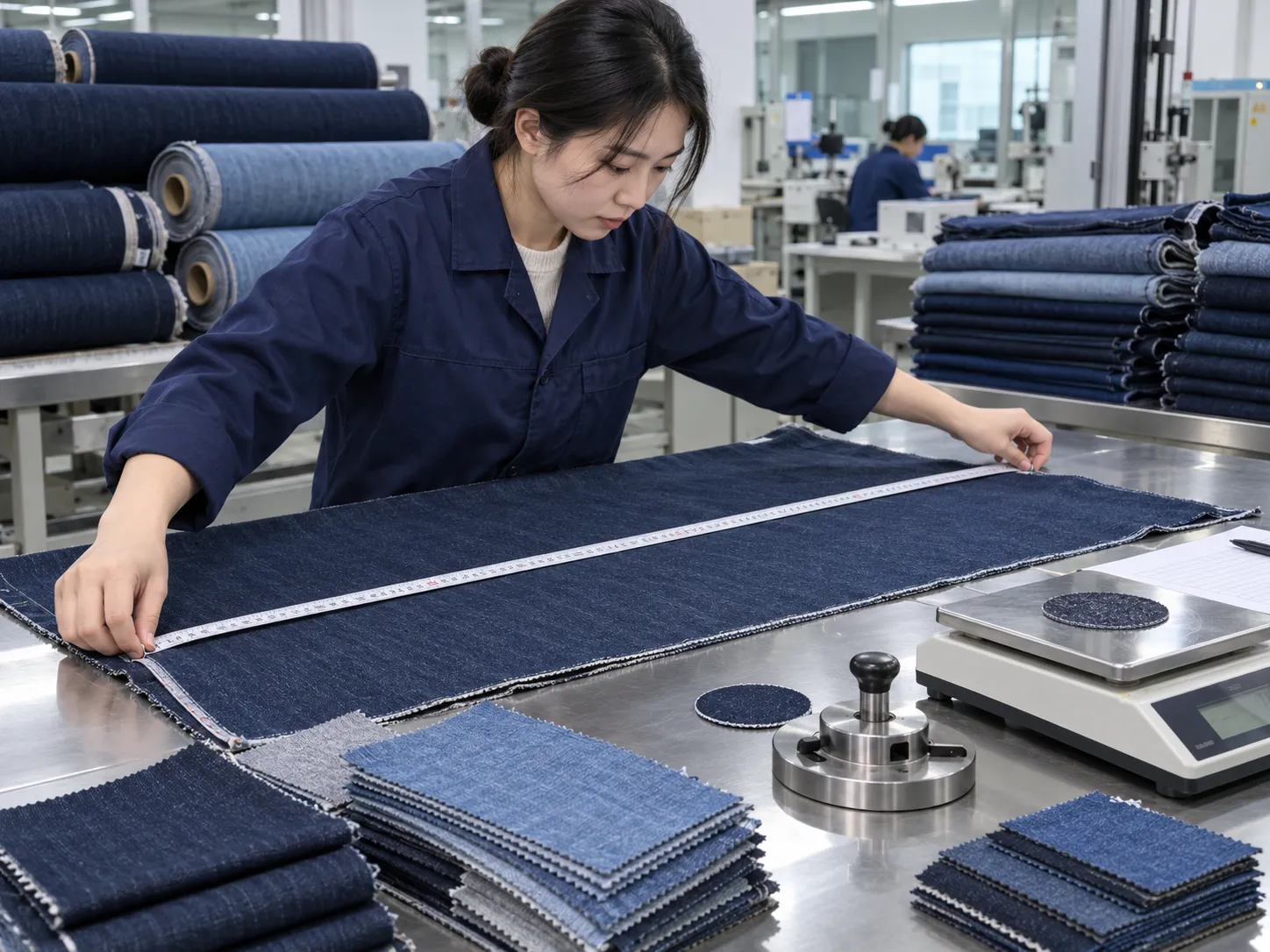
- Measurement method: a 100 cm² cutter and a full-width sample give different results on an irregular fabric. Use ASTM D3776 or ISO 3801 and state the method on the PO.
Specify finished GSM after shrinkage. If you buy a pre-shrunk shirt fabric at 120 g/m², the 120 should describe the fabric after the pre-shrinking step, not the greige roll. Otherwise the first wash can take the fabric outside your tolerance and change the hand-feel your buyer approved.
For knits, GSM alone is weaker as a specification. Two single jerseys at 180 g/m² can feel different because loop length and stitch density differ. For knitwear, specify GSM plus yarn count plus stitch length, or approve a sample and keep it as the reference. Our knitted cotton guide explains the main knit structures.
How to Choose Fabric Width
Width is a cost decision as much as a technical one. A wider roll can reduce meters per garment, but it also costs more per meter. The only fair comparison is cost per garment, calculated on the cuttable width.
| Full width | In inches | Typical use |
|---|---|---|
| 110 cm | 43/44” | Sampling, small parts, childrenswear |
| 145 cm | 57” | Standard apparel |
| 150 cm | 59” | Most common apparel width |
| 160 cm | 63” | Wider apparel, home textiles |
| 180 cm | 71” | Maximum marker efficiency |
| 220–250 cm | 87–98” | Wide bedding |
| 280 cm | 110” | Sheeting, seamless curtains |
On our woven rolls, cuttable width is usually 5–10 cm less than the full width because the selvedges and stenter pin holes cannot be cut. A 10 cm loss is 6.7% of a 150 cm roll. If you calculate consumption on the label width, you will run short at the cutting table.
Two more width rules for cotton:
- Allow for shrinkage across the width. A 150 cm roll that shrinks 3% in the wash finishes at about 145.5 cm. For bedding, start from the finished sheet width and work backwards through shrinkage and seam allowance before you choose 220, 250 or 280 cm.
- Know whether a knit is open width or tubular. Open-width jersey is quoted by flat width; tubular fabric is quoted by tube size and must be cut open. The same garment can need very different fabric consumption depending on which you buy.
If width is your main cost lever, our guide to fabric width and consumption shows the full calculation, including a worked shirt example at four widths.
How to Choose Yarn Count
Cotton yarn count is written in Ne (English cotton count). It is an indirect number: one Ne means one 840-yard hank of yarn weighs one pound. The higher the number, the finer the yarn. A 60s yarn is finer than a 40s yarn, and an 80s yarn is finer still.
Finer yarn is smoother, lighter and usually more expensive, because it needs better cotton and more processing. It is not automatically stronger or more durable in the finished garment. A 40s combed poplin can outlast a 100s voile in everyday use simply because it has more fiber per square meter.
| Count (Ne) | Character | Typical cotton uses |
|---|---|---|
| 10s/2–16s/2 | Thick plied yarn; strong and coarse | Canvas, duck, bags, heavy jackets |
| 16s–21s | Coarse single yarn | Trousers, workwear, heavy shirting |
| 20s–32s | Medium yarn | T-shirts, fleece, French terry, pique |
| 30s–40s | Medium-fine yarn | Light twill, underwear, jersey |
| 40s–60s | Fine combed yarn | Poplin, oxford, bedding, shirting |
| 60s–100s | Very fine yarn | Voile, lawn, luxury shirting |
The table overlaps on purpose. A 30s yarn in a dense woven twill behaves differently from a 30s yarn in an open knit. What matters is the combination:
- Single vs ply. 40s/2 means two 40s yarns twisted together. It is stronger, smoother and more expensive than a single 40s. Canvas and workwear often use 2-ply; shirting usually uses single yarn.
- Carded vs combed. Combing removes short fibers, so the yarn is cleaner, stronger and less hairy. Combed is the default for 40s and finer retail shirting; carded is common for heavier, more economical fabrics. Our combed vs carded guide has the test differences.
- Density. Always write ends × picks per inch with the count. 40s×40s / 133×72 is a 120 gsm poplin; the same count at a lower density is lighter and more open. Without density, the mill cannot reproduce the fabric you approved.
For the spinning methods behind the count, see ring-spun vs open-end vs compact. For a full shirt construction, the poplin vs oxford vs twill comparison shows how weave changes the same count.
How to Write the Spec on a Purchase Order
A good cotton PO reads like a recipe. Here is a complete spec for a 120 gsm poplin shirt fabric. Copy the structure, not the numbers, for your own product.
Construction: 40s × 40s / 133 × 72
Weight: 120 g/m² ±5%, finished, after pre-shrinking
Width: 150 cm full / 145 cm cuttable
Shrinkage: ≤3% warp, ≤3% weft, AATCC 135 (3 home washes)
Colorfastness: ≥4 on gray scale, ISO 105-C06
Certification: OEKO-TEX Standard 100
Packing: 100 m per roll, shade-lot matched
Quantity: 500 m
Each line closes a different loophole:
- Construction fixes the yarn count and density, so the mill cannot substitute a lighter 40s fabric.
- Weight fixes the finished GSM with a tolerance and names the stage at which it is measured.
- Width gives both the full and the cuttable measurement. The cuttable number is the one your marker uses.
- Shrinkage and colorfastness name the test method and the pass level, so “good shrinkage” becomes a number.
- Packing protects the shade lot. A roll-to-roll shade difference is a common reason a cut is rejected even when the lab tests pass.
| Parameter | Test method | Write this on the PO |
|---|---|---|
| Weight | ASTM D3776 / ISO 3801 | Finished g/m², ±5% |
| Width | ASTM D3774 | Full width and cuttable width, −1/+2 cm |
| Yarn count | ASTM D1059 / ISO 2060 | Nominal count and density, verified on the sample |
| Shrinkage | AATCC 135 / ISO 6330 | ≤3% warp and weft after 3 washes, or your target |
| Colorfastness | ISO 105-C06 / AATCC 61 | ≥4 gray scale, dry and wet rubbing ≥3–4 |
For a poplin-specific PO template with fill-in fields, see our poplin PO spec guide. For the sourcing process around the PO, the cotton sourcing guide covers supplier vetting, samples and QC.
Common Cotton Specification Mistakes
These are the errors we see most often when a buyer compares quotes from several mills.
- Comparing greige GSM with finished GSM. A greige 110 gsm fabric can finish at 120 gsm after shrinking. Ask for the finished number, measured after the final finish.
- Buying on full width. The price per meter looks lower on a 150 cm roll, but your marker can only use about 140–145 cm. Calculate cost per garment on the cuttable width.
- Quoting a yarn count without density. “40s cotton” can be a 100 gsm voile or a 140 gsm poplin. Without ends × picks, the mill is guessing at your hand-feel.
- Comparing knit GSM with woven GSM. A 180 gsm jersey and a 180 gsm poplin are different products. Knits need count and stitch length as well as weight.
- Forgetting shrinkage in costing. A 4% shrinkage allowance is about 4% more fabric per garment. On a 10,000-piece order, that is 400 pieces’ worth of fabric if you leave it out.
- Assuming higher count or higher GSM is better. The right spec is the one that fits the end use. A heavy 500 gsm canvas makes a poor summer shirt; a 70 gsm voile makes a poor work uniform.
Cotton Fabric Specifications: FAQ
What GSM is good for a cotton T-shirt?
150–180 g/m² is the standard retail weight. 180–220 g/m² feels heavier and more structured, while under 140 g/m² is light and can be semi-sheer in white. Yarn count is usually 24s–32s for basic tees and 32s–40s for softer premium jersey.
What GSM is cotton shirting fabric?
Most dress-shirt poplin is 100–140 g/m², with 110–130 g/m² being the sweet spot. Oxford and casual twill run 130–170 g/m². Summer voile drops to 70–90 g/m² and needs a lining or careful color choice in light shades.
What is the standard width of cotton fabric?
145–150 cm (57/58”) is the standard apparel width. 160 cm and 180 cm are available for wider markers, and bedding/curtain cotton comes in 220, 250 and 280 cm. Always confirm the cuttable width, which is 5–10 cm less than the full width.
What yarn count should I use for a cotton shirt?
40s–60s combed is the commercial range for dress shirts. 40s gives a durable everyday poplin; 60s is smoother and lighter; 80s–100s is luxury and needs careful washing. Pair the count with density, for example 40s×40s / 133×72 or 60s×60s / 140×100.
Is 60s cotton better than 40s cotton?
60s is finer, smoother and more expensive, but not automatically better. It is lighter and less abrasion-resistant than 40s, so it suits dress shirts and bedding more than workwear or heavy uniforms. Choose the count that matches the product, not the highest number on the quote.
Can I convert yarn count to GSM directly?
No. GSM depends on yarn count, ends and picks per inch, weave crimp, yarn shrinkage and finishing. The same 40s count can produce a 100 gsm voile or a 140 gsm poplin. Use the construction to estimate, then confirm the weight with a lab test on the finished fabric.
What cotton specs are best for bedding?
Percale at 40s / 133×72 and 110–130 g/m² gives a crisp, breathable sheet. Sateen at 60s×40s and 120–160 g/m² gives a smoother, heavier hand. A thread count of 200–400 is meaningful; numbers above that are often inflated by counting plies. Width should be 220–280 cm depending on bed size.
Can you weave custom widths and yarn counts?
Yes. We weave cotton from 145 to 180 cm as standard, with wider bedding and curtain qualities up to 280 cm. Counts from 10s/2 canvas to 100s voile are available depending on the weave. MOQ is 500 m per order, and free samples ship in 3–5 days; you pay shipping only.
Have an end use but no spec yet? Tell us the garment or home-textile item, the target market and the quantity. We will propose a construction with finished GSM, width and yarn count, then send a sample for approval.
Cotton fabric wholesale · Request a quote · Why buyers order from us