
Short answer: Fabric width is not set by the garment type. It is set by how your pattern pieces fit across the roll. A wider roll usually lowers fabric consumption (meters per garment), but it also costs more per meter. Compare fabric cost per garment, not price per meter, and always calculate on the cuttable width, which is 5–10 cm narrower than the full width on our rolls.
A shirt can be cut from a 150 cm roll or a 180 cm roll. A 160 cm roll can go into shirts, trousers, dresses or uniforms. Width and end use do not map one to one, so there is no “correct width for a shirt”. What changes from one width to another is how many meters you buy, how much you pay per garment, and how many garments one order makes. This guide shows how to calculate fabric consumption, and the cost and garment count that follow from it, before you place an order.
Full Width vs Cuttable Width
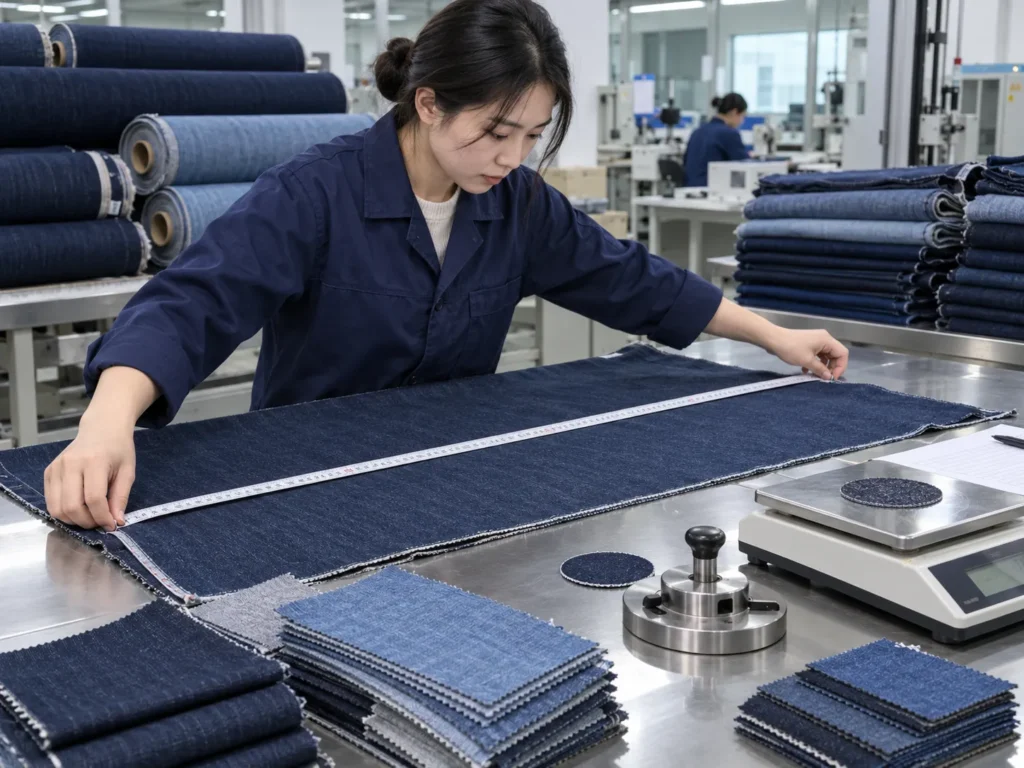
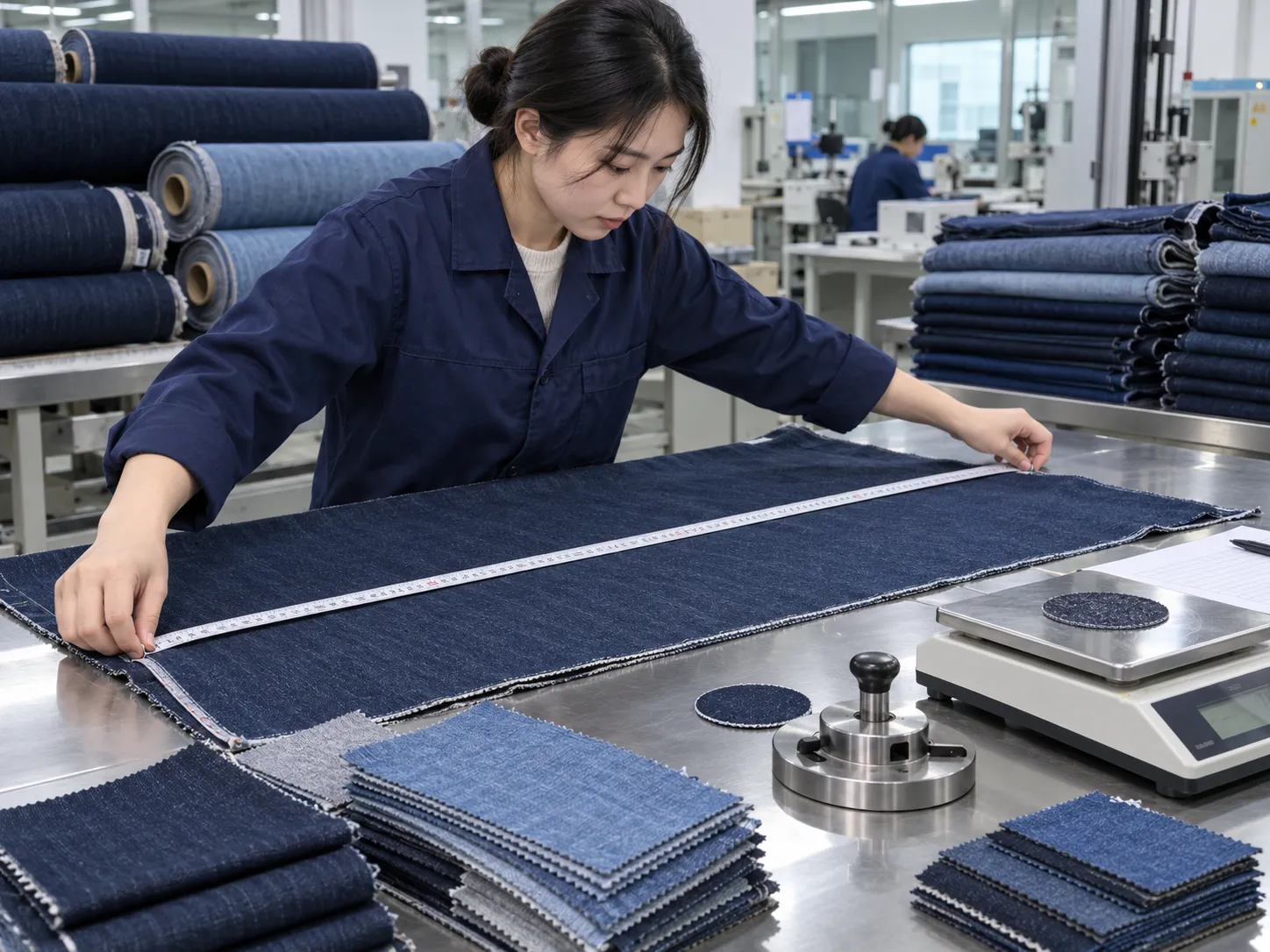
Full width is measured from selvedge to selvedge. Cuttable width is the part you can actually lay pattern pieces on, after removing the selvedges, pin-hole edges and any edge shade variation. On our woven rolls the cuttable width is usually 5–10 cm less than the full width. Every fabric consumption calculation should use the cuttable width.
Where the lost width goes
- Selvedges: the woven edges on both sides are denser and often a different texture. Cutters avoid them.
- Stenter pin holes: the finishing frame holds the fabric by its edges and leaves small holes or marks.
- Edge-to-center shade: on some dyed fabrics the edges can differ slightly in shade from the center, so a cutter may stay clear of the outer few centimeters.
The difference is not small. A 10 cm loss is 6.7% of a 150 cm roll and 5.6% of a 180 cm roll. If you calculate on full width, your fabric consumption figure will be too low by roughly that percentage, and you will run short at the cutting table.
Common widths in cm and inches
| Full width | In inches | Cuttable width at −5 cm | Cuttable width at −10 cm |
|---|---|---|---|
| 150 cm | 59.1″ | 145 cm | 140 cm |
| 160 cm | 63.0″ | 155 cm | 150 cm |
| 170 cm | 66.9″ | 165 cm | 160 cm |
| 180 cm | 70.9″ | 175 cm | 170 cm |
We produce almost all of our fabric families, including cotton, denim, polyester, linen, flannel and yarn-dyed fabric, in widths from 150 to 180 cm. Within that range, width is something you can choose to suit your marker, not a fixed property of the fabric.
How to Calculate Fabric Consumption per Garment
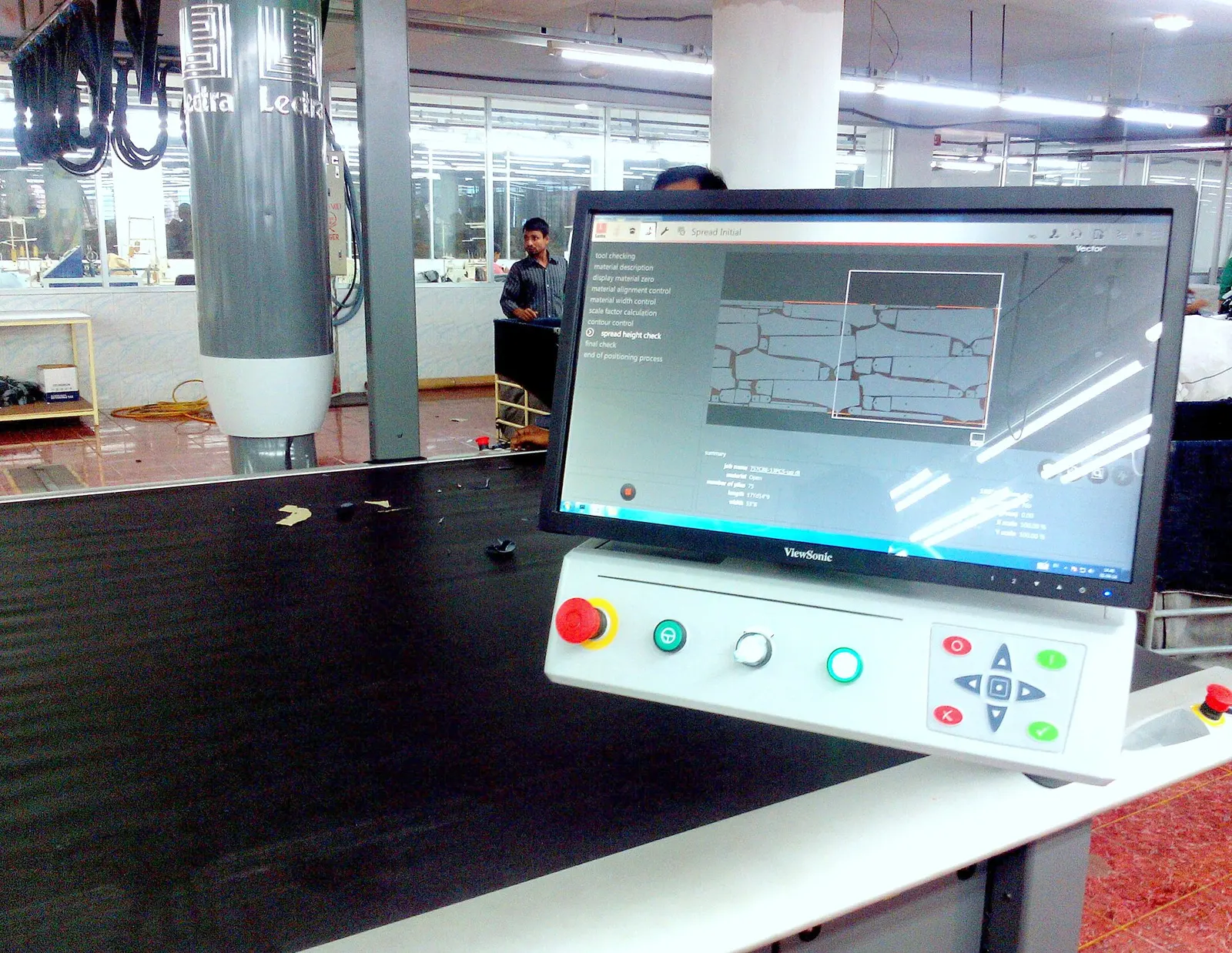
The most accurate way to calculate fabric consumption is to make a marker on the real cuttable width and divide the marker length by the number of garments in it. Without marker software, you can estimate fabric consumption from the total area of the pattern pieces, the cuttable width and an assumed marker efficiency, then add shrinkage.
Method 1: from a marker (most accurate)
Final consumption = Consumption ÷ (1 − Shrinkage)
Ask your pattern maker or the cutting room to build the marker on the cuttable width of the exact fabric you will order. A marker made on 145 cm does not tell you what will happen on 170 cm.
Method 2: from pattern area (estimate)
Final consumption = Consumption ÷ (1 − Shrinkage)
Marker efficiency is the share of the marker area covered by pattern pieces; the rest is waste between pieces. It depends on the style, the number of sizes nested together and the cutter. Use your own cutting room’s figure if you have one. The examples below assume 80% only to show the method.
Why divide by (1 − shrinkage) rather than multiply by (1 + shrinkage)? If fabric shrinks 4%, every 1 m you buy becomes 0.96 m. To end up with 1 m you need 1 ÷ 0.96 = 1.042 m. Multiplying by 1.04 gives 1.040 m, slightly too little. At 3–5% the difference is small, but on a large order it adds up.
Worked example
A long-sleeve woven shirt. We assume 1.75 m² of pattern pieces including seam allowances, 80% marker efficiency, a 160 cm roll with 150 cm cuttable width, and 4% length shrinkage.
1.458 ÷ (1 − 0.04) = 1.519 m → about 1.52 m per shirt
Calculated example, not a measured marker. Replace the pattern area and efficiency with your own figures.
Same Garment, Four Widths: Consumption Compared
With the same assumptions, moving from a 150 cm roll to a 180 cm roll cuts fabric consumption for the example shirt from about 1.63 m to 1.34 m, an 18% drop. In a real marker the saving can be larger or much smaller, because pieces either fit an extra column across the width or they don’t.
| Full width | Cuttable width (−10 cm) | Before shrinkage | After 4% shrinkage | Change vs 150 cm |
|---|---|---|---|---|
| 150 cm | 140 cm | 1.563 m | 1.63 m | — |
| 160 cm | 150 cm | 1.458 m | 1.52 m | −6.7% |
| 170 cm | 160 cm | 1.367 m | 1.42 m | −12.5% |
| 180 cm | 170 cm | 1.287 m | 1.34 m | −17.6% |
Calculated with the area method: 1.75 m² pattern area, 80% marker efficiency, 4% shrinkage. Not a measured marker.
Why the real saving is rarely proportional
The area method assumes the same marker efficiency at every width. Real pieces have fixed sizes, so they fit across the roll in whole columns. Take a trouser panel that is 55 cm wide at its widest point:
| Cuttable width | Panels across | Width used | Width left over |
|---|---|---|---|
| 140 cm | 2 | 110 cm | 30 cm (21%) |
| 160 cm | 2 | 110 cm | 50 cm (31%) |
| 170 cm | 3 | 165 cm | 5 cm (3%) |
Going from 140 to 160 cm buys no extra panel; the extra 20 cm only helps if smaller pieces such as pockets or waistbands can fill the gap. Going to 170 cm fits a third panel and the saving jumps. This is why two buyers can get very different results from the same width change.
When a wider roll saves the most
- Large pieces that land just over a column break on the narrow width, such as trouser legs, coat bodies or wide skirt panels.
- Several sizes nested in one marker, so small pieces fill the gaps.
- Long straight pieces that run along the length, such as bedding or curtain panels.
When it saves little or nothing
- Small pieces that already pack tightly on a narrow width.
- One-way fabrics, such as napped flannel, directional prints or some twills, where pieces cannot be rotated to fill gaps.
- Stripes and checks that must be matched at seams, where matching rules decide placement more than width does.
Price per Meter vs Cost per Garment
A wider fabric at the same g/m² contains more fabric per running meter, so it usually costs more per meter. A wider roll only pays off when the drop in fabric consumption per garment is bigger than the rise in price per meter. Calculate fabric cost per garment for both widths before choosing.
Weight per running meter (g) = GSM × Width (m)
Same GSM, wider roll, heavier meter
A 200 g/m² fabric weighs 300 g per running meter at 150 cm and 360 g at 180 cm, 20% more. Woven fabric cost is driven largely by the amount of yarn in it, so per-meter prices for wider rolls tend to rise with width.
Break-even rule
If the wide roll costs X% more per meter, it saves money only when fabric consumption falls by more than 1 − 1 ÷ (1 + X). A 20% price premium needs a consumption drop of more than 16.7%.
Using the example shirt: at 150 cm it uses 1.63 m; at 180 cm it uses 1.34 m. If the 180 cm fabric costs 20% more per meter, the cost per shirt is 1.63 P against 1.34 × 1.2 P = 1.61 P. The saving is about 1%, close to nothing. The wide roll only wins clearly if your real marker nests better than the area method assumes, or if the price premium is below the width increase.
Calculated example. Ask for quotes at two widths on the same fabric and run your own numbers.
Other Factors That Change How Much Fabric You Need
Besides width, fabric consumption is driven by shrinkage, directional fabric, pattern matching and end-of-roll and defect losses. Each adds a few percent, and together they decide whether an order is enough or runs short.
Shrinkage
Our fabrics are controlled to 3–5% shrinkage. Shrinkage acts in both directions: length shrinkage increases the meters you need, and width shrinkage narrows the cuttable width. If the garment is washed after sewing, build the pattern allowance in as well, or the garment ends up smaller than the spec sheet.
Stripes, checks and directional fabric
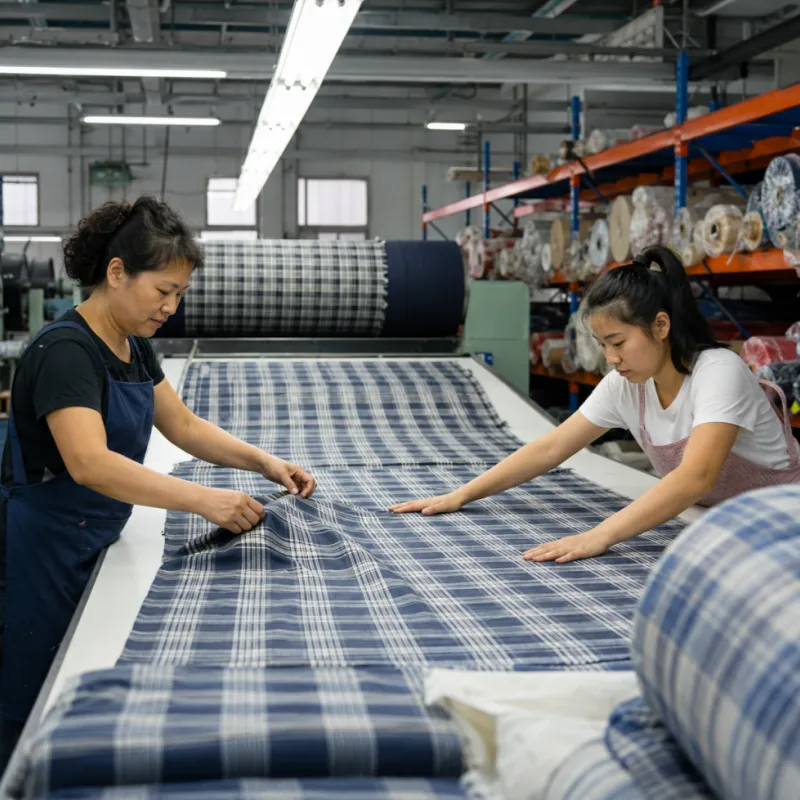
Matching stripes and checks at seams forces pieces into fixed positions and raises fabric consumption. See yarn-dyed vs piece-dyed vs printed fabric for how pattern type affects cutting. Napped fabrics such as brushed flannel and one-way prints also limit how pieces can be rotated.
Roll ends, defects and splicing
The first and last part of a roll and any marked defects are cut out, and lay ends at each table add loss. Production guides commonly add a margin of around 10% for defects and waste to the purchase quantity (Moldey, fabric consumption). Use your own cutting room’s history if you have it.
Fabric weight
Weight does not change fabric consumption in meters, but it changes cost and how many meters fit on a roll. See our fabric weight guide and the denim weight guide.
Meters or Kilograms: Woven vs Knit Fabric Consumption
Woven fabric consumption is usually calculated and bought in meters at a stated width. Knit fabric is usually calculated in kilograms per dozen garments, because knits are sold by weight. The two convert through width and GSM: kilograms = meters × width (m) × GSM ÷ 1,000.
Why the units differ
Woven fabrics such as poplin, twill, denim and canvas are sold by length, so cutting rooms think in meters per garment. Knits such as jersey and fleece are sold by weight, so garment merchandisers often use a kg-per-dozen formula built from body length, sleeve length, half chest and GSM. If you compare a woven quote with a knit quote, convert both to cost per garment first.
Converting meters to kilograms
Example: 500 m of 160 cm fabric at 200 g/m² weighs 500 × 1.6 × 200 ÷ 1,000 = 160 kg. The same 500 m at 180 cm weighs 180 kg. This is also why a wider roll at the same GSM costs more per meter.
Our production range is 110–380 g/m² at 150–180 cm. See the fabric weight guide for how GSM is measured.
How Many Garments Does 500 m Make?
Our minimum order is 500 m per order, not per color. With the example shirt, 500 m makes about 306 shirts at 150 cm and about 373 shirts at 180 cm, before any defect margin. Turn the fabric consumption formula around to work out how many meters to order for a target quantity.
Garments from an order = Meters ÷ [Final consumption × (1 + Margin)]
| Full width | Final consumption | Shirts from 500 m (no margin) | Shirts from 500 m (10% margin) |
|---|---|---|---|
| 150 cm | 1.63 m | 306 | 278 |
| 160 cm | 1.52 m | 328 | 299 |
| 170 cm | 1.42 m | 352 | 320 |
| 180 cm | 1.34 m | 373 | 339 |
Calculated from the example shirt; rounded down to whole garments.
For example, 1,000 shirts on 160 cm fabric need 1,000 × 1.52 × 1.10 = 1,672 m. More on order terms is on our custom fabric manufacturing page.
How to Write Width on a Purchase Order
State the width in cm or inches, say whether it is full width or cuttable width, and agree a tolerance in writing. Then check it when the rolls arrive, before cutting.
What to write
- “Cuttable width 150 cm minimum” is clearer than “160 cm” and protects your marker.
- Give one unit only. 58/60″ fabric is often written loosely; 147 cm and 152 cm are not the same marker.
- Put shrinkage limits next to width, since width shrinkage reduces the cuttable width after washing.
For a full PO example, see how to write a PO spec for poplin fabric.
What to check on arrival
- Measure cuttable width at several points along each roll, not just at the start.
- Re-check width after a wash test if the garment will be washed.
- If the width comes in narrower, re-run the marker before cutting rather than after you run short.
Fabric Width and Consumption: FAQ
Is 150 cm or 180 cm fabric better?
Neither is better in general. 180 cm gives lower fabric consumption per garment but costs more per meter. Compare cost per garment on a marker made at each cuttable width. For the example shirt in this guide, the two came out within about 1% of each other.
Does wider fabric always cost more?
At the same g/m², a wider fabric has more fabric in each running meter, so the price per meter is usually higher. A 200 g/m² fabric weighs 300 g per meter at 150 cm and 360 g at 180 cm.
What is cuttable width?
The part of the fabric you can actually cut from, after removing selvedges, pin holes and edge variation. On our rolls it is usually 5–10 cm less than the full width.
How do you calculate fabric consumption for a garment?
Divide marker length by the number of garments in the marker, then divide by (1 − shrinkage). Without a marker, divide total pattern area by cuttable width × marker efficiency, then adjust for shrinkage.
How much fabric do I need for one shirt?
It depends on the style, size range and width. In our calculated example, a long-sleeve woven shirt with 1.75 m² of pattern pieces needs about 1.52 m of 160 cm fabric after 4% shrinkage. Use your own pattern area or marker for real orders.
Can every fabric be made in 180 cm?
We can make almost all our fabric families, including cotton, denim, polyester, linen, flannel and yarn-dyed fabric, in widths from 150 to 180 cm. Tell us your target width when you ask for a quote.
Does fabric width change the MOQ?
No. Our MOQ is 500 m per order at any width. Width changes how many garments those 500 m make: about 306 to 373 for the example shirt.
How do I convert fabric width from inches to cm?
Multiply inches by 2.54. 59″ is about 150 cm, 63″ is 160 cm, 67″ is 170 cm and 71″ is 180 cm.
Not sure which width fits your marker? Send us your style, size range and target quantity. We will quote the same fabric at two widths so you can compare cost per garment. Free samples ship in 3–5 days; you pay shipping only.