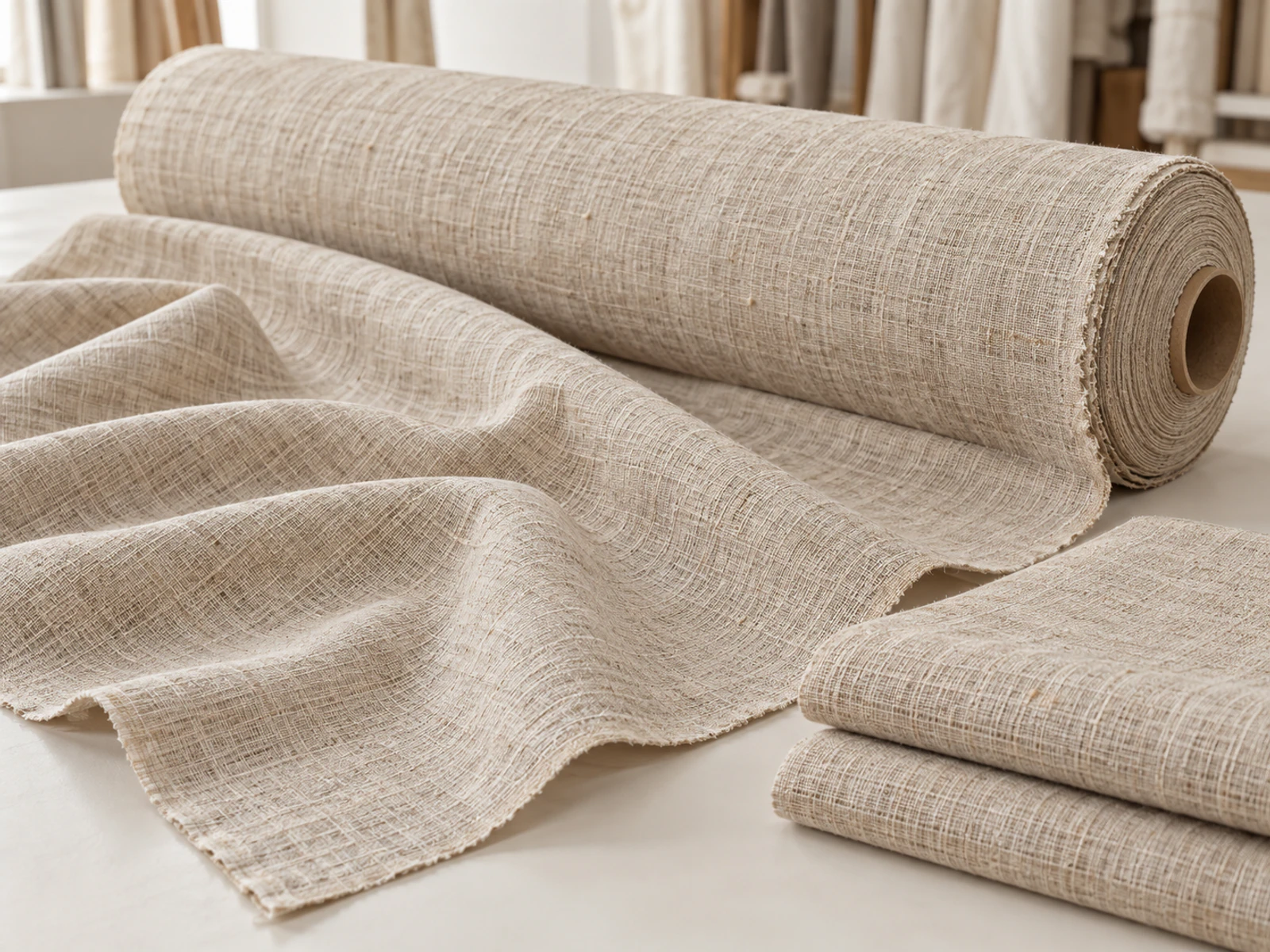
Flannel vs fleece is one of the most common fabric questions we get from garment factories and home textile brands, and the two are easy to confuse. Both feel soft, both are sold as “warm” fabrics, and both end up in pajamas, shirts and blankets. Yet they are made in completely different ways, and that difference decides how a finished product breathes, shrinks, pills and wears.
In short: flannel is a woven fabric that has been brushed to raise a soft surface, and it is most often made from cotton. Fleece is a knitted fabric with a raised pile, and it is almost always made from polyester. If you are deciding between fleece vs flannel for a bulk program, the right answer depends on the end product, the climate it will be used in, and the specifications you can control at the mill.
This guide is written from the production side. We weave, brush and finish flannel every season, and we regularly quote fleece alongside it for the same customers. Below we compare the two fabrics point by point, then show how to turn that comparison into a fabric specification, a test plan and a purchase order that a supplier can actually execute.
Flannel is a brushed woven fabric (usually cotton) that breathes well and suits shirts, pajamas and sheets. Fleece is a napped knit fabric (usually polyester) that traps more heat, dries faster and suits hoodies, jackets and throws.
Choose flannel when breathability and a natural feel matter. Choose fleece when warmth-to-weight and fast drying matter. For bulk orders, compare GSM, fiber content, brushing level, shrinkage and pilling grade — not hand feel alone.
What Is the Main Difference Between Flannel and Fleece?
The main difference between fleece and flannel is construction. Flannel starts life as a woven cloth: warp yarns run along the length, weft yarns cross them at right angles, and the fabric is then brushed. Fleece starts life as a knitted cloth: yarn is formed into interlocking loops, and the loops or the back of the knit are then napped into a thick pile. Fiber content follows from that — most flannel is cotton, most fleece is polyester — but construction is what drives performance.
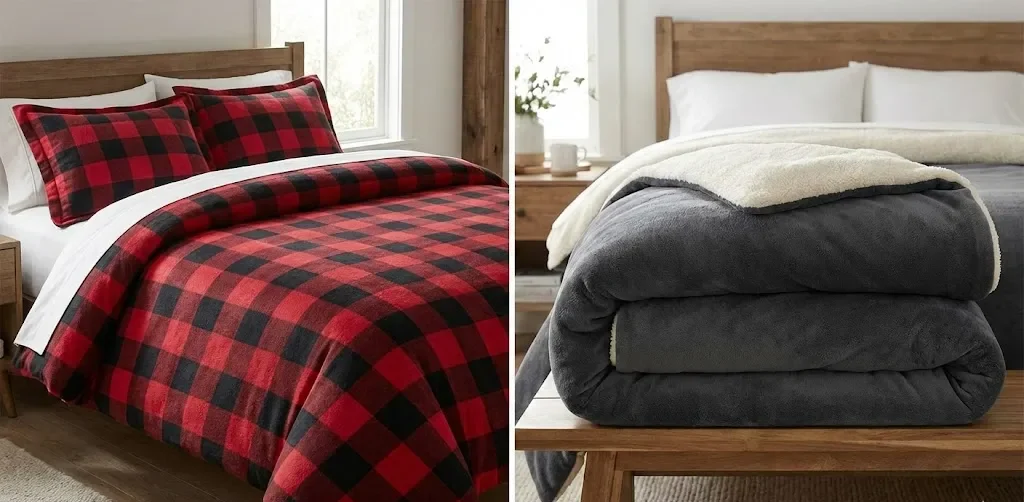
Flannel Is Usually a Brushed Woven Fabric
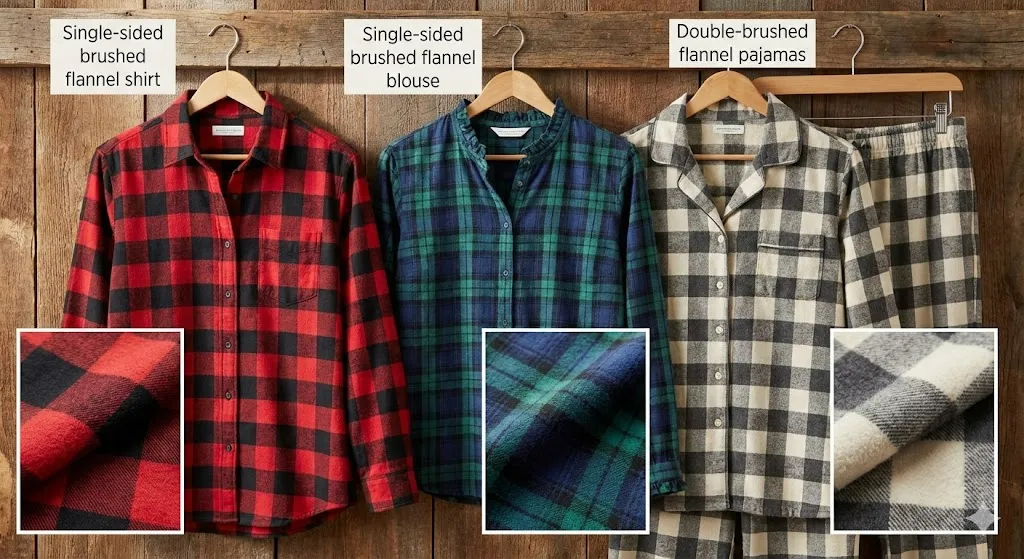
Flannel is woven first, usually in a plain or twill weave, from carded or combed cotton yarns, polyester, or blends. After weaving and dyeing (or after weaving with dyed yarns for plaids), the fabric passes through a napping machine. Rollers covered with fine wire teeth lift fiber ends out of the yarns and create a soft, slightly fuzzy surface. A fabric brushed on one face is single-brushed; one brushed on both faces is double-brushed.
Because the base is woven, flannel keeps the stability of a woven: it has little stretch, it holds its shape at the seams and it can be cut and sewn like any shirting or sheeting. If you are new to the category, our guide to what flannel fabric is and how it is made covers the history, fiber options and main flannel types in more detail.
Fleece Is Usually a Knitted Pile Fabric
Fleece is knitted, typically on circular knitting machines, using a jersey or terry-type structure with an extra loop yarn. The fabric is then napped to break and lift those loops into a dense pile, and often sheared to an even height. Polar fleece is napped and sheared on both sides; microfleece uses finer filaments and a lower pile; sherpa-style fleece imitates sheepskin with a curly pile.
Almost all commercial fleece is polyester, and there is a structural reason for that. Polyester filament holds the napped pile well, does not absorb much water and accepts anti-pilling finishes. There is also a supply reason.
Woven vs Knitted Construction: Why It Matters
Weaving and knitting create two different fabric skeletons, and almost every comparison later in this article traces back to them:
- Stability: a woven flannel has very little stretch and holds collar, placket and seam shapes. A knitted fleece stretches, especially in width, and recovers less precisely.
- Air paths: woven flannel has open spaces between interlaced yarns, so air moves through it. Fleece pile creates thousands of small air pockets that slow air movement and hold heat.
- Edges and cutting: woven flannel frays at a cut edge and needs finished seams. Fleece edges do not fray easily, which is why fleece blankets are often sold with simple bound or raw edges.
- Shrinkage behavior: cotton woven flannel shrinks mainly through yarn and fiber relaxation after washing. Polyester fleece is heat-set, so it is more stable, but knitted width can still change if heat-setting is poorly controlled.
For buyers, the practical takeaway is simple: choose the construction that suits the product first, then fine-tune fiber, weight and finish.
Flannel vs Fleece: Quick Comparison
If you only need the headline differences between fleece and flannel, the table below summarizes them. The notes underneath explain what each line means for a production order, so you can decide whether fleece or flannel fits your product.
| Property | Flannel | Fleece |
|---|---|---|
| Typical fiber | Cotton; also polyester, cotton/poly, rayon, wool | Polyester; sometimes cotton/poly or recycled polyester |
| Construction | Woven (plain or twill), then brushed | Knitted (circular knit), then napped and often sheared |
| Surface | Low, flat nap; fabric texture still visible | Dense raised pile; weave/knit structure hidden |
| Warmth | Moderate; warm but breathable | High warmth for its weight |
| Breathability | Good, especially cotton flannel | Lower; holds heat and humidity |
| Moisture | Absorbs moisture; slower to dry | Absorbs very little; dries fast |
| Stretch & drape | Little stretch; crisp to soft drape | Noticeable stretch; bulky, soft drape |
| Shrinkage | Higher if cotton is not pre-shrunk | Low if properly heat-set |
| Pilling | Depends on yarn and brushing level | Depends on filament, napping and anti-pill finish |
| Typical GSM | 120–220 GSM apparel; up to ~300 GSM overshirts | 150–200 GSM microfleece; 200–350 GSM blankets/outerwear |
| Best uses | Shirts, pajamas, sheets, baby wraps | Hoodies, jackets, throws, outdoor layers |
Fiber Content
Most flannel is 100% cotton, with cotton/polyester and 100% polyester flannel as cheaper or easier-care alternatives. Most fleece is 100% polyester. Fiber decides absorbency, heat resistance, dye method and price, so always state the exact composition — for example “100% cotton, combed” or “100% polyester, 150D/288F” — rather than just “flannel” or “fleece”.
Fabric Construction
Flannel is specified like a woven: weave (plain or 2/1 or 2/2 twill), yarn counts and ends/picks per inch. Fleece is specified like a knit: machine gauge, yarn deniers and filament counts, and the number of napped sides. A supplier quoting either fabric without these details is quoting a category, not a fabric.
Surface and Hand Feel
Flannel has a short, even nap through which you can often still see the weave or the plaid. Fleece has a deeper pile that hides the structure completely. Flannel feels soft and slightly dry; fleece feels plush and slightly slick, especially in polyester.
Warmth
At the same weight, fleece usually feels warmer because its pile holds more still air. Flannel gives steady, comfortable warmth without the heat build-up of fleece. We cover the reasons in the next section.
Breathability
Woven cotton flannel lets air and water vapor through more easily. Polyester fleece is warmer but traps more humidity against the body, which matters in sleepwear and indoor clothing.
Moisture Absorption and Drying Speed
Cotton absorbs moisture; polyester barely does. That makes cotton flannel more comfortable against damp skin but slower to dry, while fleece dries quickly after washing or in outdoor use.
Stretch and Drape
Flannel behaves like a shirting or sheeting fabric: stable, easy to cut and press. Fleece stretches and has bulk, so patterns need ease adjustments and seams are usually overlocked or flatlocked.
Shrinkage and Pilling
Shrinkage is the bigger risk for cotton flannel; pilling can be a risk for both. Neither is fixed by the fabric name alone — they depend on yarn, finishing and testing. Before you compare quotes, it helps to know how to interpret flannel fabric specifications so you can see which supplier has actually committed to shrinkage and pilling limits.
Which Is Warmer: Flannel or Fleece?
Buyers ask which is warmer, fleece or flannel more than any other question in this comparison. The short answer to “is fleece warmer than flannel?” is usually yes, at the same fabric weight. But warmth comes from trapped air, not from the fabric name, so a heavy double-brushed flannel can feel warmer than a thin microfleece.
How Flannel Traps Warm Air
Brushing lifts fiber ends out of the yarn surface. Those raised fibers create a thin layer of still air on the fabric face, and cotton’s ability to absorb some body moisture keeps the skin feeling dry. The result is a gentle, even warmth that stays comfortable over a long period, which is why flannel is popular for shirts and sleepwear.
How Fleece Creates Thermal Insulation
Fleece pile is thicker and denser than a flannel nap, and it usually runs on both sides. That structure holds a much larger volume of still air for the same grams of fiber, giving fleece a high warmth-to-weight ratio. Polyester also does not soak up moisture, so fleece keeps much of its insulation when damp — the reason it became standard for outdoor mid-layers.
How Brushing Affects Flannel Warmth
Brushing is the lever that most changes flannel warmth without changing fiber or weight. More passes raise more fiber and add loft, but every pass also weakens the yarn surface. Too much brushing creates loose fiber that turns into fuzz and pills after a few washes.
If you are choosing between one-side and two-side napping, our comparison of single-brushed vs double-brushed flannel explains the trade-offs in warmth, feel and pilling risk.
Why GSM Alone Does Not Determine Warmth
Two fabrics at 200 GSM can feel completely different. A dense, lightly brushed twill flannel at 200 GSM holds less air than a lofty double-brushed flannel at 180 GSM, and a 200 GSM fleece holds more air than both. Thickness, loft and fiber all matter.
- Ask for thickness (mm) as well as GSM when warmth is critical.
- Compare samples after one wash, because nap relaxes and fleece pile can flatten.
- Specify the brushing level (single or double, light/medium/heavy) for flannel and the pile type for fleece.
For typical weight ranges by product, see our flannel weight guide, which converts GSM to oz/yd² and lists the ranges we use for shirts, pajamas and bedding.
Which Is More Breathable: Flannel or Fleece?
When comparing flannel vs fleece breathability, flannel wins in most real-world uses. If you are asking is fleece or flannel more breathable for a garment worn indoors or next to skin, cotton flannel is usually the safer choice.
Breathability of Flannel
A woven flannel has defined gaps between warp and weft yarns. Air and water vapor move through those gaps, and cotton fibers absorb some sweat and release it slowly. The fabric therefore regulates temperature rather than simply holding heat. Lighter flannels (130–160 GSM) and plain weaves are more breathable than heavy twills.
Breathability of Fleece
Fleece is designed to slow air movement. The dense pile blocks drafts, which is excellent outdoors, but it also holds warm, humid air close to the body. Polyester does not absorb sweat, so moisture stays on the skin or passes through as vapor only. Grid-back and lightweight technical fleeces breathe better, but standard polar fleece runs warm.
Which Is Better for Sleepwear and Indoor Clothing?
For sleepwear, lounge pants and indoor shirts, cotton flannel is usually better: people move between warm and cool rooms, sleep under covers and sweat a little during the night. Fleece suits cold bedrooms, children who kick off blankets, or very cold climates where warmth matters more than airflow.
| Situation | Better choice | Why |
|---|---|---|
| Heated home, all-night wear | Cotton flannel 140–180 GSM | Breathes and absorbs night sweat |
| Cold bedroom, no heating | Fleece or heavy double-brushed flannel | More trapped air |
| Layered under a jacket | Flannel shirt | Breathes during activity |
| Outdoor mid-layer | Fleece | Warm when damp, dries fast |
Flannel vs Fleece for Moisture and Drying
Flannel vs fleece moisture behavior comes almost entirely from fiber content. Cotton loves water; polyester does not. That single difference shapes comfort, washing and flannel vs fleece drying time.
How Cotton Flannel Absorbs Moisture
Cotton has a standard moisture regain of about 8.5%, meaning it holds a meaningful amount of water from the air and from the skin. Brushed cotton flannel therefore feels dry and comfortable against damp skin. The downside is that soaked cotton flannel takes longer to dry and feels heavy and cold when wet.
Why Polyester Fleece Usually Dries Faster
Polyester’s moisture regain is roughly 0.4%. Water sits on the fiber surface and between the pile rather than inside the fiber, so fleece spins out well in a washing machine and air-dries quickly. In practice, a polyester fleece blanket is usually dry well before a cotton flannel sheet of similar size.
How Fiber Content Changes Fabric Performance
Polyester flannel and cotton/polyester flannel sit between the two extremes: they absorb less, dry faster and shrink less than cotton flannel, but they also feel less natural and breathe less. If you are weighing those blends, our side-by-side guide on cotton flannel vs polyester flannel covers handfeel, shrinkage, pilling and printing differences in detail.
Which Is Better for Indoor and Outdoor Use?
- Indoor clothing and bedding: cotton flannel, because comfort against skin matters more than drying speed.
- Outdoor and travel: fleece, because it stays warm when damp and dries overnight.
- Workwear shirts: cotton or cotton-rich flannel, sometimes with a polyester blend for durability.
- Products washed very often (hospitality throws, pet beds): fleece, or polyester-blend flannel to reduce drying time.
Flannel vs Fleece: Which Feels Softer?
Flannel vs fleece softness is partly personal preference. Fleece feels plusher on first touch; good flannel feels softer over time and against skin. A well-made, soft flannel fabric gets softer with each wash, while low-grade fleece can feel harsh once the pile mats.
The Brushed Surface of Flannel
Flannel softness comes from raised cotton fiber ends sitting on a stable woven base. The nap is short, so the fabric feels soft but not slippery, and it has a natural, matte look. Finer, combed yarns and even brushing give a smoother hand; coarse, open-end yarns give a rougher, more rustic feel.
The Raised Pile of Fleece
Fleece softness comes from a dense pile of fine polyester filaments. Finer filaments (microfleece) feel silkier; coarser filaments feel bulkier. The finish after napping — shearing height and anti-pilling treatment — controls how smooth the pile looks and feels.
Single-Brushed vs Double-Brushed Surface Feel
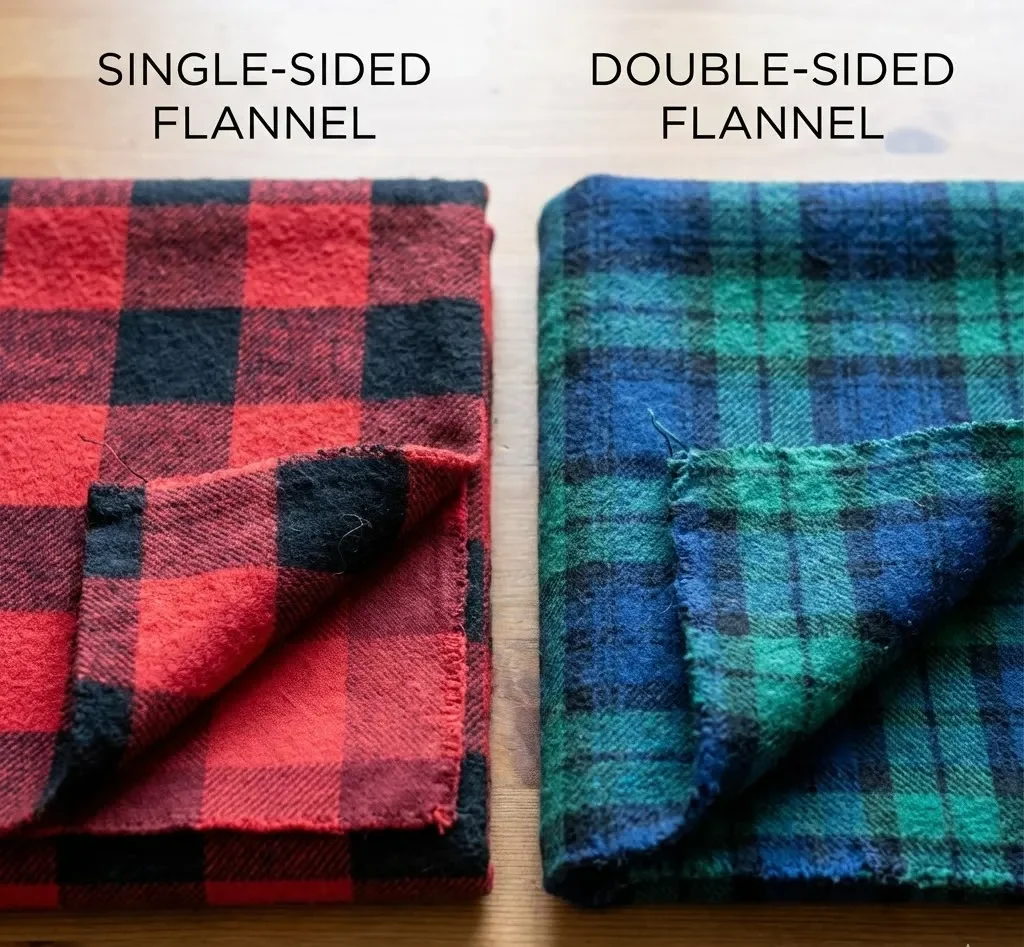
Single-brushed flannel has a soft face and a smoother back, so it slides over other layers and works well for shirts. Double-brushed flannel is soft on both faces, which buyers prefer for pajamas and bedding. Our article on single-brushed vs double-brushed flannel shows how the choice changes warmth and pilling risk.
Why Softer Does Not Always Mean Better Quality
A fabric can be made to feel very soft at sampling stage with heavy brushing or softeners — and then fuzz, pill or lose softness after three washes. When you evaluate softness:
- Touch the fabric after a home-laundry cycle, not only the fresh swatch.
- Ask which softener is used and whether it is durable to washing.
- Check that softness has not been bought with weak, over-brushed yarn — look for loose fiber on a dark cloth after rubbing the face.
Flannel vs Fleece: Pilling, Shrinkage and Durability
Flannel vs fleece durability depends less on the fabric name and more on yarn, finishing and testing. Pilling and shrinkage are the two complaints we see most often, and they behave differently in each fabric, so it is worth understanding flannel vs fleece pilling before you sign off a bulk order.
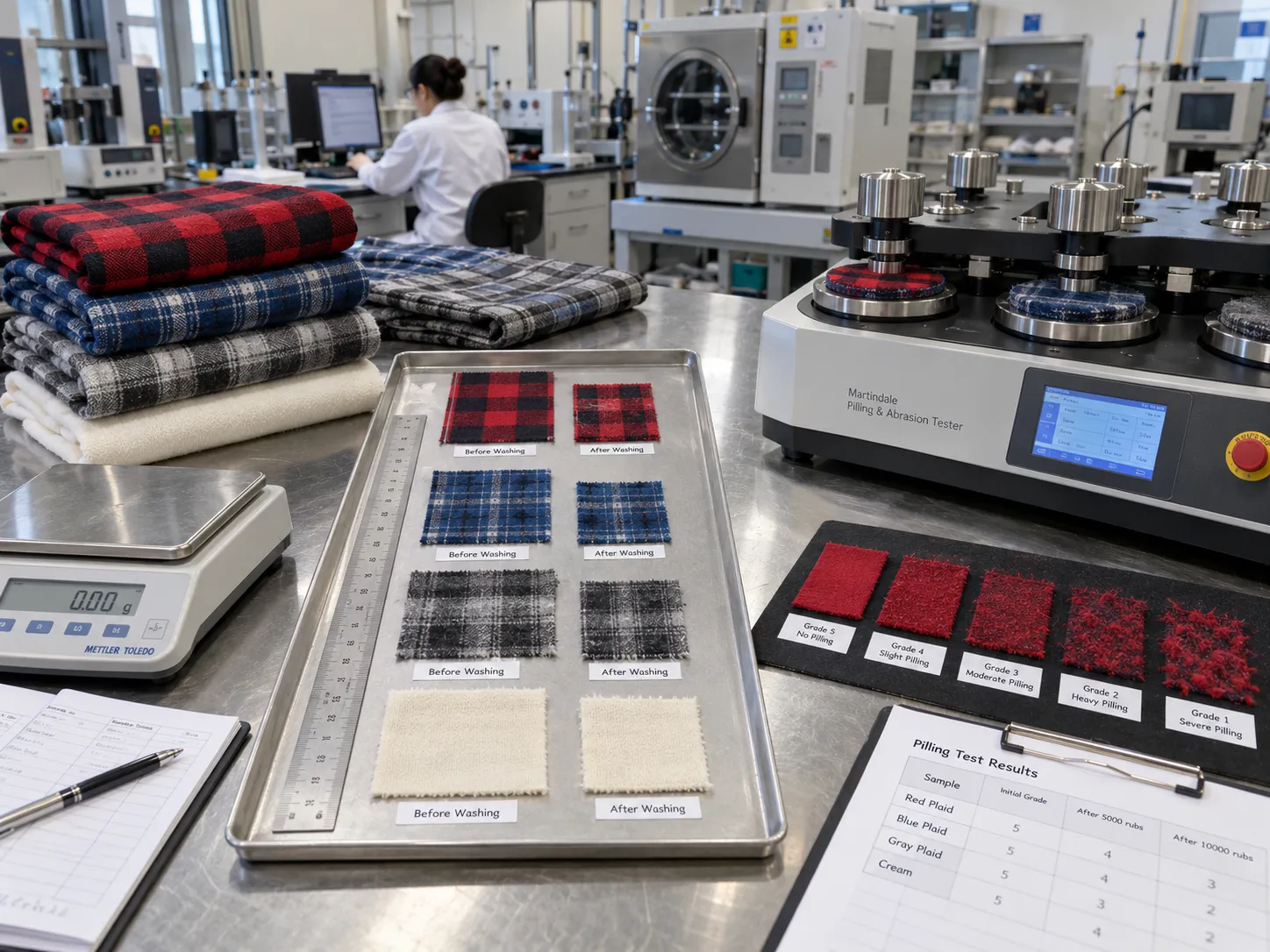
Does Flannel Pill?
Yes, flannel can pill, especially when short-staple yarn is brushed heavily. The raised fibers tangle into small balls during wear and washing. Cotton pills tend to break off over time; polyester-blend pills stay attached because polyester fiber is stronger. Combed or ring-spun yarns, moderate brushing and a correct twist level reduce pilling noticeably.
Does Fleece Pill?
Fleece pilling is a well-known problem, particularly on cheaper polyester fleece. The pile is made of loose fiber ends, and polyester pills cling rather than fall off. Napping intensity, shearing and anti-pilling finishes make the difference between a fleece that stays smooth and one that looks worn after a month.
Which Fabric Shrinks More?
Cotton flannel almost always shrinks more than polyester fleece. Untreated cotton flannel can shrink well beyond acceptable garment tolerances, mainly in length, because yarns relax after the tension of weaving and finishing. Properly heat-set polyester fleece is far more stable, though poorly heat-set fleece can still change in width.
Shrinkage should be measured, not guessed. As defined by AATCC TM135, Test Method for Dimensional Changes of Fabrics after Home Laundering, specimens are marked, laundered and dried under set conditions, then re-measured to calculate dimensional change in length and width. Agreeing on the method, wash temperature and number of cycles is what makes two suppliers’ shrinkage numbers comparable.
| Fabric | Typical risk | Common bulk target* |
|---|---|---|
| Cotton flannel (pre-shrunk) | Length shrinkage after first washes | ≤ 3% length and width |
| Cotton flannel (no pre-shrink) | High, often outside garment tolerance | Not recommended for garments |
| Polyester / poly-blend flannel | Low | ≤ 2–3% |
| Polyester fleece (heat-set) | Width change if heat-setting is poor | ≤ 3% length and width |
*Typical targets we see on apparel and bedding programs; confirm the final limit with your brand standard and test method.
How Fiber Composition Affects Shrinkage and Durability
Moving from 100% cotton to a cotton/polyester blend reduces shrinkage and improves abrasion resistance, but changes pilling behavior and hand feel. Our guide on cotton flannel vs polyester flannel shows where each composition makes sense, and how to write the difference into a spec sheet.
What Buyers Should Check Before Bulk Production
- Pilling grade — agree on the test method and a minimum grade (for example ≥ Grade 3–4) for both flannel and fleece.
- Dimensional change — agree on method, temperature and number of wash cycles; check both length and width.
- Weight tolerance — typically ±5% on GSM; measure before and after finishing.
- Colorfastness — washing and rubbing, especially wet rubbing on dark, brushed shades.
- Surface after washing — compare a washed swatch with the approved sample for nap, pile and fuzz.
Dimensional change: ≤ 3% L/W after 3 home launderings (AATCC TM135)
Weight: 180 GSM ± 5%, measured on finished fabric
Approval: bulk to match approved washed reference for nap/pile
Flannel vs Fleece for Shirts
When buyers compare a flannel shirt vs fleece, they are usually comparing two different garment types: a woven button-up shirt and a knitted pullover or jacket. Some brands also ask for a “flannel fleece shirt” — normally a flannel shirt with a fleece lining, or a fleece shirt-jacket with a flannel-look print.
Why Flannel Is Commonly Used for Shirts
Shirts need collars that stand, plackets that lie flat and buttonholes that hold. A woven flannel does all of that while adding softness and warmth. It presses well, takes yarn-dyed checks and prints, and can be sewn on standard shirt lines. Single-brushed flannel is preferred because the smooth back slides over T-shirts and base layers.
Flannel Is a Fabric, Not a Pattern
Many shoppers call any checked shirt a “flannel”, but the name describes the brushed fabric, not the check. A solid flannel shirt is still flannel; a crisp checked poplin shirt is not. Our guide to flannel vs plaid explains the difference and why it matters when you write a purchase order.
Why Fleece Is Less Common for Traditional Shirts
Fleece stretches, has bulk and does not hold a sharp collar or a fine buttonhole well. It is used for shirt-jackets, quarter-zips and overshirts in outdoor ranges, but rarely for a classic button-up shirt. When it is, the fleece is usually a lighter microfleece with a stabilized structure.
Recommended Flannel GSM for Shirts
| Shirt type | Flannel GSM | Notes |
|---|---|---|
| Lightweight / spring shirt | 120–150 | Plain weave, single-brushed |
| Classic flannel shirt | 160–200 | Twill or plain, single-brushed |
| Heavy overshirt / shacket | 220–300 | Twill, often double-brushed |
For conversions to oz/yd² and more detail on how weight changes drape, see the flannel weight guide.
Flannel vs Fleece for Pajamas and Sleepwear
Flannel vs fleece pajamas is a choice between breathable warmth and maximum warmth. Many sleepwear brands carry both, but they sell to different customers and climates, so the fleece vs flannel pajamas decision should be made product by product.

Cotton Flannel for Pajamas
Cotton flannel pajamas breathe, absorb night sweat and feel soft on both sides when double-brushed. They suit adults who sleep under a duvet in heated homes, and children’s sleepwear where comfort and natural fiber are selling points. The risks are shrinkage and pilling at the seat and knees, which are both controllable with the right yarn and finishing.
Fleece for Cold-Weather Sleepwear
Fleece pajamas and onesies are warmer and dry faster, which suits cold climates, unheated bedrooms and children who kick off covers. Microfleece is the usual choice because standard polar fleece can feel too bulky to sleep in. Buyers should check pilling grade and static, and confirm that children’s sleepwear meets the flammability rules of the destination market.
Breathability vs Warmth for Sleepwear
For most indoor sleepwear, breathability is more important than peak warmth. Over-warm fabrics cause people to wake up sweating, which leads to returns described as “too hot” or “uncomfortable”. Flannel’s moderate warmth plus moisture absorption fits the widest range of users; fleece suits a narrower, colder use case.
Recommended GSM for Flannel Pajamas
- 140–160 GSM double-brushed cotton flannel: all-season sleepwear, children’s pajamas.
- 160–180 GSM double-brushed: the core winter pajama weight for most brands.
- 180–200 GSM: extra-warm ranges and loungewear; check that the fabric is not too stiff.
The flannel weight guide lists the same ranges alongside shrinkage allowances for sleepwear patterns.
Flannel vs Fleece for Blankets and Bedding
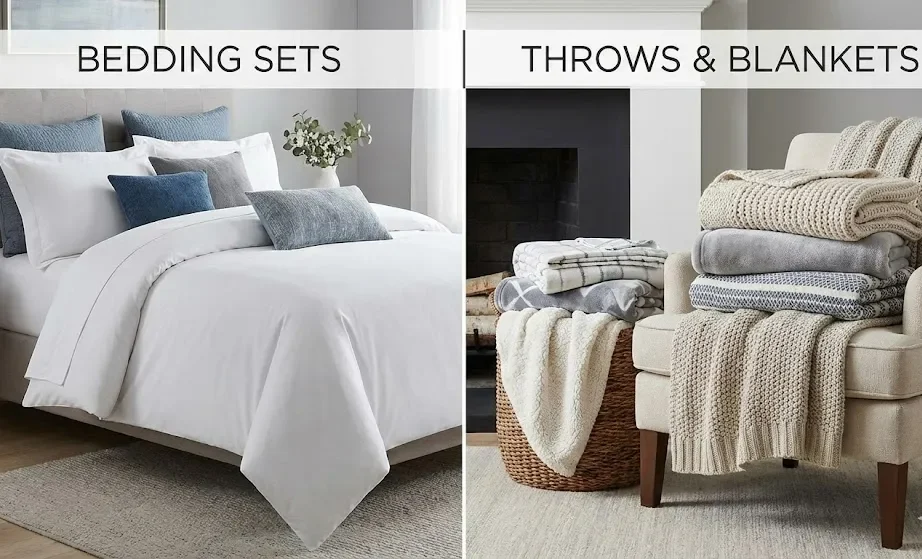
For home textiles, the flannel vs fleece blanket question usually splits by product: flannel for sheets and duvet covers, fleece for throws and blankets. Comparing fleece vs flannel sheets, flannel is the more common and more breathable option.
Flannel for Sheets and Bedding
Flannel sheets sit directly against skin all night, so breathability and absorbency matter. Double-brushed cotton flannel in the 150–200 GSM range is the market standard. Bedding needs wide widths to avoid center seams, tight shrinkage control because sheets must still fit the mattress after washing, and good color consistency across lots.
Fleece for Blankets and Throws
Throws and blankets sit on top of bedding or on a sofa, so warmth and plush look matter more than breathability. Polyester fleece is light, warm, quick-drying and does not fray, which makes it cost-effective for throws, travel blankets and promotional products. Higher-end ranges use heavier double-sided fleece with careful shearing for a smooth pile.
Warmth vs Breathability
A useful rule for bedding buyers: the closer a product sits to the skin, the more breathability matters; the further from the skin, the more warmth and appearance matter. That is why many retailers pair flannel sheets with a fleece throw rather than choosing one fabric for everything.
GSM, Width and Shrinkage Requirements
| Product | Typical fabric | GSM | Width | Shrinkage target* |
|---|---|---|---|---|
| Flannel sheets | Double-brushed cotton flannel | 150–200 | Wide width preferred (e.g. 230–280 cm) | ≤ 3% L/W |
| Duvet covers | Cotton or cotton-blend flannel | 140–180 | Wide width preferred | ≤ 3% L/W |
| Fleece throws | Double-sided polyester fleece | 200–300 | Open-width knit, typically 150–180 cm | ≤ 3% L/W |
| Heavy blankets | Polyester fleece / sherpa | 300+ | Open-width knit | ≤ 3% L/W |
*Typical targets; confirm against your brand standard. Width capability varies by mill, so confirm it before you design a cutting plan. Our article on how to interpret flannel fabric specifications explains how to read width, GSM and density lines on a supplier’s sheet.
Flannel vs Fleece for Clothing Manufacturers
For a garment factory, the fleece vs flannel fabric decision is really a set of smaller decisions about flannel vs fleece material: fiber, weight, finish and testing. Getting these right before bulk is what prevents claims later.
Choose Fabric Based on the Final Product
Start from the garment, its wearer and its care instructions. A woven shirt or pajama points to flannel; a hoodie, jacket or blanket points to fleece. If the brand wants a “cozy” look in a woven style, flannel is the natural fit; if it wants maximum warmth in a knit silhouette, fleece is.
Compare Fiber Composition
Write the full composition and yarn type, not just “cotton” or “polyester”. Cotton flannel offers comfort and breathability; polyester and blends offer lower shrinkage and faster drying. The guide on cotton flannel vs polyester flannel gives a use-case table you can copy into an internal brief.
Compare GSM and Fabric Weight
Compare weights on finished fabric, after brushing or napping, and allow a tolerance (commonly ±5%). Use the same unit across suppliers — GSM or oz/yd² — and check that weights are measured the same way. Our flannel weight guide includes a conversion table.
Compare Brushing and Surface Finish
For flannel, specify single- or double-brushed and the brushing level, and approve it on a physical reference. For fleece, specify one- or two-side napped, sheared or unsheared, and whether an anti-pilling finish is required. Our guide to single-brushed vs double-brushed flannel lists the wording we recommend.
Check Shrinkage, Pilling and Colorfastness
Set measurable limits for dimensional change, pilling grade, colorfastness to washing and colorfastness to rubbing, and agree which laboratory and which methods will be used. Dark brushed shades deserve extra attention on wet rubbing, because raised fibers carry more loose dye.
Approve a Physical Sample Before Bulk Production
Approve a sealed sample of the actual fabric — not a swatch card — and keep one half at each side. Wash one piece before approval so both sides know what the fabric looks like after laundering. Bulk inspection should be made against this reference, not against memory or photos.
How to Choose Between Flannel and Fleece for Bulk Orders
Deciding flannel or fleece for a bulk order is easier when you follow the same sequence every time. These seven steps are the process we walk buyers through when they ask us to compare fleece vs flannel fabric for a new program.
Step 1 — Define the Final Application
Write down the product, the wearer, the climate and the care instructions before you request any quote. “Women’s winter pajama set, machine wash 40 °C, tumble dry low” leads to a very different fabric from “outdoor quarter-zip, wash cold”. This one paragraph decides flannel or fleece more reliably than comparing swatches.
Step 2 — Confirm Fiber Composition
Choose the fiber that fits the application and price target, and write it precisely, including yarn type (combed, carded, ring-spun, open-end; or denier/filament for polyester). If you are torn between natural and synthetic flannel, compare cotton flannel vs polyester flannel before fixing the composition.
Step 3 — Set GSM and Fabric Width
Set a target GSM with tolerance (for example 170 GSM ±5%) and a cuttable width that suits your marker. Wider fabric reduces waste on bedding and large pattern pieces. Use the flannel weight guide as a starting point, then confirm against your own samples.
Step 4 — Define Brushing Requirements
For flannel, state single- or double-brushed and attach a brushing reference. For fleece, state napped sides, sheared or not, and anti-pill finish. The guide to single-brushed vs double-brushed flannel helps you choose which side should be napped for shirts versus sleepwear.
Step 5 — Confirm Fabric Specifications
Put everything on one spec sheet: composition, construction, GSM, width, finish, color references and test limits. Ask the supplier to confirm every line in writing. Our guide on how to interpret flannel fabric specifications shows which lines are often missing and how to read density and yarn counts.
Weight: 170 GSM ± 5% (finished) · Cuttable width: 150 cm
Pilling ≥ Grade 4 · Dimensional change ≤ 3% L/W
Color: match approved lab dip under D65; shade bands per lot
Step 6 — Test Shrinkage, Pilling and Colorfastness
Test the approved sample and then each bulk lot. A simple sequence works for most programs:
- Cut and mark specimens from the beginning, middle and end of the lot.
- Run dimensional change after the agreed number of home launderings.
- Run pilling on finished fabric and rate against visual standards.
- Test colorfastness to washing and to dry and wet rubbing.
- Compare a washed specimen against the washed reference sample for nap, pile and color.
Record results per lot so that any later claim can be traced to a specific production batch.
Step 7 — Request Samples Before Bulk Production
Request a pre-production sample from the real bulk process — not a hand-loom or lab sample — and approve it before the supplier starts. Keep the sealed sample with the PO. If you need both fabrics, ask for flannel and fleece samples in the same color so your team can compare them side by side.
You can also send your spec sheet directly to our team through the contact page and we will reply with matching flannel options and test data.
Flannel vs Fleece: Which One Should You Choose?
There is no single winner in flannel vs fleece. Each fabric is the better choice for a different set of products, and the right fleece or flannel decision comes from the end use.
Choose Flannel for Shirts, Pajamas and Bedding
Choose flannel when the product is woven in style, sits close to the skin, or is used indoors: button-up shirts, pajamas, sheets, duvet covers and baby wraps. Cotton flannel gives breathable warmth and a natural feel; polyester-blend flannel lowers shrinkage and drying time.
Choose Fleece for Hoodies, Jackets and Warm Blankets
Choose fleece when warmth-to-weight, fast drying and easy care matter more than breathability: hoodies, zip jackets, outdoor mid-layers, throws and travel blankets. Specify pilling grade and shearing quality, because they decide how long the product looks new.
When You Should Compare Physical Samples Before Ordering
- When the product could reasonably use either fabric (pajamas, lounge sets, throws).
- When the weight is close to a boundary — for example a heavy flannel competing with a light fleece.
- When the brand has had shrinkage or pilling complaints in the past.
- When the price difference between options is small enough that comfort and returns become the deciding factor.
| If your product is… | Choose | Key spec to lock |
|---|---|---|
| Button-up shirt | Flannel | Single-brushed, 160–200 GSM |
| Winter pajamas | Flannel (fleece for cold climates) | Double-brushed, 160–180 GSM, ≤ 3% shrinkage |
| Sheets / duvet cover | Flannel | Wide width, ≤ 3% shrinkage |
| Hoodie / jacket | Fleece | Anti-pill finish, pilling ≥ Grade 4 |
| Throw / blanket | Fleece | Double-sided, sheared, 200–300 GSM |
Frequently Asked Questions About Flannel vs Fleece
Is flannel warmer than fleece?
Usually no. At the same weight, fleece is warmer because its dense pile traps more still air. A heavy, double-brushed flannel can match a thin microfleece, so compare thickness and samples rather than fabric names when warmth is critical.
Is fleece the same as flannel?
No. The difference between fleece and flannel is construction: flannel is a brushed woven fabric, usually cotton, while fleece is a napped knitted fabric, usually polyester. They look similar but differ in breathability, stretch, shrinkage and drying speed.
Which is more breathable, flannel or fleece?
Flannel. In terms of flannel vs fleece breathability, woven cotton flannel lets air and vapor pass and absorbs sweat, while polyester fleece holds heat and humidity. For indoor clothing and sleepwear, flannel is the more comfortable choice.
Is flannel or fleece better for pajamas?
For most indoor sleepwear, flannel. In flannel vs fleece pajamas, double-brushed cotton flannel at 160–180 GSM breathes better and suits heated homes; fleece suits very cold bedrooms or children who kick off covers.
Is flannel or fleece better for blankets?
It depends on the product. For a flannel vs fleece blanket, fleece is warmer, lighter and dries faster, so it suits throws; flannel is better for sheets and duvet covers that sit against the skin all night.
Does fleece pill more than flannel?
Often, yes — especially low-cost polyester fleece, because polyester pills cling to the surface. In flannel vs fleece pilling, both fabrics can reach Grade 4 with the right yarn, napping and anti-pill finishing, so specify a pilling grade in the PO.
Does flannel shrink more than fleece?
Yes. In flannel vs fleece shrinkage, cotton flannel usually shrinks more than heat-set polyester fleece. Ask for pre-shrunk flannel and set a limit such as ≤ 3% length and width after home laundering, tested to an agreed method.
Is flannel made from cotton or polyester?
Flannel can be either. Most flannel is 100% cotton, but polyester and cotton/polyester flannels are common for lower shrinkage and cost. Our guide to cotton flannel vs polyester flannel explains which to choose for each product.
Need Flannel for Your Next Program?
We weave, dye, brush and finish flannel in-house and ship in 20–35 days from a 5,000 m MOQ. Send us the product, target GSM and test limits, and we will reply with matching options, swatches and test reports.