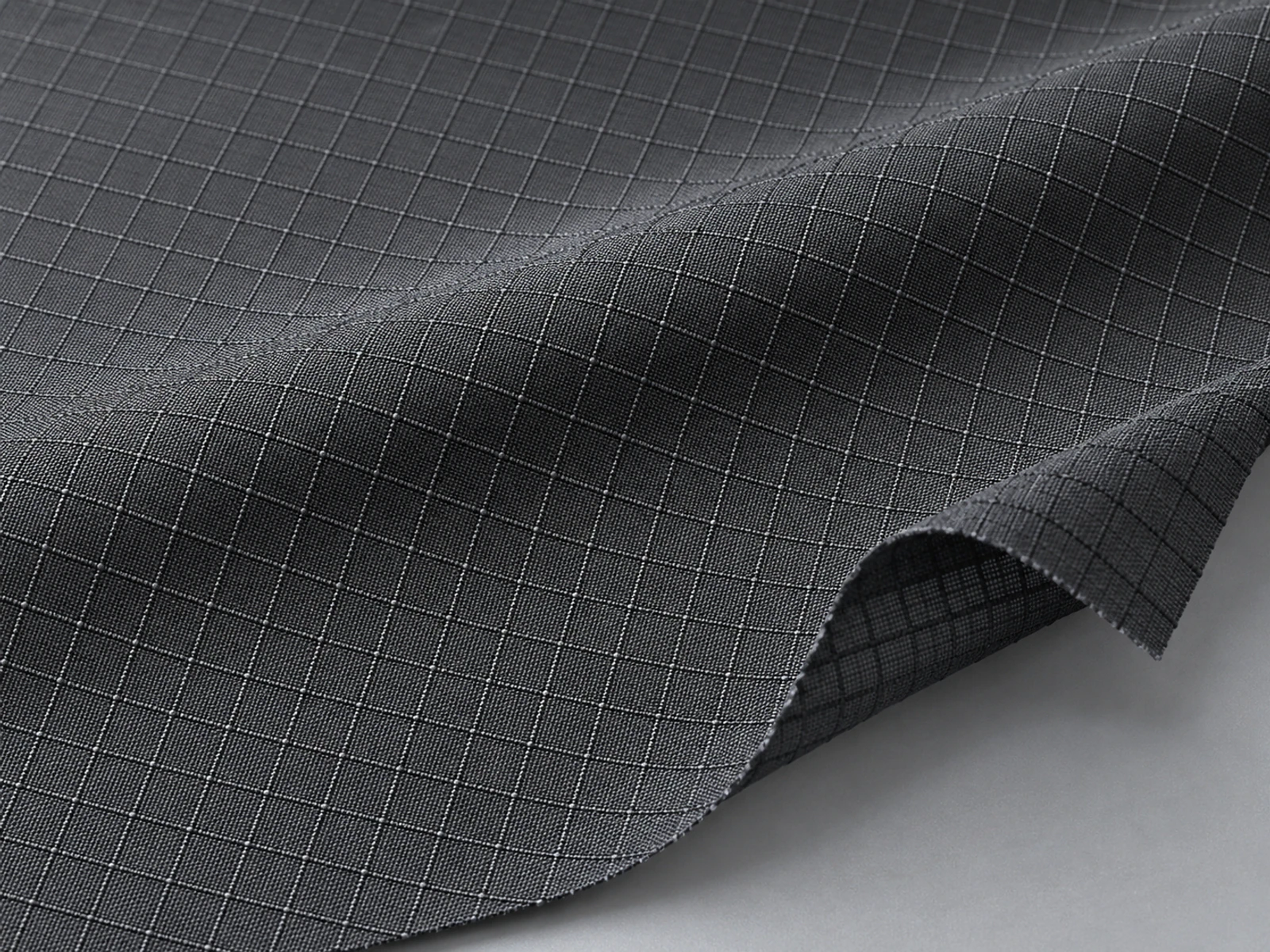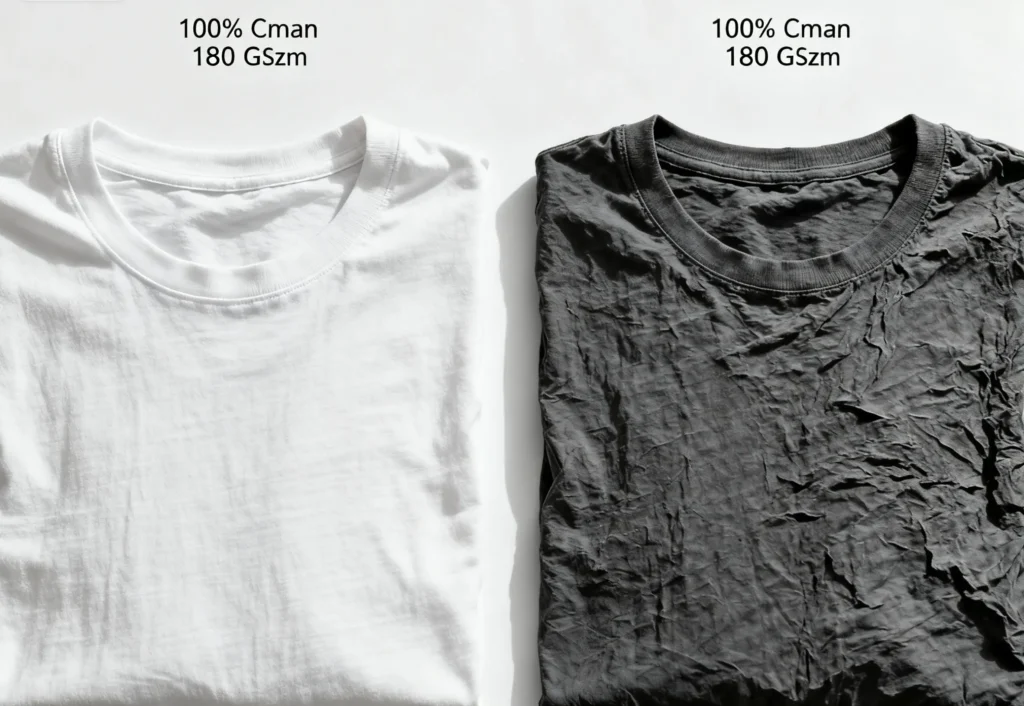

Short answer: for most T-shirts, the best cotton T-shirt fabric is 100% combed cotton single jersey at 160–180 g/m², 26s–32s yarn, 160–180 cm open width. Choose 180–220 g/m² interlock or compact jersey for premium retail, 220–280 g/m² single jersey for oversized and heavyweight styles, and 95/5 cotton-spandex jersey when stretch and recovery matter. Confirm finished GSM, usable width, shrinkage and spirality on a bulk-production sample before you place the order.
Cotton T-shirt fabric is not a single product. A 150 g/m² carded jersey for a promotional tee and a 240 g/m² compacted jersey for a streetwear drop can both be labeled “100% cotton”, yet they differ in opacity, drape, shrinkage, print performance and cost per piece. The specification has to start from the T-shirt style and the market, not from the fiber name.
This guide to cotton T-shirt fabric is written for buyers who need to turn a style brief into a mill-ready specification. It covers knit structure, GSM, yarn count, combing and spinning, fiber blends, width, quality tests, dyeing and finishing, and the exact fields to put on an RFQ. Where a range depends on the construction, we say so. For the underlying knit definitions, see our guide to knitted cotton fabric; for weight and count theory, see fabric weight and yarn count explained.
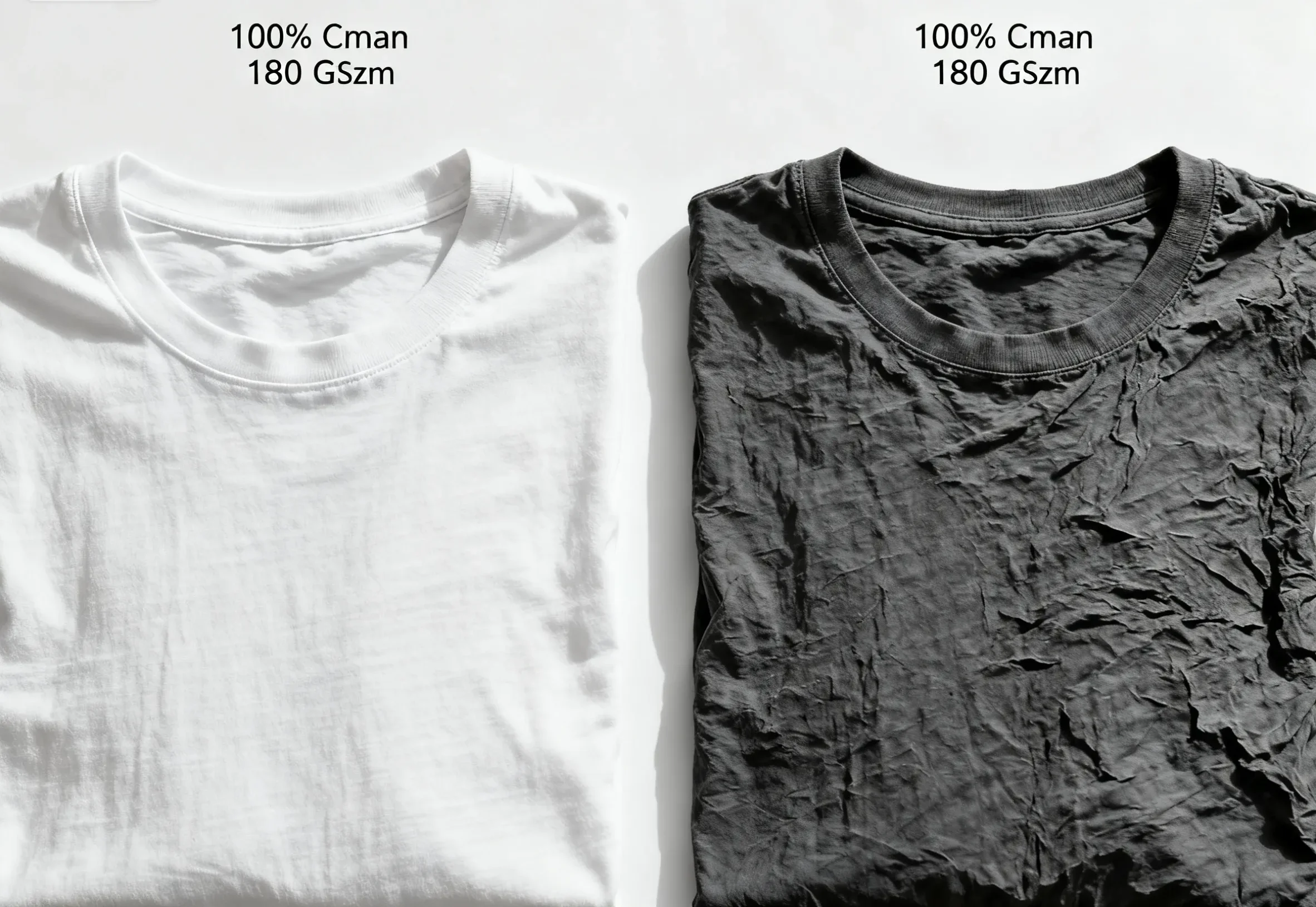
What Is the Best Cotton Fabric for T-Shirts?
Direct answer: 100% combed cotton single jersey at 160–180 g/m², 26s–32s, 160–180 cm open width is the best all-round cotton T-shirt fabric. It balances softness, opacity, breathability, printability and cost. Move to interlock or compact jersey for a smoother premium hand, and to 220–280 g/m² jersey for heavyweight or oversized silhouettes.
For cotton T-shirt fabric, there is no universal “best” without an end use. A fabric that makes an excellent $6 promotional tee will be too thin for a $40 retail tee, and a 260 g/m² heavyweight jersey will feel wrong for a summer basic. The right question is: which cotton construction gives the hand, opacity and durability your target customer expects at a cost the product can carry?
Why Single Jersey Is the Most Common Choice
Single jersey cotton T-shirt fabric is knitted on one set of needles. The loops interlock in one direction, giving a smooth face, a textured back and natural stretch across the width. It is lighter and more breathable than interlock at the same GSM, takes screen and digital printing well, and can be produced on a wide range of circular knitting machines. That combination is why it is the default for most T-shirts.
Its limitations are equally important. Single jersey curls at the edges, can be dimensionally unstable if it is not compacted, and shows needle lines or loop distortion if the gauge and yarn count do not match. Those are finishing and construction problems, not reasons to avoid the structure. A well-compacted 180 g/m² single jersey is a more reliable T-shirt fabric than a poorly finished interlock at the same weight.
When to Choose 100% Cotton or Cotton Blends
For cotton T-shirt fabric, choose 100% cotton when the product promise is natural hand-feel, breathability, absorbency and a premium retail story. It is also the easiest base for water-based printing and garment washing. The trade-off is shrinkage, wrinkling and slower drying, which you manage with compacting, pre-shrinking and a clear care label.
Choose a cotton blend when the product needs lower cost, better shape retention, faster drying or stretch. A cotton-rich CVC (typically 60/40 cotton/polyester) keeps a cotton-like hand with better durability; a polyester-rich TC (typically 65/35 polyester/cotton) is more economical and more stable but less breathable. A 95/5 or 90/10 cotton-spandex blend is the right choice for fitted tees that must recover after washing.
Recommended Cotton Fabrics for Different T-Shirt Styles
For basic cotton T-shirt fabric, use 100% cotton single jersey at 160–180 g/m² with 26s–30s yarn. For a premium retail tee, use combed compact single jersey or interlock at 180–220 g/m² with 30s–40s yarn. For an oversized or heavyweight tee, use 220–280 g/m² single jersey with 20s–24s yarn and a 180–190 cm finished width. For a stretch tee, use 95/5 cotton-spandex jersey at 160–200 g/m². For promotional work, carded single jersey or a 50/50 blend at 150–170 g/m² controls cost. For childrenswear, prioritise 100% combed cotton at 150–180 g/m² with strict shrinkage and colorfastness limits.
| T-shirt application | Recommended cotton fabric | GSM | Yarn count | Why it works |
|---|---|---|---|---|
| Everyday retail tee | 100% combed single jersey | 160–180 | 26s–32s | Best balance of hand, opacity, durability and cost |
| Premium retail tee | Combed compact jersey or interlock | 180–220 | 30s–40s | Smoother surface, better drape and shape retention |
| Oversized / heavyweight | 100% cotton single jersey | 220–280 | 20s–24s | Structure, opacity and a substantial hand |
| Stretch / fitted tee | 95/5 cotton-spandex jersey | 160–200 | 30s–40s | Stretch and recovery for close-fitting silhouettes |
| Promotional / printed tee | 100% carded jersey or 50/50 blend | 150–170 | 24s–30s | Low cost, good print area, acceptable durability |
The cotton T-shirt fabric recommendations above are a starting point. Confirm final GSM, width and shrinkage on a production sample, especially for white and light colors where opacity is critical.
What Types of Cotton Fabric Are Used for T-Shirts?
Direct answer: five cotton knit structures cover most cotton T-shirt fabric production: single jersey for everyday tees, interlock for premium and stable tees, rib for fitted tees and neckbands, piqué for polo shirts, and cotton-spandex jersey for stretch tees. Each has a different stretch direction, surface, weight range and cutting behavior.
The cotton T-shirt fabric structure determines how the fabric stretches, how it drapes, how it curls at the cut edge and how it behaves in the wash. Two fabrics with the same 180 g/m² and the same 30s yarn can still be single jersey and interlock — and they are not interchangeable in a pattern room.
Single Jersey for Everyday T-Shirts
Single jersey is the most widely used cotton T-shirt fabric. One set of needles forms loops that interlock in a single direction, producing a smooth face and a looped back. It stretches across the width, drapes softly and is breathable at 150–200 g/m². It is the default for basic tees, promotional tees and most retail cotton tees. Expect edge curling, so tubular knitting or a well-controlled open-width finishing line matters.
Interlock Knit for Premium T-Shirts
Interlock cotton T-shirt fabric is a double knit made from two sets of needles and two yarns. Two 1×1 rib structures are interlocked, so the fabric is smooth on both sides, more stable and less prone to curling. It is heavier and less stretchy than single jersey at the same count, which gives a premium, structured hand. It suits 180–220 g/m² premium tees, especially styles that need a clean neckline and a stable body panel.
Rib Knit for Fitted T-Shirts and Neckbands
Rib knit cotton T-shirt fabric alternates knit and purl wales, creating vertical ridges and high stretch. A 1×1 rib stretches in both directions; a 2×2 rib is thicker and more textured. Rib is used for neckbands, cuffs and hems because it recovers well, and for fitted tees where the body needs to follow the silhouette. Common T-shirt rib weights are 180–300 g/m² with 24s–30s yarn.
Piqué Knit for Polo Shirts
Piqué cotton T-shirt fabric is a double knit with a raised, honeycomb-like surface. The texture keeps the fabric off the skin, improves airflow and gives a structured look. It is the standard for polo shirts and can also be used for heavier, textured T-shirts. Typical weights are 180–240 g/m² with 24s–30s yarn. Piqué is less drapey than jersey and holds a collar shape better.
Cotton-Spandex Jersey for Stretch T-Shirts
For stretch cotton T-shirt fabric, cotton-spandex jersey adds 5–10% elastane to a cotton jersey. The elastane gives stretch and recovery, so the tee holds its shape after wearing and washing. It is used for fitted tees, women’s tees, active-casual styles and any garment that needs a close fit without a seam-heavy construction. Typical weights are 150–220 g/m². Heat setting, chlorine bleach and high drying temperatures can damage elastane, so the care label matters.
| Knit type | Structure | Stretch | Typical GSM | Best application |
|---|---|---|---|---|
| Single jersey | One needle bed; loops interlock in one direction | Good widthwise stretch | 120–280 | Everyday tees, oversized tees, printing |
| Interlock | Two needle beds; two interlocked 1×1 ribs | Moderate, stable | 180–260 | Premium tees, clean necklines |
| Rib | Alternating knit and purl wales (1×1 or 2×2) | High, both directions | 180–300 | Fitted tees, neckbands, cuffs |
| Piqué | Double knit with a raised cell texture | Moderate | 180–240 | Polo shirts, textured tees |
| Cotton-spandex jersey | Single jersey with 5–10% elastane | High, with recovery | 150–220 | Fitted tees, women’s tees, active-casual |
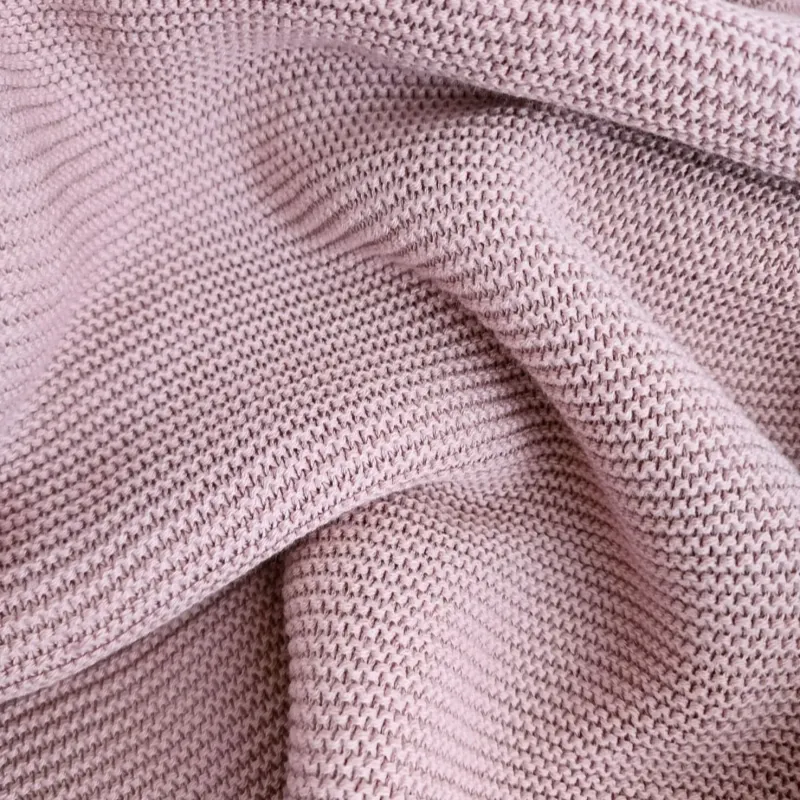
For diagrams and a deeper explanation of each structure, see The Ultimate Guide to Knitted Cotton Fabric.
What GSM Is Best for Cotton T-Shirts?
Direct answer: 160–180 g/m² is the best all-round GSM for cotton T-shirt fabric. Use 120–150 g/m² for lightweight summer tees, 180–220 g/m² for premium and streetwear tees, and 220–280 g/m² for heavyweight and oversized tees. For white and light colors, choose the upper end of the range or a denser knit to avoid transparency.
For cotton T-shirt fabric, GSM is the finished weight of the fabric in grams per square meter. It is not an independent setting: it is the result of yarn count, loop length, stitch density and finishing. That is why a 180 g/m² jersey can feel light and airy on one machine and compact and dense on another.
120–150 GSM: Lightweight Summer T-Shirts
Lightweight cotton T-shirt fabric at 120–150 g/m² is cool, breathable and inexpensive, but it can be semi-sheer in white and light colors. Use 30s–40s yarn with a tighter gauge to improve opacity, and test the fabric over a dark background before approving. This band suits summer basics, undershirts, sleepwear and layering pieces, not premium retail tees that need a substantial hand.
150–180 GSM: Everyday T-Shirts
For everyday cotton T-shirt fabric, this is the commercial sweet spot. At 160–180 g/m², a 26s–32s single jersey is opaque enough for most colors, soft enough for direct-to-consumer retail and durable enough for repeated washing. It prints well, embroiders well and cuts efficiently at 160–180 cm. Most basic and mid-market T-shirt programs sit here.
180–220 GSM: Premium and Streetwear T-Shirts
At 180–220 g/m², cotton T-shirt fabric has more body and a smoother surface when made from combed compact yarn at 30s–40s. It holds a structured drape, supports a clean neckline and feels more substantial in the hand. This band is common for premium basics, small-batch brands and streetwear that wants a dense but not heavy jersey. Compacting is essential to keep shrinkage under control.
220–280 GSM: Heavyweight and Oversized T-Shirts
Heavyweight cotton T-shirt fabric uses coarser yarn, usually 20s–24s, and a denser loop structure. It gives the boxy, structured look of oversized streetwear, hides body contours and holds a shape after washing. The trade-offs are warmth, slower drying and higher fabric consumption per garment. At 260–280 g/m², check that the knitting machine can maintain a consistent loop and that the fabric does not become too stiff for the intended drape.
How GSM Affects Opacity, Drape and Fabric Consumption
The opacity of cotton T-shirt fabric rises with GSM and stitch density, but color matters as much as weight. A 180 g/m² white jersey can still show a dark underlayer if the yarn is fine and the loop is open. Drape falls as GSM rises: 140–160 g/m² jersey drapes softly, 180–220 g/m² holds a cleaner shape, and 240 g/m²+ feels structured and boxy. Consumption is easier to calculate in kilograms than in meters because knit fabric is often sold by weight.
At 180 g/m² and 180 cm width, one linear meter weighs about 324 g, so 1,000 kg yields about 3,086 m. At 160 cm width, the same fabric weighs about 288 g/m, so 1,000 kg yields about 3,472 m. The narrower roll gives more meters per kilogram but less usable area per meter. Always compare cost per garment, not price per kilogram or per meter alone.
| GSM band | Best for | Opacity | Drape | Typical yarn count |
|---|---|---|---|---|
| 120–150 | Summer basics, layering, sleepwear | Low to medium; white can be sheer | Soft, fluid | 30s–40s |
| 150–180 | Everyday retail tees | Good in most colors | Soft with some body | 26s–32s |
| 180–220 | Premium, retail, streetwear | High | Structured, clean | 30s–40s |
| 220–280 | Heavyweight, oversized, boxy fits | Very high | Stiff to structured | 20s–24s |
When a buyer approves cotton T-shirt fabric at 180 g/m², the number that matters is the finished, relaxed GSM after dyeing and compacting. Greige weight can read several percent lighter, and a fabric that is stretched on the finishing frame can read heavier than it will after washing. We measure the finished sample, conditioned, and put both the measured value and the tolerance on the report.
For conversion between g/m² and oz/yd², and for the standard test method, see Fabric Weight (GSM) Explained. As a quick reference, 1 oz/yd² is about 33.9 g/m².
What Yarn Count Is Best for Cotton T-Shirt Fabric?
Direct answer: 26s–32s is the best all-round yarn count for cotton T-shirt fabric. Use 20s–24s for heavyweight and oversized tees, 30s–40s for premium and softer retail tees, and 40s+ for lightweight premium jersey. The count must be matched to the knitting gauge and target GSM; a count on its own does not define the fabric.
For cotton T-shirt fabric, yarn count is written in Ne (English cotton count). It is an indirect measure: one Ne means one 840-yard hank of yarn weighs one pound. The higher the number, the finer the yarn. A 40s yarn is finer than a 26s yarn, but finer does not automatically mean better — it means a different balance of softness, opacity, strength and cost.
20s, 26s, 30s, 32s and 40s Cotton Yarn Compared
- 20s: a coarse yarn for 220–280 g/m² heavyweight jersey. It is strong, opaque and durable, with a drier, more textured hand. Best for oversized, boxy and workwear-inspired tees.
- 26s: the workhorse count for 160–180 g/m² everyday jersey. It balances softness, strength and cost, and is widely available in carded and combed qualities.
- 30s: softer and smoother than 26s at a similar weight. Common in mid-market retail tees and premium basics where hand-feel matters more than cost.
- 32s: a finer, smoother yarn for 170–200 g/m² premium jersey. It gives a cleaner surface and better drape, but needs combed or compact spinning to control hairiness and pilling.
- 40s: a fine yarn for 140–180 g/m² lightweight premium jersey. It feels soft and smooth, but can be semi-sheer in white at low GSM and is more expensive per kilogram.
How Yarn Count Affects Fabric Softness and Surface Appearance
In cotton T-shirt fabric, finer yarns bend more easily, so they feel softer and drape better. They also create a smoother surface because the loops are smaller and more uniform. Coarser yarns are stiffer, more abrasion-resistant and more textured. That is why 40s jersey feels smooth and fluid while 20s jersey feels substantial and dry.
Spinning method changes the surface as much as the count. Combed yarn removes short fibers, so it is cleaner and less hairy than carded yarn at the same count. Compact spinning condenses the fiber strand before twisting, reducing hairiness and improving strength. Open-end (rotor) yarn is more uniform but generally weaker and less soft than ring-spun yarn. For premium T-shirt fabric, combed compact ring-spun yarn at 30s–40s is the usual choice.
How Yarn Count, Knitting Gauge and GSM Work Together
For cotton T-shirt fabric, knitting gauge is the number of needles per inch on the machine. A finer gauge has more needles, smaller loops and a smoother surface. A coarser gauge has fewer needles and larger loops. The same 30s yarn on a 20G machine and a 28G machine produces different loop lengths, different GSM and a different hand.
In practice, the three variables are linked: GSM ≈ stitch density × loop length × yarn linear density, adjusted for finishing. You cannot fix all three independently. If you want a softer 180 g/m² jersey, you may move from 26s on a coarser gauge to 32s on a finer gauge; if you want a heavier 240 g/m² jersey, you may move to 20s and a longer loop. This is why a sample is more reliable than a spreadsheet.
| Yarn count | Typical fabric construction | Hand feel | Application |
|---|---|---|---|
| 20s | 220–280 g/m² single jersey, 18–20G | Dry, sturdy, textured | Heavyweight, oversized, boxy tees |
| 26s | 160–180 g/m² single jersey, 20–24G | Balanced, slightly textured | Everyday retail and promotional tees |
| 30s | 160–190 g/m² single jersey, 24G | Soft, smooth | Mid-market and premium basics |
| 32s | 170–200 g/m² single jersey, 24–28G | Smooth, clean surface | Premium retail tees |
| 40s | 140–180 g/m² single jersey, 28–32G | Soft, fluid, fine | Lightweight premium, women’s tees |
Myths vs Facts: GSM and Yarn Count
| Common myth | Actual fact |
|---|---|
| Higher GSM always means better quality. | GSM describes weight, not quality. Yarn quality, knitting consistency, dyeing and finishing decide whether a 180 g/m² tee outperforms a 220 g/m² tee. |
| A higher yarn count is always softer and stronger. | Finer yarn is smoother and often softer, but it can be less abrasion-resistant and more transparent. Combed compact 32s can feel better than poorly spun 40s. |
| You can calculate GSM from yarn count alone. | No. You also need loop length, stitch density, machine gauge and finishing shrinkage. Use the construction to estimate, then test the finished fabric. |
| Combed cotton is a type of cotton fiber. | Combing is a spinning process that removes short fibers. Any suitable cotton can be combed; the fiber type is a separate decision. |
For the full conversion between count, weight and construction, see Yarn Count and Weight.
Combed Cotton vs Carded Cotton for T-Shirts
Direct answer: combed cotton T-shirt fabric is the better choice for premium T-shirts because it is smoother, stronger and less prone to pilling. Carded cotton is the cost-effective choice for promotional and economy tees where a slightly rougher surface and lower strength are acceptable. For the best hand, use combed compact ring-spun yarn.
Why Combed Cotton Is Preferred for Many Premium T-Shirts
Combed cotton T-shirt fabric is made by running the cotton sliver through fine combs that remove short fibers and impurities. The result is a cleaner, more uniform yarn with fewer protruding fiber ends. In a T-shirt, that translates into a smoother surface, better drape, higher strength and less pilling after washing. Combed cotton also takes dye more evenly, which helps shade consistency in light colors.
The cost is higher because combing removes a percentage of the fiber mass and adds a process step. That cost is usually justified in premium retail, where the hand-feel and surface appearance are part of the product promise. For a basic tee sold on price, it may not be.
When Carded Cotton Is a Cost-Effective Choice
Carded cotton retains short fibers, so the yarn is hairier and slightly weaker at the same count. In a 160–180 g/m² jersey for a promotional tee, that difference is often invisible to the end user and irrelevant to the price point. Carded cotton is also acceptable for heavily printed tees, where the print covers most of the surface, and for products with a short expected life.
If you choose carded cotton, specify a pilling test and a minimum grade. The cost saving is real, but a tee that pills after three washes is not a saving. For more detail, see Combed Cotton vs Carded Cotton.
Ring-Spun, Open-End and Compact-Spun Yarn Compared
Ring spinning produces a strong, soft yarn with a normal twist structure. Open-end (rotor) spinning is faster and cheaper; the yarn is more uniform but generally weaker, stiffer and less soft. Compact spinning is a modified ring process that condenses the fiber strand before twisting, reducing hairiness and improving strength and surface cleanliness. For premium cotton T-shirt fabric, compact-spun combed yarn is the strongest starting point.
| Yarn type | How it is made | Strength | Softness | Cost | Best for |
|---|---|---|---|---|---|
| Carded ring-spun | Carded sliver, ring-spun | Good | Medium | Low–medium | Promotional and basic tees |
| Combed ring-spun | Combed sliver, ring-spun | High | High | Medium–high | Premium retail tees |
| Combed compact | Combed sliver, compact ring-spun | Very high | Very high | High | Premium and luxury tees |
| Open-end (rotor) | Rotor spinning | Medium | Medium–low | Low | Economy and promotional tees |
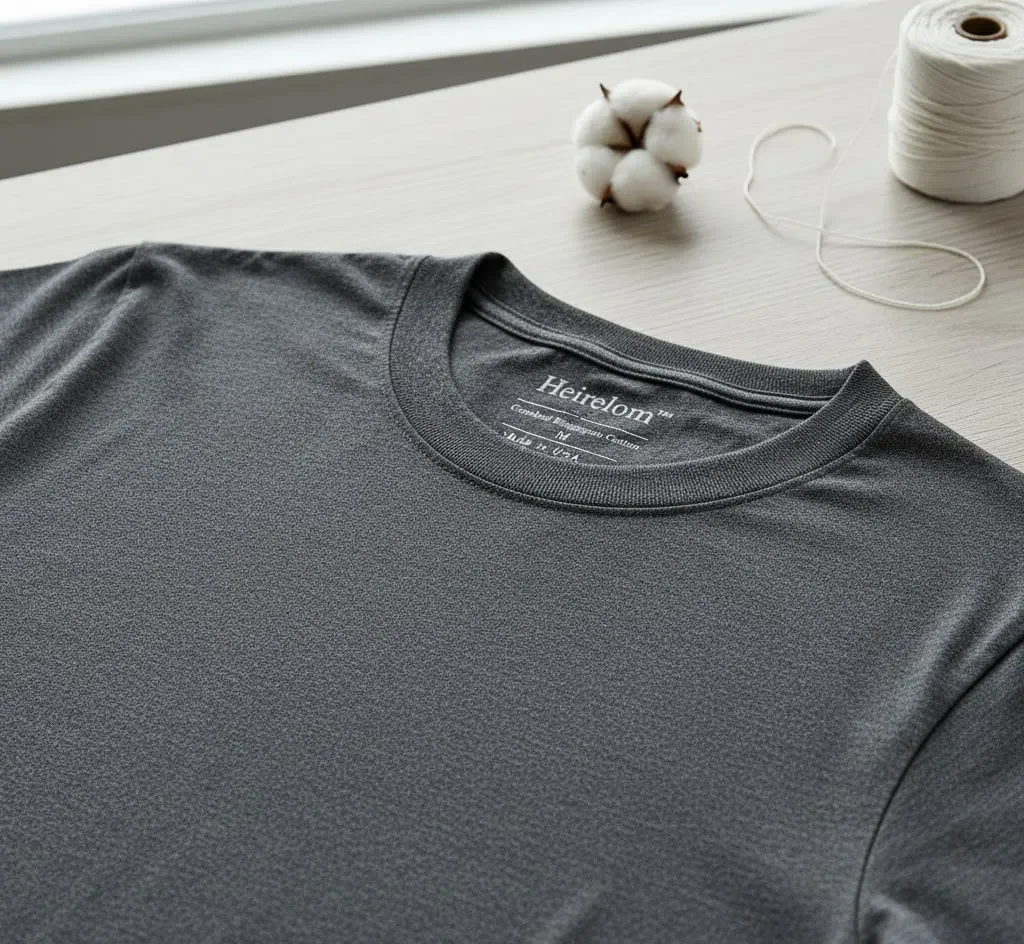
For a deeper comparison of spinning methods, see Ringspun vs Open-End vs Compact.
100% Cotton vs Cotton Blends for T-Shirts
Direct answer: For cotton T-shirt fabric, choose 100% cotton for natural hand-feel, breathability and premium retail positioning. Choose a cotton-polyester blend for lower cost, better shape retention and faster drying. Choose a cotton-spandex blend when the tee needs stretch and recovery. The right composition depends on the product promise, wash care and target price — not on a universal ranking.
100% Cotton for Natural Hand Feel and Breathability
Cotton T-shirt fabric is absorbent, breathable and comfortable against the skin. It takes reactive dyes well, prints cleanly and supports a natural, premium story. The disadvantages are shrinkage, wrinkling, slower drying and lower shape retention than synthetics. Compacting and pre-shrinking reduce the shrinkage risk, but they cannot make cotton behave like polyester.
Cotton-Polyester Blends for Easy Care and Shape Retention
A cotton-rich CVC (typically 60/40 cotton/polyester) keeps much of the cotton hand while improving durability, shrinkage and shape retention. A polyester-rich TC (typically 65/35 polyester/cotton) is more economical, faster drying and more stable, but less breathable and less natural in the hand. Blends are common in promotional tees, uniforms, workwear and active-casual products.
Blends are not automatically more pill-resistant. Polyester can pill when short fibers migrate to the surface, especially in low-twist yarns. Specify a pilling test and a minimum grade, and confirm the blend ratio by fiber-content testing rather than relying on the label.
Cotton-Spandex Blends for Stretch and Recovery
A 95/5 cotton-spandex jersey gives a close-fitting tee that recovers after wearing and washing. A 90/10 blend gives more stretch for active and shapewear-adjacent styles. Elastane is sensitive to heat, chlorine and some dyeing conditions, so the finishing and care instructions matter. Test stretch and recovery after repeated washing, not just on the greige sample.
Which Fiber Composition Should T-Shirt Brands Choose?
Use 100% cotton for premium retail, natural-positioned brands and print-heavy tees. Use 95/5 cotton-spandex for fitted women’s tees and stretch basics. Use 60/40 CVC for everyday tees that need better shape retention. Use 65/35 TC or 50/50 for promotional, uniform and cost-sensitive programs. Use 90/10 polyester-spandex for performance-oriented active-casual tees. If the product carries a certification claim — organic, recycled or OEKO-TEX — confirm the certification covers the actual fiber and process, not just the supplier’s brochure.
| Composition | Breathability | Shrinkage | Durability | Cost | Best for |
|---|---|---|---|---|---|
| 100% cotton | High | Medium–high unless compacted | Good | Medium | Premium retail, natural-positioned brands |
| 95/5 cotton-spandex | High | Medium | Good, with recovery | Medium–high | Fitted tees, women’s tees |
| 60/40 CVC | Medium–high | Low–medium | Very good | Medium | Everyday retail, uniforms |
| 65/35 TC | Medium | Low | Very good | Low–medium | Promotional, workwear |
| 50/50 cotton-polyester | Medium | Low | Good | Low | Promotional, event tees |
For a direct fiber comparison, see Cotton vs Polyester.
What Fabric Width Is Best for Cotton T-Shirts?
Direct answer: 160–180 cm open width is the best general width for cotton T-shirt fabric. Use 150 cm for basic and smaller-size programs, 180–190 cm for oversized and plus-size tees, and 60–80 cm tubular lay-flat width for basic seamless tees. Always specify the finished usable width, not just the nominal width, and do not treat tubular lay-flat width as open width.
The width of cotton T-shirt fabric affects the marker, the fabric consumption per garment and the number of garments a kilogram of fabric can make. It also affects the style: a tubular fabric can eliminate side seams on a basic tee, while an open-width fabric gives the cutter freedom to place body and sleeve panels across the roll.
Open-Width vs Tubular Cotton Jersey
Open-width jersey is knitted as a tube, slit open, and finished flat. It is measured from selvedge to selvedge and sold by open width. The cutter can lay a marker across the full width, which suits side-seamed tees, oversized fits, sleeve panels and prints that must be placed precisely. The edges are not a seam; they are finished edges that may include a small unuseable margin.
Tubular jersey stays as a tube. It is measured as lay-flat width, which is half the tube circumference. A tube with a 75 cm lay-flat width has a circumference of about 150 cm. If you cut it open, the open width is approximately 150 cm minus the edges — but it is not the same as a 150 cm finished open-width fabric, because the tube has not been slit, opened and finished under the same tension. Relaxation, shrinkage, compacting and edge trim all change the final usable width.
Tubular fabric has real advantages: no side seams on basic tees, faster sewing, less seam bulk and a clean tubular body. It also has limits: the tube diameter constrains the size range, side-seam styling is impossible without cutting, and large-size or oversized tees may not fit the tube. Open width is more flexible for fashion fits and plus sizes.
Common Cotton T-Shirt Fabric Widths: 150, 160, 180 and 190 cm
150 cm is common for basic tees and smaller sizes, especially in tubular form. 160 cm is the standard open width for everyday tees and gives a good balance between marker efficiency and fabric cost. 180 cm suits premium, oversized and plus-size tees and can improve marker efficiency when the pattern pieces nest well. 190 cm is the widest common option for large-size and oversized programs; confirm machine availability and the finished usable width before you build the marker around it.
| Width | Fabric form | Garment application | Cutting considerations |
|---|---|---|---|
| 150 cm | Open width or tubular | Basic tees, smaller sizes, sampling | Less efficient for large sizes; check tube diameter |
| 160 cm | Open width | Everyday retail tees | Standard marker; good balance of cost and efficiency |
| 180 cm | Open width | Premium, oversized, plus-size tees | Better nesting for wide body panels; check edge loss |
| 190 cm | Open width | Oversized and plus-size programs | Confirm machine availability and usable width |
| 60–80 cm | Tubular lay-flat width | Basic seamless tees | Half the tube circumference; not equal to open width |
Usable Width vs Nominal Fabric Width
The nominal width on the label is measured on the finished roll. The usable width is what remains after the selvedge, pin holes, edge shade variation and any unuseable margin are removed. On cotton jersey, the difference is often 2–5 cm; on some finishes it can be more. Specify both the full width and the cuttable width, and state the tolerance, for example −1/+2 cm or ±2%.
Measure width after the fabric has relaxed, not while it is stretched on the inspection frame. Use ASTM D3774 or the method agreed in the PO. If the fabric is tubular, state whether the width is lay-flat or circumference; they are not interchangeable.
How Fabric Width Affects Cutting Efficiency and Fabric Consumption
A wider roll is not automatically cheaper per garment. At the same GSM, a wider fabric weighs more per linear meter: 180 g/m² at 180 cm is 324 g/m, while the same fabric at 160 cm is 288 g/m. If you buy by kilogram, the wider roll gives fewer meters per kilogram; if you buy by meter, it costs more per meter. The only fair comparison is cost per garment after the marker is made at each usable width.
Width also interacts with shrinkage. A 3% width shrinkage on a 160 cm fabric removes about 4.8 cm; if the marker was built on the nominal width, the cut may not fit. Build the marker on the finished usable width after shrinkage, and add the shrinkage allowance to the consumption calculation.
For the full calculation, including cuttable width, marker efficiency and meters versus kilograms, see fabric width and consumption.
Choosing Fabric Width for Oversized and Plus-Size T-Shirts
Oversized and plus-size tees need wider body panels and often a drop shoulder. A 180–190 cm open width gives the cutter room to place the front and back panels side by side and to nest sleeves efficiently. If the body panel is wider than the usable width, the pattern must be pieced, which adds a seam and changes the design. Tubular fabric is usually not suitable for oversized tees because the tube diameter limits the body width. Confirm the finished garment width, the seam allowance and the shrinkage allowance before choosing 180 cm or 190 cm.
How to Choose Cotton Fabric for Different T-Shirt Styles
Direct answer: For cotton T-shirt fabric, match the style to a construction, not to a fiber name. Basic tees use 160–180 g/m² carded or combed single jersey; premium tees use 180–220 g/m² combed compact jersey or interlock; oversized tees use 220–280 g/m² jersey; sports tees use cotton-spandex or polyester-spandex; promotional tees use 150–170 g/m² carded jersey or 50/50; children’s tees use 150–180 g/m² combed cotton with strict shrinkage and colorfastness limits.
Basic Everyday T-Shirts
We recommend 100% cotton single jersey at 160–180 g/m², 26s–30s, 160–170 cm open width, in carded or combed quality depending on the price point. This gives a soft, opaque everyday tee with good printability. Specify a shrinkage limit of ≤5% after three washes, or ≤3% if the fabric is compacted and the budget allows.
Premium Brand T-Shirts
We recommend 100% combed compact single jersey or interlock at 180–220 g/m², 30s–40s, 170–180 cm open width. This construction gives a smooth surface, a clean neckline and better shape retention. Add shrinkage ≤3%, pilling grade ≥4 and a tight shade tolerance. If the brand uses a retail hand-feel standard, approve the sample after the full finishing route, not on greige.
Oversized and Heavyweight T-Shirts
We recommend 100% cotton single jersey at 220–280 g/m², 20s–24s, 180–190 cm open width. The heavier fabric gives the boxy drape and opacity that oversized styles need. Check bursting strength, loop consistency and shrinkage; a heavy jersey that shrinks 7% will lose the intended fit. Compacting and a controlled finishing route are essential.
Sports and Active Casual T-Shirts
We recommend 95/5 cotton-spandex jersey at 160–200 g/m², 30s–40s, 160–180 cm, or a 90/10 polyester-spandex jersey if moisture management is the priority. Specify stretch and recovery after washing, colorfastness to perspiration and light, and a smooth surface for printing or heat transfer. Pure cotton is comfortable but stays wet longer, which matters for performance positioning.
Promotional and Printed T-Shirts
We recommend 100% carded cotton single jersey at 150–170 g/m², 24s–30s, 160–180 cm, or a 50/50 cotton-polyester blend if the budget is tight and the print coverage is high. The fabric must be flat, consistent in shade and free of needle lines. For screen printing, confirm the surface pH and the absence of excessive softener, which can affect ink adhesion.
Children’s T-Shirts
We recommend 100% combed cotton single jersey at 150–180 g/m², 26s–32s, 150–170 cm, with strict limits for shrinkage, colorfastness to saliva and perspiration, and harmful substances. Softness and a smooth surface matter, but safety and wash durability matter more. Confirm the applicable children’s safety standard for the destination market and test the finished fabric, not just the yarn.
| T-shirt style | Recommended knit | GSM | Yarn count | Finished width | Fiber composition |
|---|---|---|---|---|---|
| Basic everyday | Single jersey | 160–180 | 26s–30s | 160–170 cm open | 100% cotton |
| Premium retail | Combed compact jersey or interlock | 180–220 | 30s–40s | 170–180 cm open | 100% cotton or 95/5 |
| Oversized / heavyweight | Single jersey | 220–280 | 20s–24s | 180–190 cm open | 100% cotton |
| Sports / active casual | Cotton-spandex or polyester-spandex jersey | 150–200 | 30s–40s | 160–180 cm open | 95/5 or 90/10 |
| Promotional / printed | Single jersey | 150–170 | 24s–30s | 160–180 cm open | 100% cotton or 50/50 |
| Children’s | Combed single jersey | 150–180 | 26s–32s | 150–170 cm open | 100% cotton |
Use this table to brief a supplier, then confirm the exact GSM, width and test limits on a production sample. A style that sits between two rows should be tested in both constructions before the bulk order.
What Quality Problems Should T-Shirt Fabric Buyers Check?
Direct answer: Cotton T-shirt fabric buyers should check six things before bulk production: shrinkage after washing, spirality (side-seam twisting), pilling, colorfastness and shade variation, GSM and width variation, and bursting strength. Test the finished fabric with the agreed method and put the pass limits on the PO; a good greige sample does not prove the finished fabric will pass.
Shrinkage After Washing
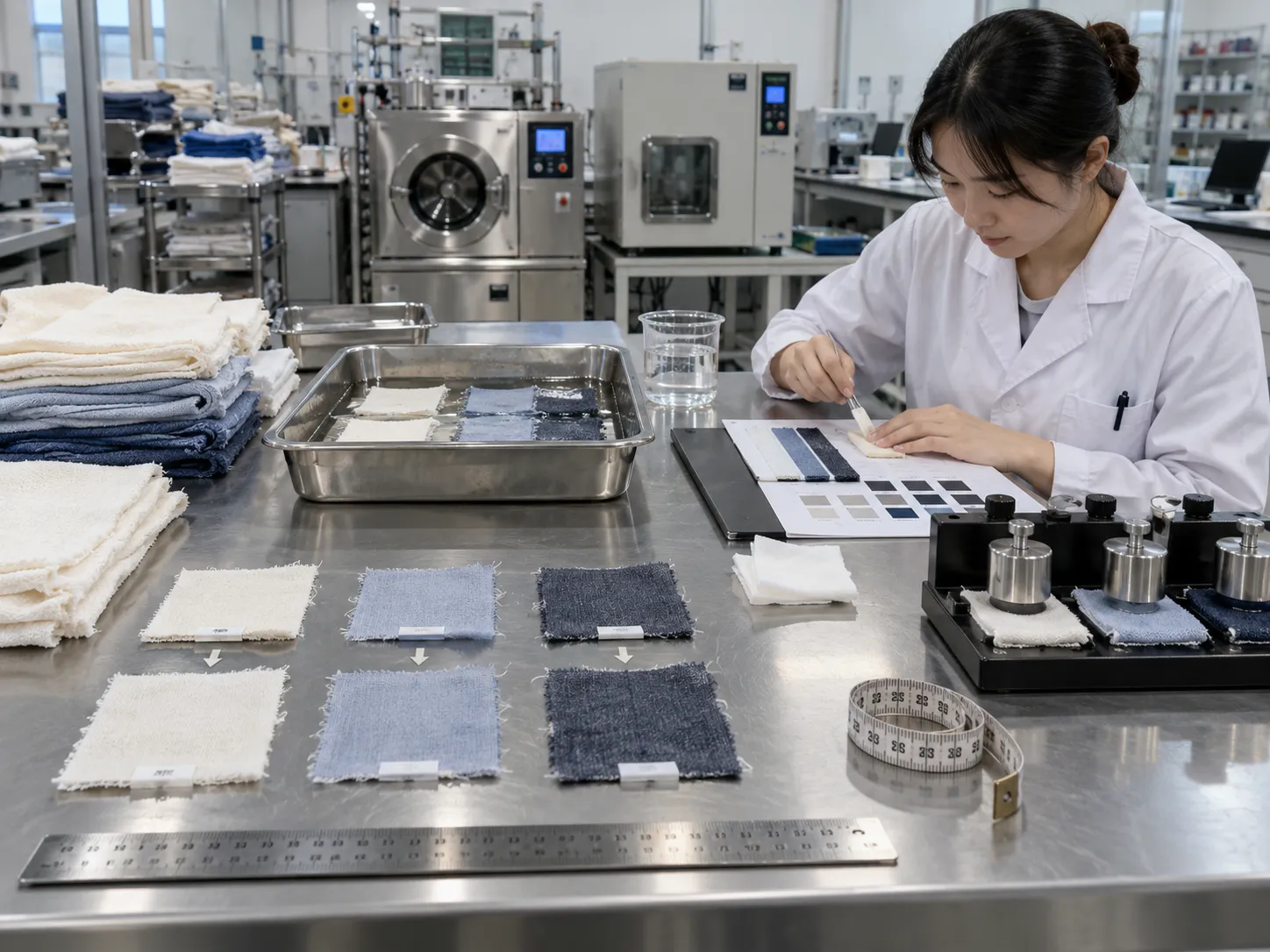
Cotton jersey shrinks because the loops relax, the yarn untwists and the finishing tensions release. Untreated cotton jersey can shrink well above the limits most brands accept; compacting and pre-shrinking reduce the residual shrinkage but do not eliminate it. Test with AATCC 135 or ISO 6330 using the care conditions on the label, and measure both warp (length) and weft (width) shrinkage. A common buyer limit is ≤3% after three washes, but the correct limit depends on the product and the test method.
Fabric Spirality and Side Seam Twisting
Spirality is the twist of the fabric after washing, which shows up as side seams that move toward the front or back. It comes from yarn twist, circular knitting rotation, dyeing tension and relaxation. Tubular knits and open-width knits can behave differently. Test with AATCC 179 or ISO 16322-2 and set a limit with the buyer — ≤5% is a common starting point, but some brands require ≤3%. Compacting and a balanced knitting tension help; a test on the finished garment is more meaningful than a test on a small swatch.
Pilling and Surface Fuzzing
Pilling occurs when loose fibers migrate to the surface and form small balls. Short fibers, low-twist yarn, loose loops and abrasion all increase the risk. Combed and compact yarns reduce it; bio-polishing can improve the surface further. Test with ISO 12945-2 (Martindale) or ASTM D4970 and agree a grade, commonly ≥3–4 after the specified number of cycles. Check the fabric after washing as well as before, because pilling often appears later.
Colorfastness and Shade Variation
Test colorfastness to washing (ISO 105-C06 or AATCC 61), rubbing (ISO 105-X12 or AATCC 8), light (ISO 105-B02 or AATCC 16.3) and, for childrenswear or activewear, perspiration (ISO 105-E04 or AATCC 15). A common requirement is grade ≥4 on the gray scale for washing and light, with a lower limit for rubbing. Shade variation is a separate issue: inspect under D65 lighting and agree a spectrophotometer tolerance (ΔE) for bulk versus the approved lab dip.
GSM and Finished Width Variation
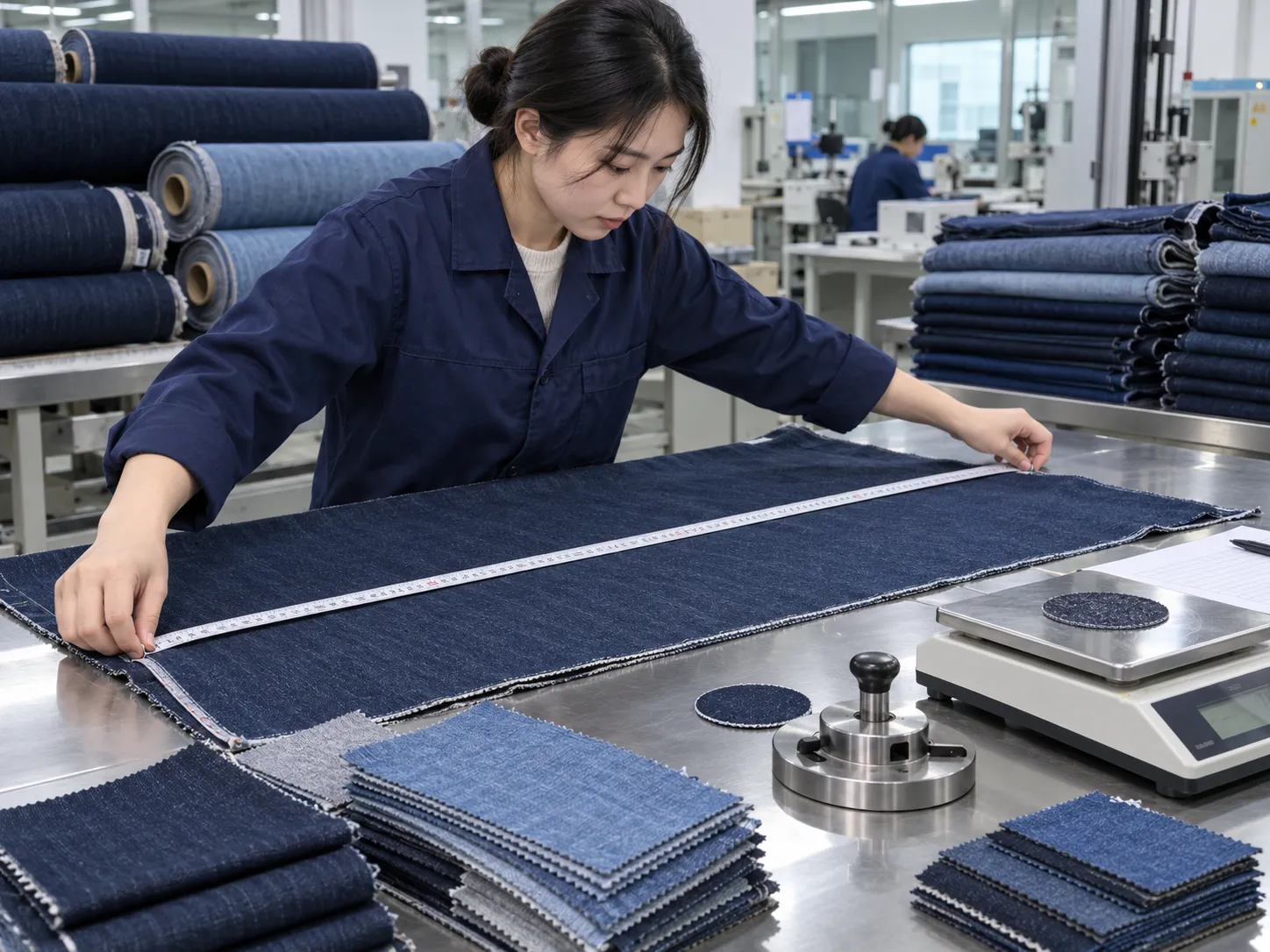
For cotton T-shirt fabric, measure GSM with ASTM D3776 or ISO 3801 on a conditioned, relaxed sample. Measure width with ASTM D3774 after relaxation, not on a stretched frame. A ±5% GSM tolerance and a −1/+2 cm width tolerance are common, but the right tolerance depends on the construction and the marker. Variation across the roll and from roll to roll matters as much as the average; ask for the measurement method and the sample points.
Bursting Strength and Fabric Stability
Bursting strength indicates how the knit resists pressure and abrasion in wear. Test with ASTM D3786 or ISO 13938-1. There is no universal pass number: a lightweight summer jersey and a 260 g/m² heavyweight jersey should not share the same limit. Set the requirement by end use and confirm it on the finished fabric, not on a laboratory swatch made from a different yarn lot.
| Quality problem | Main cause | Test method | Buyer requirement |
|---|---|---|---|
| Shrinkage | Loop relaxation, yarn twist, finishing tension | AATCC 135 / ISO 6330 | Buyer-specified, e.g. ≤3% after 3 washes |
| Spirality | Yarn torque, knitting rotation, dyeing tension | AATCC 179 / ISO 16322-2 | Buyer-specified, e.g. ≤5% |
| Pilling | Short fibers, loose loops, abrasion | ISO 12945-2 / ASTM D4970 | Grade ≥3–4 after agreed cycles |
| Colorfastness | Dye selection, rinsing, fiber and process | ISO 105-C06 / AATCC 61; rubbing and light as applicable | Grade ≥4 washing, agreed rubbing/light limits |
| Shade variation | Dye lot, water, pH, heat history | D65 light box; spectrophotometer ΔE | Agreed ΔE and visual pass/fail |
| GSM / width variation | Knitting, dyeing, stretching, compacting | ASTM D3776 / ISO 3801; ASTM D3774 | GSM ±5%, width −1/+2 cm (example) |
| Bursting strength | GSM, yarn strength, loop structure | ASTM D3786 / ISO 13938-1 | Set by end use and GSM |
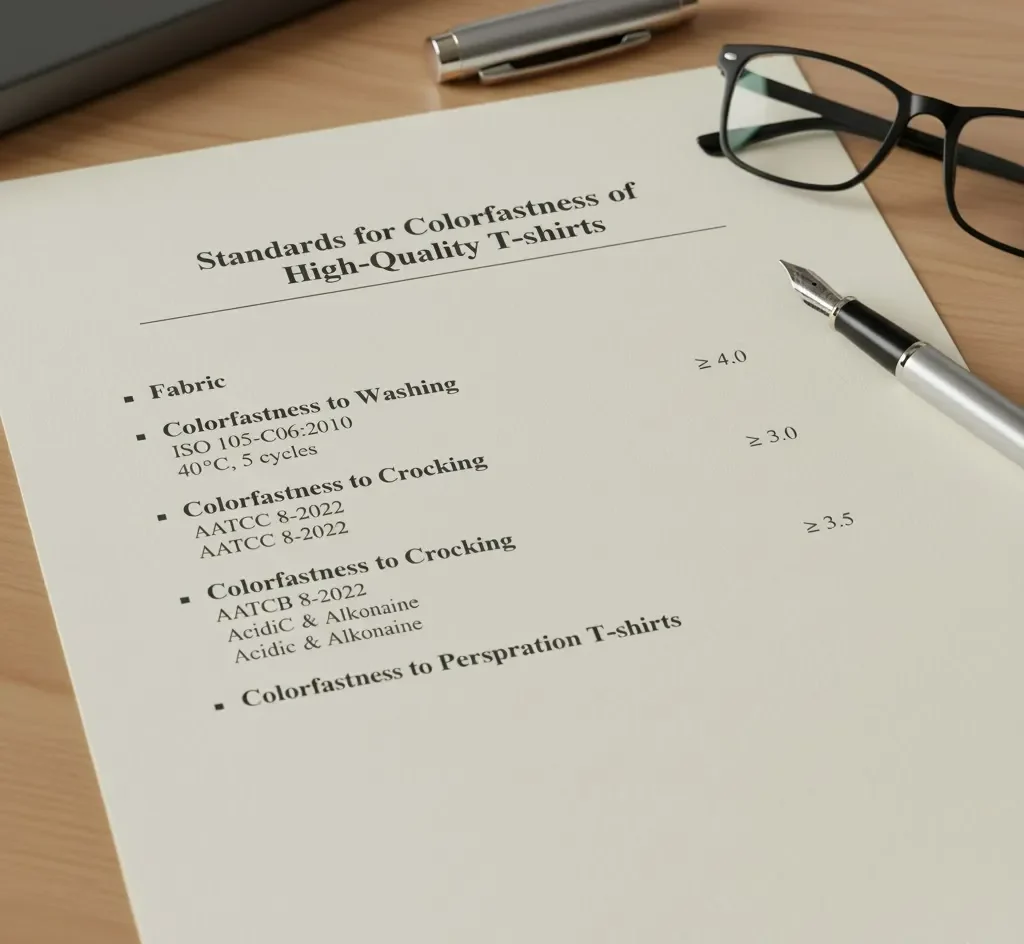
For fiber and yarn test methods, see Cotton Quality Tests. For the colorfastness standards behind these limits, see Colorfastness Test Standards.
How Do Dyeing and Finishing Affect Cotton T-Shirt Quality?
Direct answer: For cotton T-shirt fabric, dyeing and finishing decide the shade, shrinkage, surface smoothness, hand-feel and print performance of cotton T-shirt fabric. Reactive dyeing gives the best wash fastness for cotton; enzyme bio-polishing improves surface smoothness; compacting controls residual shrinkage; silicone softening changes the hand but can affect absorbency and print adhesion. Specify the finishing route, not just the color.
Reactive Dyeing for Cotton Jersey
For cotton T-shirt fabric, reactive dyes form covalent bonds with the cellulose in cotton, which gives excellent wash fastness when the dyeing is properly controlled. The process needs salt, alkali, controlled temperature and thorough rinsing. Poor rinsing leaves unfixed dye that can bleed or crock; poor shade matching shows up as lot-to-lot variation. For a T-shirt program, approve a lab dip and a bulk dye lot under D65 lighting, and specify the colorfastness tests in the PO.
Enzyme Washing and Bio-Polishing
Bio-polishing uses cellulase enzymes to remove protruding fibers and mild surface fuzz. The result is a smoother, cleaner surface with less pilling and a softer hand. The process must be controlled: too much enzyme action can reduce fabric strength and weight, and inconsistent conditions produce shade or hand variation between lots. Specify the target weight loss, strength retention and pilling grade, not just “bio-polished”.
Compacting and Pre-Shrinking Treatments
Compacting is a mechanical process that compresses the fabric lengthwise and allows the loops to relax before the fabric is set. It reduces residual shrinkage and improves dimensional stability. Tubular compactors and open-width compactors are not interchangeable; the choice depends on the fabric form. Compacting can increase GSM and reduce width and length, so the finished specifications must be measured after compacting, not before. It reduces shrinkage but does not guarantee zero shrinkage — test the finished fabric with the actual care conditions.
Silicone Softening and Fabric Hand Feel
Silicone softeners give cotton a smooth, lubricated hand that many retail buyers associate with premium quality. Amino silicone is soft and durable but can be hydrophobic; hydrophilic silicone keeps absorbency but may feel less slick. Over-softening can reduce seam strength, affect print adhesion and make the fabric feel slippery rather than soft. For print-heavy programs, confirm the softener compatibility with the print method.
How Finishing Affects Printing and Color Consistency
Printing performance depends on surface pH, absorbency, smoothness and heat history. A fabric with too much softener or a uneven surface can produce patchy ink coverage; a fabric with residual alkali can change the ink color. Heat setting before printing, controlled moisture and a consistent lot are more important than the printer’s settings alone. If the T-shirt is garment-dyed or washed after printing, test the full sequence, not the fabric and the print separately.
For the differences between reactive, vat and pigment dyeing, see Cotton Fabric Dyeing Methods.
How to Specify Cotton Fabric for Bulk T-Shirt Production
Direct answer: specify cotton T-shirt fabric in six steps: define the style and market, select the fiber and knit, confirm GSM/count/gauge, set finished width and tolerance, set shrinkage/spirality/colorfastness limits, and approve samples plus MOQ/lead time. For cotton T-shirt fabric, each step should end with a measurable acceptance standard that goes on the PO.
Step 1 — Define the T-Shirt Style and Target Market
Write down the style, target retail price, size range, print method, wash-care story and destination market. Those inputs decide whether you need 150 g/m² promotional jersey or 240 g/m² premium heavyweight. Add any certification requirement (OEKO-TEX Standard 100, GOTS, organic or recycled content) at this stage; it affects the fiber and the dyeing route. Acceptance standard: a one-page brief that the mill can quote against without guessing.
Step 2 — Select Fiber Composition and Knit Construction
Choose 100% cotton, a CVC/TC blend or a cotton-spandex blend, and choose single jersey, interlock, rib or piqué. Match the knit to the silhouette: single jersey for drape and printability, interlock for a stable premium body, rib for stretch, piqué for polos. Acceptance standard: the mill confirms it can produce the specified knit and composition at the target GSM and width.
Step 3 — Confirm GSM, Yarn Count and Knitting Gauge
Set the finished GSM with a tolerance, the yarn count and the knitting gauge. For example: 180 g/m² ±5%, 32s combed cotton, 24G single jersey. Ask for a knitted sample made with the production yarn and machine, then measure GSM, width and shrinkage after the full finishing route. Acceptance standard: the sample meets the GSM and hand-feel target, and the mill confirms the production machine and gauge.
Step 4 — Specify Finished Width and Width Tolerance
State whether the fabric is open width or tubular, the full width, the usable width and the tolerance after finishing. For example: 180 cm open width, 175 cm usable, −1/+2 cm. If the fabric is tubular, state the lay-flat width and the tube circumference separately. Acceptance standard: the measured usable width supports the approved marker, and the tolerance is written into the PO.
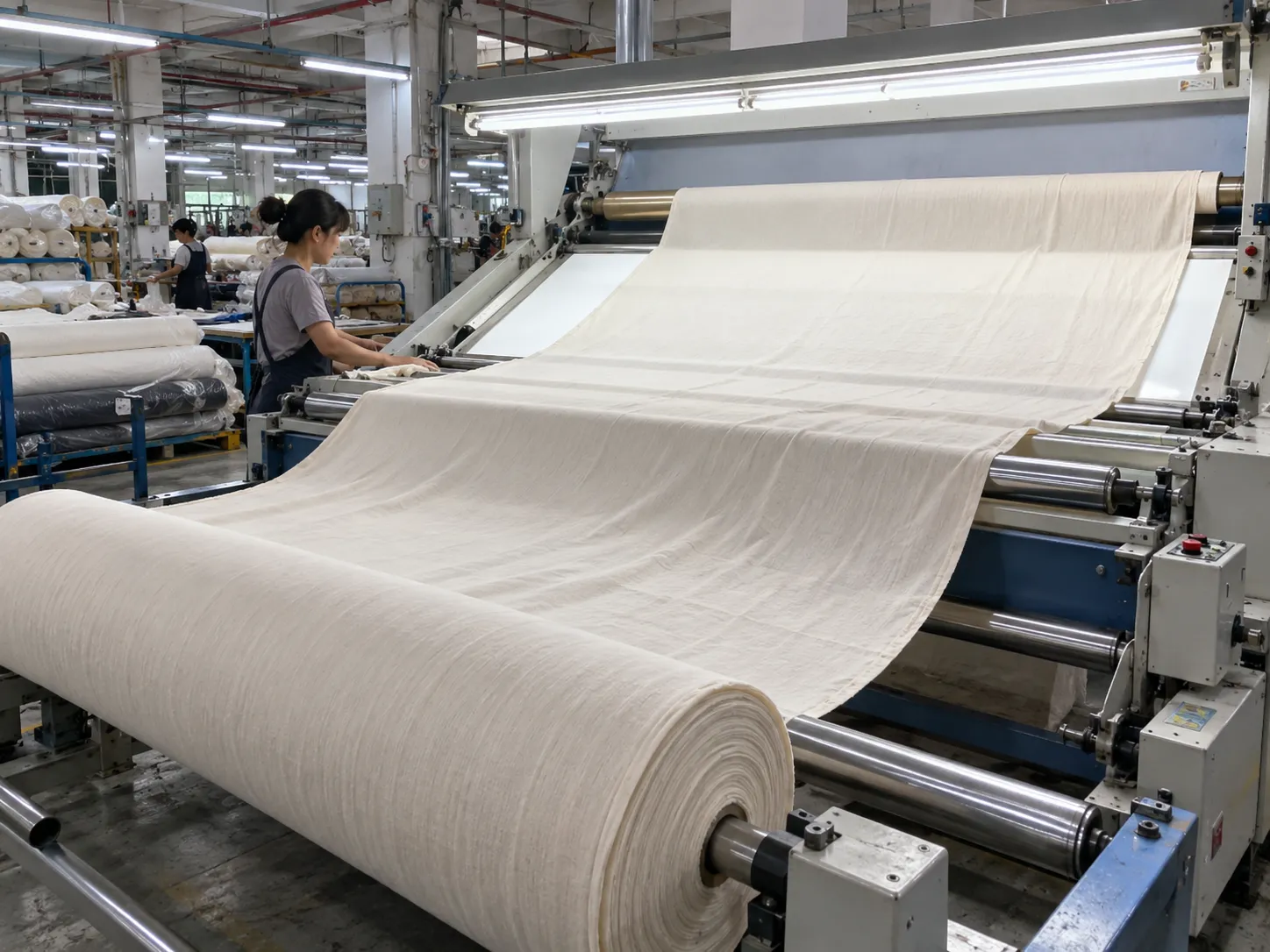
Step 5 — Set Shrinkage, Spirality and Colorfastness Requirements
Name the test method and the pass limit for each property. For example: shrinkage ≤3% warp and weft after three home washes (AATCC 135); spirality ≤5% (AATCC 179); colorfastness to washing grade ≥4 (ISO 105-C06). Do not write “good shrinkage” or “fast color”. Acceptance standard: a test report from a lab both parties accept, on the finished fabric, using the agreed method.
Step 6 — Approve Samples, MOQ, Lead Time and Bulk Quality Standards
Approve a lab dip, a production sample and a pre-production sample. Confirm the MOQ in kilograms per color, the lead time, the packing method and the bulk inspection standard. For fabric, agree the inspection system (for example, the four-point system), the acceptable defect rate, the roll length and the shade-lot policy. Acceptance standard: signed samples, a written PO and a clear bulk inspection plan before production starts.
| Specification | Example for buyer reference |
|---|---|
| Composition | 100% Cotton |
| Knit construction | Single Jersey |
| Yarn count | 32s Combed Cotton |
| Fabric weight | 180 GSM |
| Finished width | 180 cm Open Width |
| Shrinkage | Buyer-specified limit, e.g. ≤3% |
| Spirality | Buyer-specified limit |
| Colorfastness | Agreed test method and grade |
| Quantity | 1,000 kg |
| Finish | Compacted / Bio-polished |
This is an RFQ example for buyer reference, not a verified stock product. Not every knit structure can achieve all of these parameters at the same time. Shrinkage and spirality limits must be confirmed against the agreed test method, and the final specification should be approved on a production sample.
For the sourcing process around the specification, see the Cotton Fabric Sourcing Guide. To compare available cotton qualities, visit our cotton fabric wholesale page.
How to Choose a Reliable Cotton T-Shirt Fabric Supplier
Direct answer: For cotton T-shirt fabric, check four areas: knitting, dyeing and finishing capability; test reports and production samples; GSM, width, shrinkage and shade consistency; and MOQ, lead time and repeat-order quality. A supplier who can knit but cannot control compacting, shade matching and shrinkage will not deliver a consistent T-shirt fabric program.
Check Knitting, Dyeing and Finishing Capabilities
Ask which gauges the factory can knit, which yarn counts it routinely runs, and whether it has in-house dyeing and compacting. A mill that knits 24G single jersey but cannot compact it consistently will struggle with a ≤3% shrinkage requirement. Ask for the machine list, the daily capacity and the finishing route. If the supplier subcontracts dyeing or compacting, find out who controls the quality and who signs the test report.
Request Fabric Testing Reports and Production Samples
Ask for test reports on the actual construction you are buying, not a generic report from another fabric. The report should cover GSM, width, shrinkage, spirality, pilling and colorfastness with the test methods stated. Request a production sample from the same yarn lot and finishing line, and compare it with the approved lab dip and hand-feel standard. A lab sample made on a different machine is not proof of bulk performance.
Compare GSM, Width, Shrinkage and Shade Consistency
Compare measured values, not nominal values. Ask for the measurement method, the sample points and the tolerance. Check shade consistency across rolls and lots under D65 lighting, and ask how the supplier handles shade bands within a dye lot. A supplier who can show repeat-order data is more reliable than one who only shows a perfect first sample.
Confirm MOQ, Production Lead Time and Repeat-Order Quality
Confirm the MOQ in kilograms per color, the sampling lead time, the bulk lead time and the capacity available in your delivery window. Ask what happens when a repeat order is placed: will the supplier use the same yarn, dye lot and finishing route? Repeat-order consistency is the real test of a T-shirt fabric supplier. Put the approved sample, the test limits and the shade standard in the PO so the next order has a reference.
Cotton T-Shirt Fabric Supplier Evaluation Checklist
- ☐ Knitting gauge range and available yarn counts confirmed.
- ☐ In-house or controlled dyeing, compacting and bio-polishing route confirmed.
- ☐ Test report on the actual construction, with methods and results.
- ☐ Production sample from the same yarn lot and finishing line.
- ☐ GSM, width, shrinkage, spirality and pilling limits agreed.
- ☐ Shade consistency checked under D65 and ΔE tolerance agreed.
- ☐ MOQ per color, lead time and capacity confirmed in writing.
- ☐ Repeat-order policy, packing and inspection standard confirmed.
Request Cotton T-Shirt Fabric Samples and Bulk Pricing
Send us the T-shirt style, target GSM, yarn count, width, composition, quantity and required test limits, together with your cotton T-shirt fabric requirements. We will match the construction, send a production sample and quote bulk pricing against the approved specification.
- Available Cotton Jersey and Cotton Blend Fabrics: single jersey, interlock, rib, piqué and cotton-spandex qualities.
- Custom GSM, Yarn Count and Width Options: 120–280 g/m², 20s–40s, 150–190 cm open width, with tubular options.
- Sample Development and Quality Verification: lab dip, hand-feel standard and test report against the agreed methods.
- Bulk Quotation and Production Support: MOQ, lead time, packing and inspection plan confirmed before production.
Ready to match a cotton T-shirt fabric to your T-shirt program? Send your style brief and target specification. Free samples ship in 3–5 days; bulk production is typically 20–35 days after sample approval.
Cotton fabric wholesale · Request a quote · Why buyers order from us
Frequently Asked Questions About Cotton T-Shirt Fabric
What is the best cotton fabric for premium T-shirts?
For premium cotton T-shirt fabric, use 100% combed compact cotton single jersey or interlock at 180–220 g/m², 30s–40s, 170–180 cm open width. This gives a smooth surface, a clean neckline, good opacity and better shape retention. Confirm shrinkage ≤3%, pilling grade ≥4 and shade consistency under D65 before bulk.
Is 180 GSM good for cotton T-shirts?
Yes. 180 g/m² is a versatile weight for cotton T-shirt fabric and suits everyday and premium retail tees. It is opaque in most colors, holds a clean shape and still feels comfortable in warm weather. For white and light colors, check opacity on the actual fabric; you may need 190–200 g/m² or a denser knit.
Is 200 GSM too heavy for summer T-shirts?
Not necessarily. 200 g/m² is a midweight cotton T-shirt fabric and can be comfortable in summer if the knit is open and the yarn is combed. Breathability depends on loop structure, fiber and finishing, not GSM alone. A 200 g/m² compact jersey may feel cooler than a dense 170 g/m² fabric with a tight loop.
What is the best yarn count for cotton T-shirts?
26s–32s is the best all-round range for everyday cotton T-shirts. Use 30s–40s for a softer premium hand, 20s–24s for heavyweight and oversized styles, and 40s+ for lightweight premium jersey. The count must be matched to the knitting gauge and target GSM.
Is combed cotton better than regular cotton for T-shirts?
For premium T-shirts, yes. Combing removes short fibers, so the yarn is smoother, stronger and less prone to pilling. Carded cotton can be perfectly acceptable for promotional and economy tees, provided the pilling and shrinkage limits are met. Combed compact yarn gives the best surface.
What is the difference between open-width and tubular T-shirt fabric?
Open-width fabric is knitted as a tube, slit open and finished flat; its width is measured selvedge to selvedge. Tubular fabric stays as a tube and is measured by lay-flat width, which is half the tube circumference. A 75 cm lay-flat tube is about 150 cm in circumference, but that is not the same as a 150 cm finished open width. Ask for the finished usable width after slitting and relaxation.
What width is commonly used for cotton T-shirt fabric?
160–180 cm open width is the most common range for cotton T-shirt fabric. 150 cm is used for basic and smaller-size programs, 180–190 cm for oversized and plus-size tees, and 60–80 cm tubular lay-flat width for basic seamless tees. Always confirm the finished usable width and tolerance.
Is 100% cotton or cotton-polyester better for T-shirts?
For cotton T-shirt fabric, 100% cotton is better for natural hand-feel, breathability and premium retail positioning. Cotton-polyester blends are better for lower cost, shape retention and faster drying. Cotton-spandex is better for stretch and recovery. Choose by product promise and wash care, not by a universal ranking.
Why do cotton T-shirt side seams twist after washing?
Side-seam twisting is spirality, caused by yarn twist, circular knitting rotation, dyeing tension and relaxation during washing. Test with AATCC 179 or ISO 16322-2 and set a buyer limit, commonly ≤5% but sometimes ≤3%. Compacting and balanced knitting tension reduce it, but the finished garment should be tested, not just a small swatch.
What specifications should buyers send to a cotton T-shirt fabric supplier?
For cotton T-shirt fabric, send the composition, knit construction, yarn count, finished GSM, finished width (open or tubular, full and usable), shrinkage and spirality limits with test methods, colorfastness requirements, finish, quantity, certifications and target lead time. Add the T-shirt style, size range and print method so the supplier can recommend the right construction instead of quoting a generic jersey.
Still comparing constructions? Send us the style, target GSM, quantity and cotton T-shirt fabric requirements. We will recommend a knit, yarn count and width, then send a sample with measured GSM, width, shrinkage and spirality for your approval.
Specification ranges in this guide are sourcing references, not guarantees. Final composition, GSM, width, shrinkage, spirality and colorfastness must be confirmed by a production sample and test report for the specific construction and finishing route.