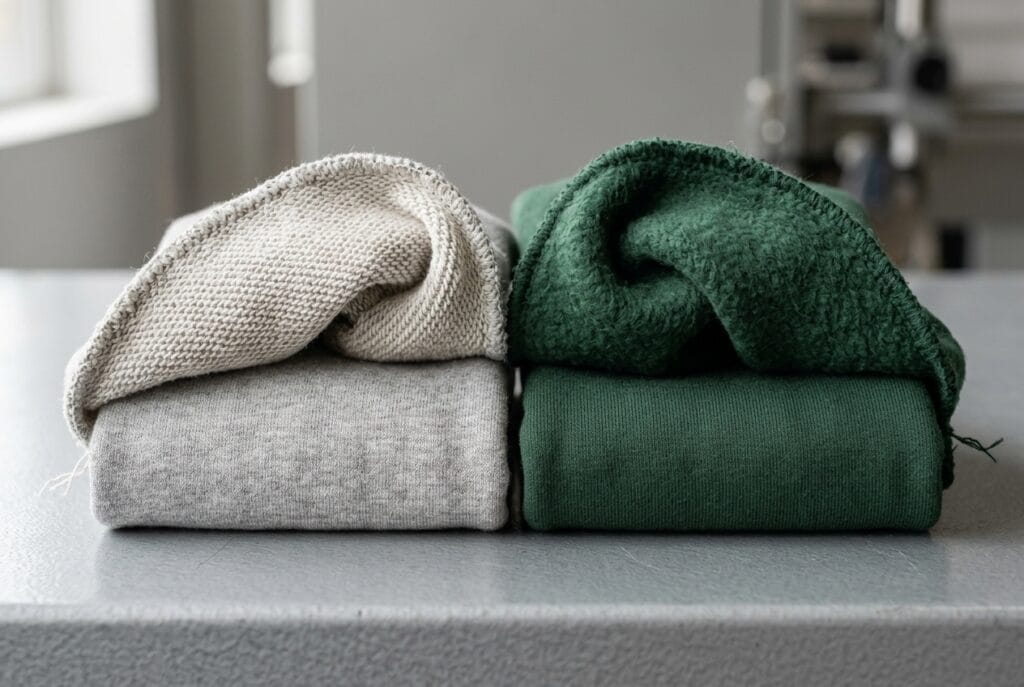

Short answer: for most everyday hoodies and crewnecks, the best cotton sweatshirt fabric is 300–360 g/m² 3-end French terry or 3-end brushed fleece, knitted with a 30s–32s combed cotton face yarn, a 30s–32s cotton (or 75D–100D polyester) binder yarn, and a 10s–16s loop/pile back yarn at 175–185 cm open width. Choose 240–300 g/m² French terry (165–180 cm open width) for spring layering and athleisure, 380–460 g/m² 100% cotton 3-end fleece or loopback (180–195 cm open width) for boxy oversized streetwear, and 80/20 cotton-polyester (CVC) 3-end fleece when low shrinkage and loft retention matter. Confirm finished GSM after brushing and compacting, usable cuttable width, inner shedding resistance, and matching 380–480 g/m² 1×1 or 2×2 rib trim (ordered at 12–15% of body fabric weight) on a production sample before placing your bulk order.
Cotton hoodie fabric starts where heavyweight T-shirt jersey stops. While cotton T-shirt fabric uses a single yarn feed to knit 150–280 g/m² single jersey, a hoodie or sweatshirt requires a multi-yarn loop or brushed pile construction at 240–480 g/m² to hold a hood shape, support a kangaroo pocket and insulate the body. Two fabrics can both be labeled “100% cotton 350 GSM fleece”, yet one sheds lint onto every undershirt and shrinks 7% lengthwise while the other stays clean, flat and true to size after ten washes.
This buyer’s guide turns a garment design brief into a mill-ready hoodie fabric specification. It covers French terry versus brushed fleece, 2-end versus 3-end knitting, GSM tiers, multi-yarn count recipes (face, binder and loop/pile), fiber blends, 165–195 cm open-width marker math, matching rib trim ratios, quality tests and a copy-ready PO template. For the broader 14-garment reference chart, see cotton fabric specifications by application; for loop fundamentals, see our guide to knitted cotton fabric; for weight and count theory, see fabric weight and yarn count explained.
What Is the Best Cotton Fabric for Hoodies and Sweatshirts?
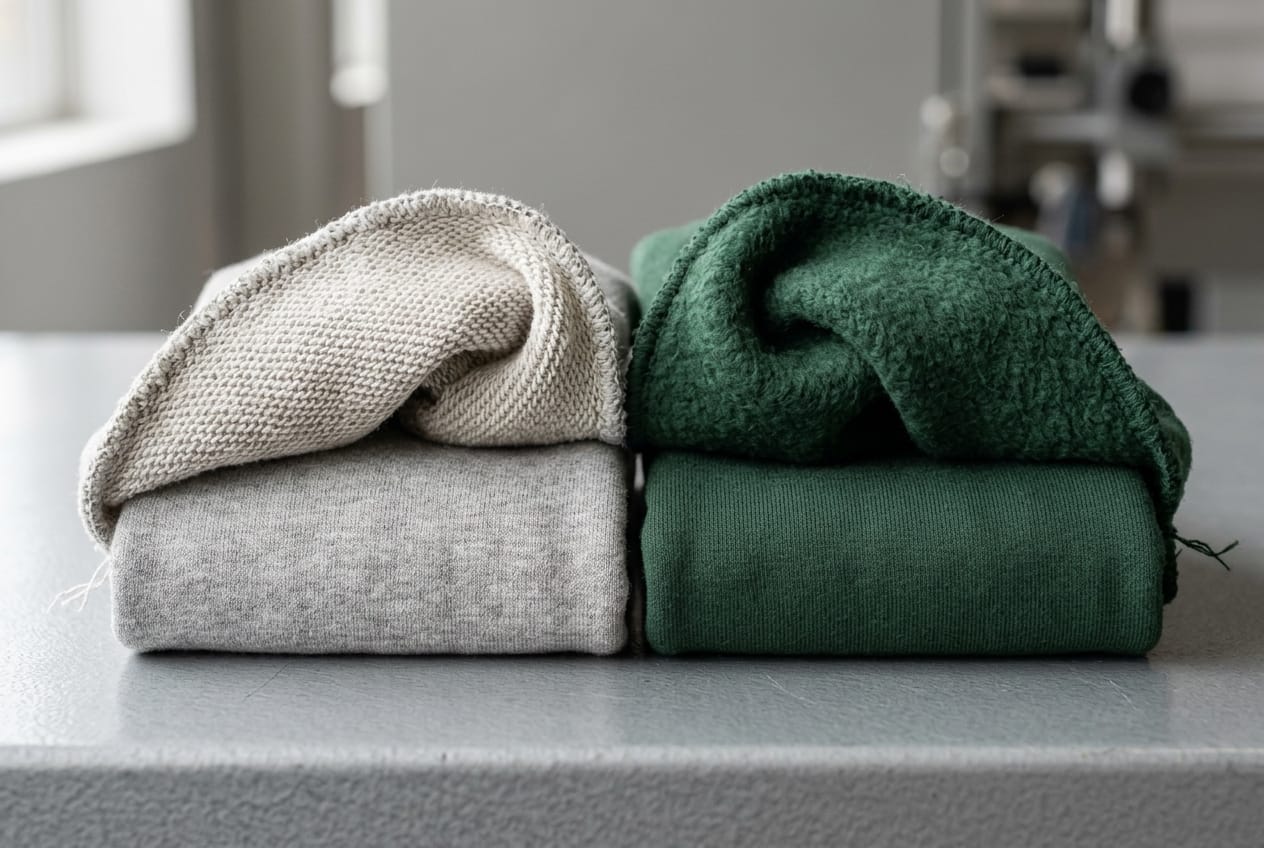
Direct answer: 300–360 g/m² 3-end French terry (for year-round, structured hoodies) and 320–380 g/m² 3-end brushed fleece (for warm autumn/winter hoodies) at 175–185 cm open width are the best all-round cotton hoodie fabrics. They combine a smooth 30s–32s combed cotton outer print surface with a substantial 10s–16s interior loop or nap. Move to 380–460 g/m² with a 21s or 16s face yarn at 185–195 cm open width for boxy streetwear silhouettes.
There is no single “best” hoodie fabric without knowing the climate, silhouette and wash route. A 440 g/m² brushed fleece that makes a standout $120 winter streetwear hoodie will feel suffocating in a spring athleisure line and too expensive for a $25 promotional crewneck. The right specification balances outer hand-feel, interior loft, hood structure, shrinkage stability and yield per ton.
Why French Terry and 3-End Fleece Are the Two Industry Standards
In our cotton T-shirt fabric guide, we showed that single jersey tops out around 240–280 g/m² using coarse 20s or 16s yarn. Trying to push single jersey to 350 g/m² requires yarn so thick that the fabric becomes stiff, rough and prone to severe side-seam twisting (spirality).
Hoodie and sweatshirt fabrics solve this by knitting two or three separate yarn feeds simultaneously on a circular knitting machine equipped with sinker loops:
- A fine face yarn stays on the outside to give a smooth, dense jersey appearance suitable for screen printing, DTG and embroidery.
- A heavy loop or pile yarn sits on the inside to build weight (240–480 g/m²), thickness and warmth without roughening the outer face.
- A middle binder (tie-in) yarn (in 3-end constructions) locks the face and back together so the inner loops cannot pull through to the front or shed during brushing.
When the interior loops are left uncut, the fabric is French terry (loopback). When those loops are mechanically brushed and sheared into a soft fibrous nap, the fabric becomes brushed sweatshirt fleece.
When to Choose 100% Cotton vs Cotton-Polyester (CVC) for Hoodies
Choose 100% cotton when the brand story demands a natural, dry-hand streetwear drape, high breathability, or post-sewing wet processing such as garment dyeing, pigment washing, enzyme stone washing or acid washing. Because every yarn feed (face, binder and loop) is cellulose, the entire fabric absorbs reactive or pigment dye uniformly. The trade-off is higher raw material cost, heavier wet weight and higher natural shrinkage (which must be controlled via open-width compacting).
Choose a cotton-rich CVC blend (typically 80/20 or 70/30 cotton/polyester) when you want a 100% cotton outer hand-feel combined with lower shrinkage, better loft retention and lower cost. In a properly engineered 80/20 3-end fleece, the outer face yarn and inner pile yarn are still 100% cotton, while the 20% polyester is hidden entirely in the middle binder yarn. The wearer and the printer only touch cotton, while the internal polyester grid holds dimensional shrinkage under 3%.
Recommended Cotton Fabrics for Different Hoodie Styles
For lightweight transitional hoodies, use 2-end or 3-end French terry at 240–280 g/m² with 32s+16s yarn. For everyday retail pullovers and crewnecks, use 300–360 g/m² 3-end French terry or brushed fleece with 32s+32s+10s (or 32s+75D+10s CVC) at 175–185 cm open width. For structured streetwear hoodies, use 380–460 g/m² 100% cotton 3-end loopback or fleece with 21s+21s+10s or 16s+32s+10s yarn at 185–195 cm open width. For fitted athletic zip-ups, use 260–320 g/m² 95/5 cotton-spandex French terry.
| Hoodie application | Recommended knit construction | Finished GSM | Yarn recipe (Face / Binder / Back) | Finished open width | Why it works |
|---|---|---|---|---|---|
| Lightweight / spring hoodie | 2-end or 3-end French terry | 240–280 | 32s + 16s (or 32s + 32s + 16s) | 165–180 cm | Breathable loopback; bridges directly from 240 GSM heavyweight tees |
| Everyday retail hoodie & crewneck | 3-end French terry or 3-end brushed fleece | 300–360 | 32s + 32s + 10s (or 32s + 75D + 10s CVC) | 175–185 cm | Smooth print surface, clean hood drape, balanced warmth and cost |
| Heavyweight / boxy streetwear | 100% cotton 3-end fleece or heavy loopback | 380–450 | 21s + 21s + 10s (or 16s + 32s + 10s) | 185–195 cm | Self-supporting hood, structured boxy fit, wide marker nesting |
| Ultra-heavy luxury drop | 100% cotton 3-end heavy loopback / fleece | 450–500+ | 16s + 21s + 8s (or 10s) | 185–195 cm | Maximum structure and winter warmth; requires heavy-duty sewing |
| Athletic / fitted zip-up hoodie | Stretch French terry or double-face interlock | 260–320 | 32s + 16s + 40D spandex | 170–180 cm | Four-way recovery, smooth inner face, low vertical zipper shrinkage |
| Promotional / uniform hoodie | 3-end CVC (60/40) or TC (65/35) brushed fleece | 280–330 | 30s TC + 100D poly + 12s TC | 175–185 cm | Low shrinkage, fast drying, high abrasion durability and lower cost |
The cotton hoodie fabric recommendations above are commercial starting points. Confirm finished GSM after brushing and compacting, usable cuttable width, and shrinkage on a bulk-production sample before cutting.
French Terry vs Brushed Fleece: What Types of Knit Structures Are Used for Hoodies?
Direct answer: four core body structures and one trim structure cover commercial cotton hoodie production: 3-end French terry (loopback) for structured year-round hoodies, 3-end brushed fleece for warm winter hoodies, 2-end French terry for lighter or stretch styles, heavy double-knit interlock/spacer for modern technical hoodies, and 380–500 g/m² 1×1 or 2×2 rib knit for matching cuffs, waistbands and side panels.
The knit architecture determines how warm the hoodie feels at a given GSM, whether the interior sheds lint onto a white T-shirt, and how the hood stands up around the neck. For a comparison between woven brushed shirtings and knitted sweatshirt pile, see flannel vs fleece.
French Terry (Loopback) for Year-Round and Structured Streetwear Hoodies
French terry has a smooth single-jersey outer face and neat, uncut semicircular loops (often called “fish-scale loops” or loopback) on the inside. Because the loops remain intact, air circulates easily and moisture wicks away from the skin. French terry feels cooler and drier than brushed fleece at the exact same GSM, drapes with a sharper architectural line, and does not shed inner fuzz. It is the preferred choice for spring/autumn hoodies, vintage garment-dyed sweatshirts, and luxury streetwear brands that want a heavy 380–440 g/m² garment customers can wear indoors without overheating.
3-End Brushed Fleece for Warmth and Plush Loft
3-end brushed fleece starts on the circular knitting machine as a 3-yarn loopback structure, then passes through mechanical napping rollers covered in fine wire teeth. The rollers tease and break the interior cotton loops into a dense, lofty pile, followed by a rotary shearing blade that trims the pile to a uniform height. That trapped air layer makes a 350 g/m² brushed fleece feel 30–50% thicker and significantly warmer than a 350 g/m² French terry. It is the classic construction for autumn/winter pullovers, campus sweatshirts and cold-weather streetwear.
2-End vs 3-End Construction: Why the Binder Yarn Matters
In mill terminology, “ends” refer to the number of yarn feeds knitted into each stitch course:
- 2-End Construction (Face Yarn + Loop Yarn): Uses two yarns. The back loop yarn is tucked directly into the face jersey stitch. In unbrushed French terry (especially 240–300 g/m² or spandex-blended terry), 2-end construction works well and offers good horizontal stretch. However, if you brush a 2-end fabric into fleece, the wire rollers tear the structural loops holding the fabric together. The result is a weak, unstable fleece that sheds heavily onto the wearer’s undershirt and shows brushing marks through the front face.
- 3-End Construction (Face Yarn + Binder Yarn + Loop/Pile Yarn): Adds a third middle yarn—the binder (tie-in) yarn—between the face and the back pile. The binder yarn forms a tight barrier that locks the heavy back loops in place while isolating the front face. When the back is brushed, the wire teeth only nap the exposed pile yarn without disturbing the face stitches.
Matching 1×1 and 2×2 Rib Knit for Cuffs, Waistbands and Necklines
A hoodie specification is incomplete without its matching rib trim. Unlike a T-shirt (where a narrow neckband uses only 4–6% of total fabric weight), a hoodie uses wide double-folded rib on the cuffs, the bottom waistband, the neckline, and sometimes side gussets—consuming 12% to 18% of the total order weight.
- Structure: 2×2 rib (two face wales alternating with two reverse wales) is thicker, chunkier and has higher elastic recovery, making it the standard for 340–460 g/m² hoodies. 1×1 rib has a finer, flatter rib appearance suited to 240–340 g/m² crewnecks and zip hoodies.
- Composition: Always specify 95% combed cotton / 5% spandex (or 97/3) for hoodie rib. A 100% cotton rib without elastane will flare out at the wrists and waist after a week of wear.
- GSM Rule: Hoodie rib GSM should be 1.15× to 1.3× the body fabric GSM. Pair a 300 g/m² body with 360–400 g/m² rib; pair a 360–420 g/m² body with 440–500 g/m² rib.
| Knit type | Yarn feeds | Interior surface | Typical GSM | Warmth & loft | Inner shedding risk | Best application |
|---|---|---|---|---|---|---|
| 2-End French terry | 2 (Face + Loop) | Uncut loops; lighter & stretchy | 220–300 | Light, breathable | Very low | Spring hoodies, stretch athleisure, loungewear |
| 3-End French terry | 3 (Face + Binder + Loop) | Dense, uniform uncut fish-scale loops | 300–450 | Medium, structured drape | Very low | Year-round retail hoodies, garment-dyed streetwear |
| 3-End brushed fleece | 3 (Face + Binder + Pile) | Plush, sheared fibrous nap | 300–480 | High warmth, thick caliper | Low (when sheared & dedusted) | Autumn/winter hoodies, boxy streetwear, crewnecks |
| 2-End brushed fleece | 2 (Face + Pile) | Loose brushed fuzz | 240–320 | Medium | High (avoid for retail) | Low-cost promotional giveaways only |
| Double-face interlock / spacer | 2–3 (Two needle beds) | Smooth jersey on both sides | 280–380 | Smooth, modern technical feel | None | Tech-wear hoodies, sleek travel zip-ups |
| Matching 1×1 or 2×2 rib | 1–2 + Spandex | Vertical ribbed wales on both sides | 360–500 | High stretch & wrist recovery | None | Hoodie cuffs, waistbands, crew necklines, side panels |
What GSM Is Best for Cotton Hoodies and Sweatshirts?
Direct answer: 300–360 g/m² is the best all-round GSM for everyday retail hoodies and crewnecks. Use 240–280 g/m² French terry for lightweight spring and layering hoodies, 360–420 g/m² for premium structured streetwear, and 420–500 g/m² for ultra-heavy boxy winter silhouettes. Always specify finished GSM after brushing and compacting, not greige weight.
In our cotton fabric specifications table, cotton T-shirts span 150–220 g/m² (extending to 280 g/m² for heavyweight tees) and hoodies span 240–450+ g/m². That 240–280 g/m² overlap is where the two categories meet—and where buyers must understand how structure changes weight perception.
240–280 GSM: Lightweight & Spring/Summer Transitional Hoodies
At 240–280 g/m², a French terry hoodie weighs roughly the same per square meter as a heavyweight oversized T-shirt, yet it behaves differently. Because the mass is split between a fine 32s outer face and a 16s loopback interior, 260 g/m² French terry is softer, more absorbent and less stiff than a 260 g/m² 20s single jersey. It is ideal for warm-weather coastal hoodies, gym warm-ups, zip-up layering pieces and women’s lounge sets. Its limitation is hood structure: a single-layer 260 g/m² hood will drape flat on the shoulders, so always specify a self-fabric double-lined hood in this weight tier.
300–360 GSM: Everyday Retail Hoodies and Crewnecks
This is the commercial backbone of the sweatshirt market (roughly 9–10.6 oz/yd²). At 320–350 g/m², a 3-end French terry or 3-end brushed fleece has enough body to hold a clean silhouette and a full kangaroo pocket without feeling stiff or overly hot indoors. An adult Large hoodie in 340 g/m² fabric weighs about 600–680 grams finished—substantial in the customer’s hand on a retail hanger, manageable in domestic washing machines, and cost-effective to ship by air or sea.
380–450+ GSM: Heavyweight, Boxy and Oversized Streetwear Hoodies
Above 380 g/m² (11.2–14+ oz/yd²), the fabric enters true heavyweight streetwear territory. Knitted with a 21s or 16s face yarn and a 10s or 8s back yarn, 400–460 g/m² fleece or loopback stands away from the body, hides underlayers completely, and supports a sculptural, three-dimensional hood that stays upright without a drawstring.
If you specify 420–480 g/m², warn your cut-and-sew factory early: two layers of 450 g/m² fleece in a double-lined hood equal 900 g/m² at the collar seam, which can pull the front neckline backward unless the pattern maker adjusts the neck drop. Overlock and flatlock machines also need heavier ballpoint needles (metric 90/14 to 100/16) so thick kangaroo-pocket corners do not skip stitches.
Why 350 GSM Fleece Feels Thicker Than 350 GSM French Terry
Buyers often hold a 350 g/m² French terry swatch next to a 350 g/m² brushed fleece swatch and assume the fleece is 420 g/m². GSM measures mass per square meter, not caliper (thickness in millimeters). When a 3-end fabric goes through the napping rollers, the wire teeth pull fibers out of the compact yarn twist and fluff them into a 2.5–3.5 mm lofty pile. The fabric traps air and feels much thicker and warmer in the hand—even though the laboratory scale reads the exact same 350 grams per square meter.
How GSM Affects Yield per Ton (Kilograms to Meters Math)
Like T-shirt jersey, circular-knitted hoodie fabric is dyed, quoted and sold by the kilogram (kg). As GSM rises, the linear meters you get out of a 1,000 kg (1-ton) dye lot drop sharply: Weight per linear meter (g) = GSM × Full width (m). Look at how yield changes across the four hoodie GSM tiers at a standard 185 cm (1.85 m) finished open width:
| GSM band | Weight per linear meter (at 185 cm width) | Linear meters per 1,000 kg | Typical adult hoodies per 1,000 kg (incl. 15% rib) | Best garment positioning |
|---|---|---|---|---|
| 260 g/m² (Lightweight terry) | 481 g/m | ~2,079 m | ~1,300–1,450 pcs | Spring zip-ups, athleisure, layering |
| 340 g/m² (Everyday retail) | 629 g/m | ~1,589 m | ~1,000–1,120 pcs | Core DTC pullovers, crewnecks, merch |
| 400 g/m² (Heavy streetwear) | 740 g/m | ~1,351 m | ~820–920 pcs | Oversized drop-shoulder streetwear hoodies |
| 460 g/m² (Ultra-heavy boxy) | 851 g/m | ~1,175 m | ~700–780 pcs | Winter luxury drops, structured boxy fits |
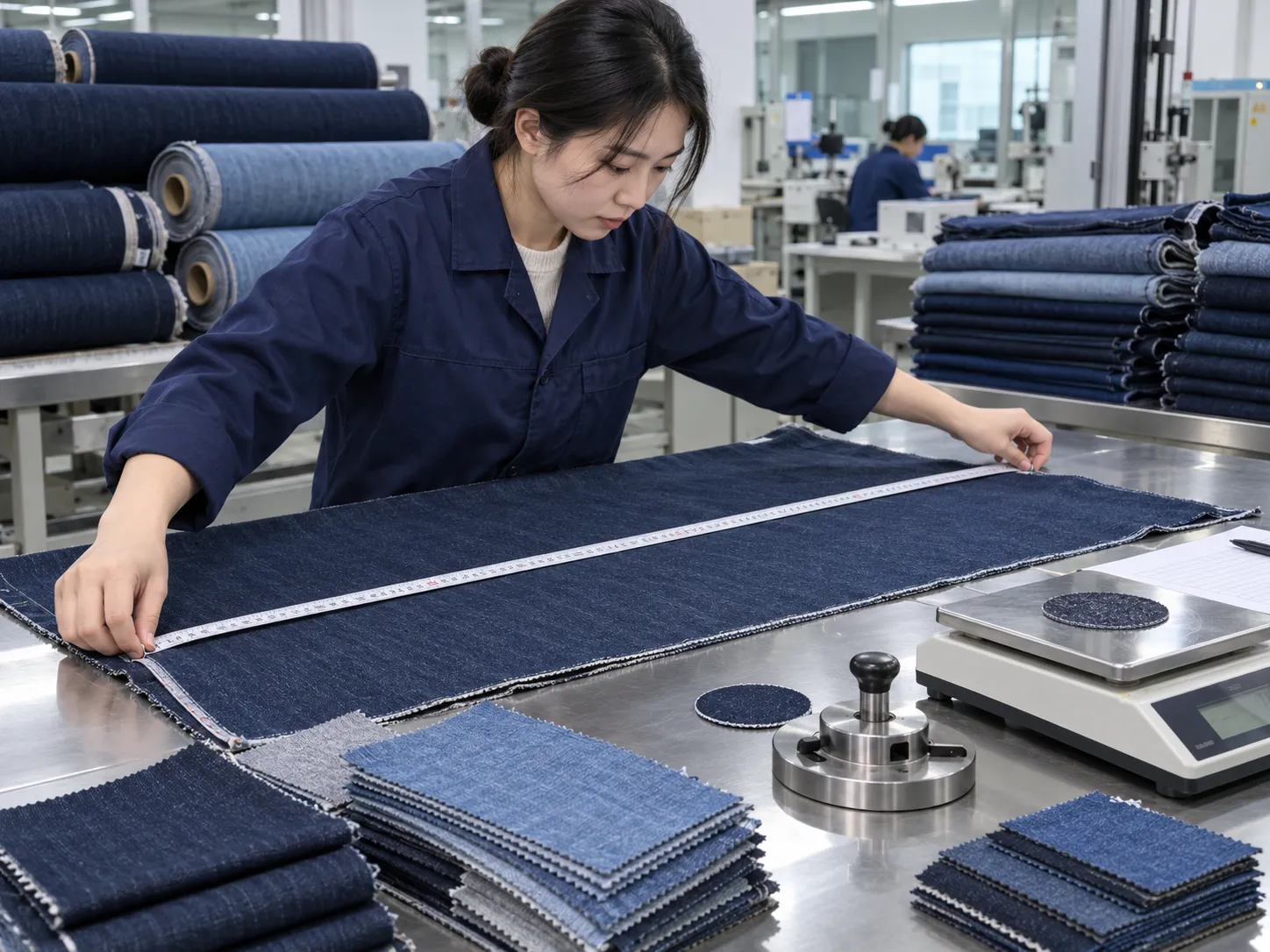
Brushing removes fiber. When greige 3-end loopback passes through the napping and rotary shearing machines, 5% to 8% of the fiber mass is brushed off as lint, while lengthwise tension stretches the roll. Compacting then compresses the fabric back up in weight. Always specify “finished, relaxed GSM after brushing, shearing and compacting (±5%)” tested under ASTM D3776 or ISO 3801—never buy on pre-brushed greige weight.
For conversion between g/m² and oz/yd², and for the standard test method, see Fabric Weight (GSM) Explained. As a quick reference, 1 oz/yd² is about 33.9 g/m².
What Yarn Count Combination Is Best for Cotton Hoodie Fabric?
Direct answer: specify a three-number yarn recipe (Face Yarn + Binder Yarn + Loop/Pile Yarn), not a single yarn count. The commercial benchmark for 320–360 g/m² retail hoodies is 32s combed cotton face + 32s cotton (or 75D–100D polyester) binder + 10s cotton loop/pile on a 20G circular machine. Move to a 21s or 16s face + 21s/32s binder + 10s/8s back on a 16G–18G machine for 380–460 g/m² dry-hand streetwear hoodies.
The single most common mistake we see on hoodie tech packs is writing “100% cotton 360 GSM fleece, 30s yarn”. A single 30s yarn cannot make a 360 g/m² sweatshirt fabric. In a multi-feed sweatshirt knit, each yarn layer has a distinct job and a different English cotton count (Ne).
Face Yarn, Binder Yarn and Loop/Pile Yarn Explained
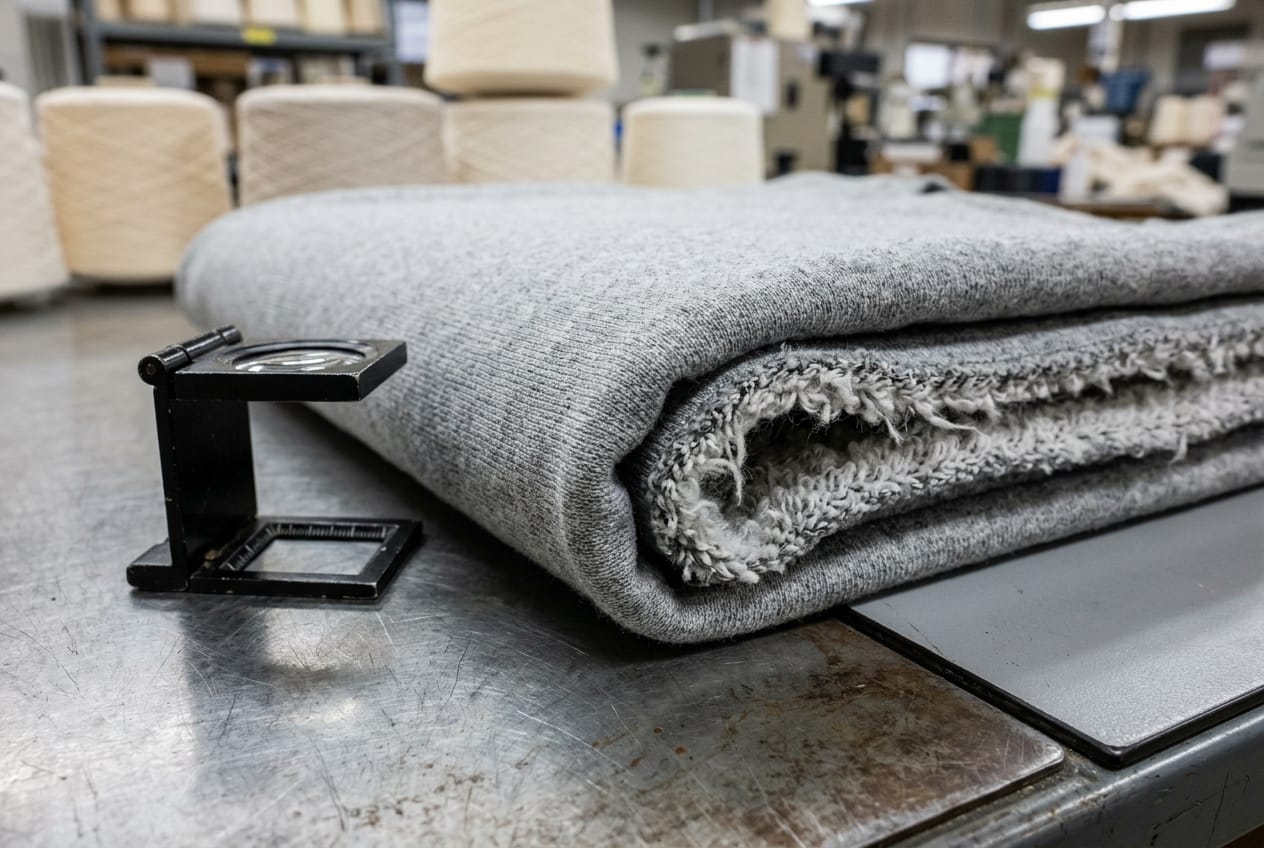
- Face Yarn (Outer Surface — typically 20s to 40s Ne): Forms the visible outer jersey stitches and determines smoothness, pilling resistance and print definition. 30s–32s combed cotton is the gold standard for clean screen printing, DTG and retail softness; 20s–21s or 16s cotton gives a denser, drier vintage hand favored by heavyweight streetwear brands.
- Binder / Tie-In Yarn (Middle Layer — typically 30s–40s cotton or 75D–100D polyester filament): Connects the face stitches to the heavy back loops in 3-end constructions. It must be fine and strong so it locks the structure without showing bumps on the front face.
- Loop / Pile Yarn (Interior Back — typically 8s, 10s, 12s or 16s Ne): A thick, low-twist yarn that forms the fish-scale loops in French terry or gets brushed open in fleece. Because English cotton count (Ne) is an indirect measure, a lower number means a thicker yarn: a 10s yarn is three times heavier per linear meter than a 30s yarn, providing the bulk of the fabric’s GSM and loft.
Common Mill Combinations (32s+10s, 32s+32s+10s, 21s+21s+10s, 16s+10s)
Instead of guessing, use the mill-proven recipes below when briefing your supplier:
| Target finished GSM | Knit structure | Face yarn (Outer) | Binder yarn (Middle) | Loop / Pile yarn (Back) | Circular gauge | Surface character & best use |
|---|---|---|---|---|---|---|
| 240–270 g/m² | 2-end French terry | 32s combed | — (None) | 16s combed/carded | 22G–24G | Smooth, fine, breathable; spring hoodies & joggers |
| 280–310 g/m² | 3-end French terry | 32s combed | 32s cotton | 16s cotton | 20G–22G | Clean face, neat medium loops; transitional crewnecks |
| 320–360 g/m² | 3-end French terry or fleece | 32s combed | 32s cotton (or 75D poly) | 10s cotton | 20G | Industry workhorse: smooth print face, plush 340–350 GSM body |
| 360–400 g/m² | 3-end French terry or fleece | 26s or 21s combed | 32s or 21s cotton | 10s cotton | 18G–20G | Denser face, heavier drape; premium streetwear hoodies |
| 400–450 g/m² | 3-end heavy loopback / fleece | 21s or 16s combed | 21s or 32s cotton | 10s or 8s cotton | 16G–18G | Dry, sturdy, vintage heavyweight hand; boxy oversized hoodies |
| 460–500 g/m² | 3-end extra-heavy loopback | 16s or 32s/2 plied | 21s cotton | 8s (or double 10s) | 14G–16G | Armor-like boxy structure; ultra-heavy winter capsule drops |
Combed vs Carded vs Open-End Yarn: Where to Spend and Where to Save
You do not always need the same spinning grade on all three yarn feeds:
- Always use Combed Ring-Spun (or Combed Compact) yarn on the Face: The outer surface takes all the friction from jacket linings, seatbelts, backpacks and washing machine drums. Using carded or open-end yarn on the face of a $70 retail hoodie leads to surface fuzzing and pilling within five washes. (Only use open-end face yarn if you are intentionally chasing a rough, dry vintage 1990s Americana texture on a 420 g/m² heavyweight piece.)
- Smart Cost Engineering on the Back Yarn: In brushed fleece, the back 10s or 12s pile yarn is going to be torn open by wire brushing rollers anyway—in fact, a carded or open-end 10s cotton yarn often brushes out into a loftier, fuller nap than a tightly twisted combed yarn, while saving 8–12% on yarn cost. In unbrushed French terry, however, the interior loops remain visible and touch the skin directly; for premium retail French terry, specifying combed cotton on both the face and the back loop gives cleaner, crisper fish-scale loops that do not fuzz after washing.
For test differences between yarn types, see Combed Cotton vs Carded Cotton and Ringspun vs Open-End vs Compact.
100% Cotton vs CVC (80/20) vs Cotton-Spandex for Hoodies
Direct answer: choose 100% cotton for garment-dyed, vintage-washed and luxury natural-positioned hoodies (especially French terry). Choose 80/20 or 70/30 CVC (cotton-rich cotton/polyester) for brushed fleece hoodies that need lower shrinkage, higher loft retention and less inner shedding. Choose 95/5 cotton-spandex for fitted athletic hoodies and all cuff/waistband rib trim.
While T-shirts are usually knitted from a single homogeneous yarn blend, 3-end hoodie fabrics allow the mill to place different fibers in different layers of the fabric. Understanding where the polyester or spandex sits prevents expensive dyeing disasters.
100% Cotton for Garment Dyeing, Acid Wash and Premium French Terry
In a 100% cotton 3-end French terry or fleece (for example, 32s cotton + 32s cotton + 10s cotton), every layer is pure cellulose. This is mandatory when your factory sews greige or PFD (prepared-for-dyeing) hoodies and runs pigment dye, reactive garment dye, enzyme wash, stone wash or acid wash. If a supplier sneaks a 75D or 100D polyester binder yarn into the middle layer, that polyester binder will refuse cotton dye. After garment dyeing, tiny white or undyed polyester dots will “grin through” at the seam lines and stretch points, ruining the batch.
80/20 and 70/30 CVC Blends: The “Hidden Polyester Binder” Advantage
For piece-dyed brushed fleece hoodies, 80% Cotton / 20% Polyester (or 85/15) is often a smarter engineering choice than 100% cotton—provided you specify how the 20% polyester is used:
- Layered 80/20 CVC (100% Cotton Face + 100% Polyester Binder + 100% Cotton Pile): Because the face yarn (32s combed cotton) accounts for ~38% of the fabric weight, the back pile yarn (10s cotton) accounts for ~45%, and the middle binder yarn (75D or 100D polyester filament) accounts for ~17%, the overall fiber composition tests at roughly 83% cotton / 17% polyester (commonly labeled 80/20 CVC).
- Why brands love this structure: The outside of the hoodie is 100% pure combed cotton (so DTG, water-based screen printing and hand-feel behave exactly like a 100% cotton garment), and the brushed inside against the skin is also 100% cotton. Meanwhile, the continuous polyester filament binder in the core acts like an invisible structural grid: it cuts lengthwise wash shrinkage in half, locks the brushed cotton pile tightly to reduce inner lint shedding, and increases bursting strength.
- Blended-Yarn CVC / TC (60/40 CVC or 65/35 TC): Here, cotton and polyester staple fibers are blended inside the yarn itself. This lowers cost and dries fast for school uniforms, workwear and promotional hoodies, but polyester fibers on the outer face can pill if abraded. Always require an ISO 12945-2 pilling grade ≥3.5–4 on blended-face fleece.
Cotton-Spandex French Terry for Stretch and Recovery
Adding 4–6% elastane (typically plating a 30D or 40D spandex filament into a 240–320 g/m² French terry) creates a 4-way stretch sweatshirt fabric. It is ideal for slim-fit athletic hoodies, travel zip-ups and tapered joggers where the elbows and knees must not bag out. Avoid high heat during screen-print curing (keep dryer temperatures below 150–160°C) so the elastane does not lose recovery.
| Composition | Layer architecture | Garment-dye compatible? | Wash shrinkage (compacted) | Printability (DTG / Screen) | Cost | Best for |
|---|---|---|---|---|---|---|
| 100% Cotton (3-End) | Cotton face + Cotton binder + Cotton loop/pile | Yes (mandatory for pigment/garment dye) | Medium (≤3.5–4%) | Excellent | Medium–High | Luxury streetwear, French terry, vintage wash programs |
| 80/20 CVC (Hidden Poly Binder) | 100% Cotton face + Poly filament binder + Cotton pile | No (binder will grin through if garment-dyed) | Low (≤2.5–3%) | Excellent (face is 100% cotton) | Medium | Everyday retail brushed fleece hoodies & crewnecks |
| 60/40 CVC (Intimate blend) | CVC blended face + Poly binder + CVC pile | No (requires two-bath piece dyeing) | Very low (≤2.5%) | Good (use low-bleed inks) | Low–Medium | Teamwear, campus merch, workwear hoodies |
| 65/35 TC (Poly-rich) | TC face + Poly binder + TC pile | No | Minimal (≤2%) | Needs dye-blocker / low-cure ink | Low | Promotional hoodies, outdoor work uniforms |
| 95/5 Cotton-Spandex | Combed cotton + 30D/40D elastane | Not recommended for high-temp wash | Medium (≤3.5–4%) | Good with stretch additives | Medium–High | Fitted athleisure hoodies, joggers, all rib trim |
For a direct fiber comparison, see Cotton vs Polyester.
What Fabric Width Is Best for Cotton Hoodies? (165–195 cm Open Width)
Direct answer: 175–185 cm finished open width (delivering 168–178 cm usable cuttable width) is the best standard width for cotton hoodie fabric. Choose 185–195 cm open width for oversized, drop-shoulder and plus-size streetwear hoodies, and 165–170 cm only for fitted crewnecks or youth programs. Always specify both full width and minimum cuttable width on the PO, because thick fleece loses 6–10 cm at the stenter edges.
In our T-shirt fabric guide, 160–180 cm open width was the sweet spot. When you move up to hoodies and sweatshirts, your marker needs an extra 10–15 cm of width to keep fabric waste under control.
Why Hoodie Markers Demand Wider Fabric Than T-Shirts (175–195 cm vs 160–180 cm)
A T-shirt marker only has four main pattern pieces: front body, back body and two short sleeves. A pullover hoodie marker has wide front and back body panels (often 62–70 cm wide per half-panel on a drop-shoulder cut), two long wide sleeves, four large hood panels (two outer hood pieces + two inner hood lining pieces), and a large kangaroo pocket.
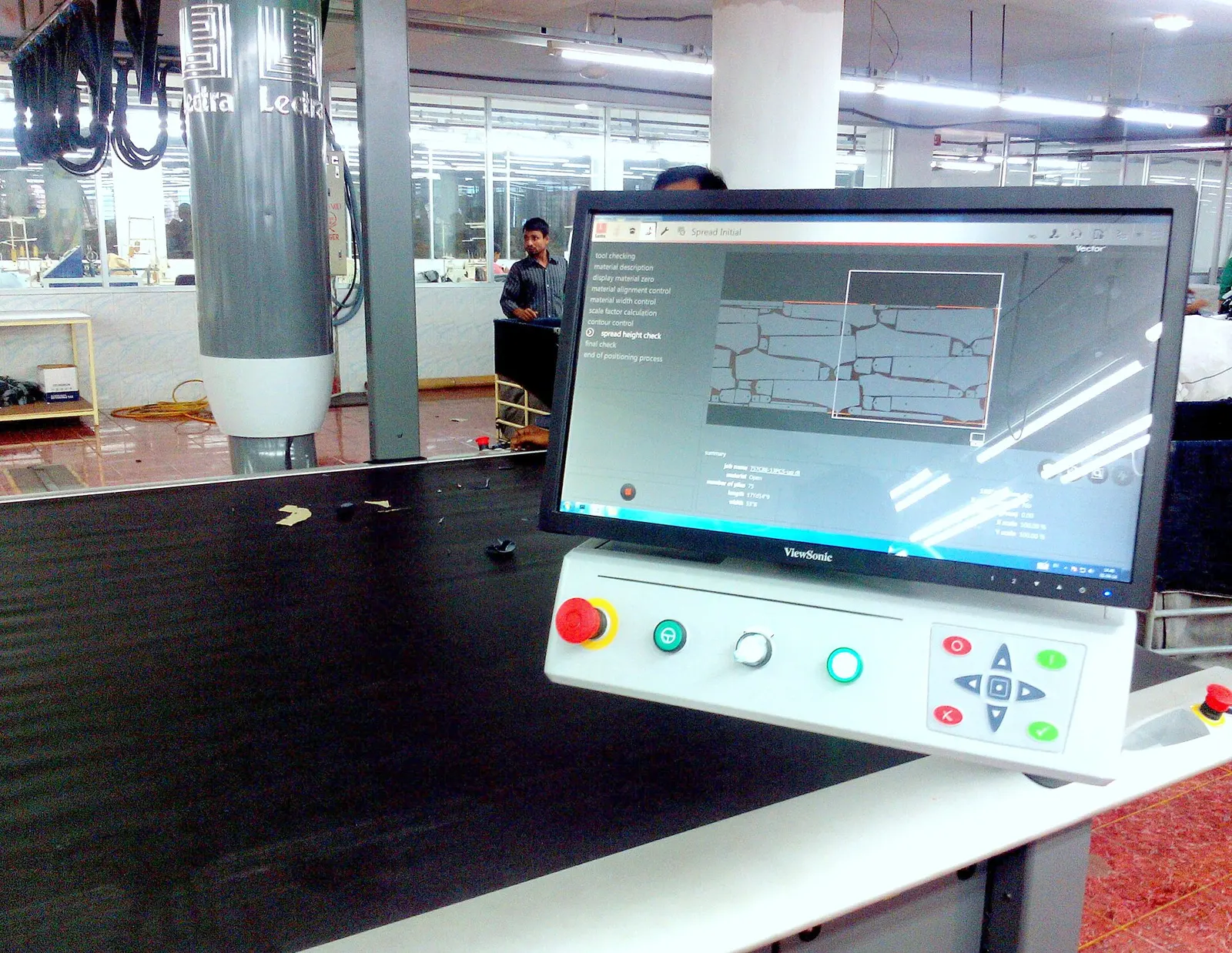
As we demonstrated in How to Choose Fabric Width and Calculate Consumption, pattern pieces fit across a fabric roll in whole columns. On a 160 cm roll (only ~152 cm cuttable), two oversized hoodie body panels (65 cm + 65 cm = 130 cm) leave a 22 cm strip down the side—too narrow to fit a sleeve or a hood panel. That 22 cm strip becomes cutting-room waste, dropping marker efficiency below 75%. Moving to a 185 cm roll (~177 cm cuttable) or 190 cm roll (~182 cm cuttable) gives the pattern maker an extra 25–30 cm column so the hood panels, kangaroo pocket and sleeves nest cleanly beside the body panels, cutting total fabric consumption per hoodie by 10% to 16%.
Full Width vs Cuttable Width on Thick Fleece (Why Fleece Loses 6–10 cm)
On lightweight 180 g/m² T-shirt jersey, selvedge trim and stenter pin holes usually take away only 3–5 cm of width. On 340–460 g/m² brushed fleece, edge loss is larger—typically 6 to 10 cm:
- Heavy Stenter Clamping & Pin Holes: Thick, wet loopback requires deeper pin-frame engagement in the stenter dryer to hold width and set shrinkage, leaving a wider perforated border on both edges.
- Unbrushed Selvedge Guard Margin: The wire napping rollers cannot brush right to the extreme selvedge without tearing the fabric edge, so the outer 2–3 cm on each side remains unbrushed and slightly thinner.
- Edge Curling: High-weight single-knit loopback curls toward the face at the cut edges unless gummed and trimmed.
Open-Width vs Tubular Hoodie Fabric
While basic promotional T-shirts often use tubular jersey to skip side seams, over 90% of commercial retail hoodies use open-width fabric. A hoodie requires precise grainline alignment for the kangaroo pocket, center-front zipper and hood attachment. Slitting the fabric open after dyeing and finishing it flat through an open-width stenter and open-width compactor straightens the wale and course lines, preventing the kangaroo pocket from twisting sideways after washing.
Hoodie Fabric Consumption & Rib Ratio per 1,000 kg Order
Because hoodie orders require both body fabric and matching rib trim dyed in the same shade lot, you must split your total kilogram order between the two constructions. Here is a worked bulk order calculation for a 360 g/m² everyday retail hoodie cut on 185 cm full open width (178 cm cuttable width):
- Linear weight of body fabric: 360 g/m² × 1.85 m = 666 g per linear meter (0.666 kg/m).
- Average marker consumption per hoodie (S–XL size ratio, including double hood & kangaroo pocket + 3.5% shrinkage allowance): ~1.25 linear meters of body fabric per hoodie.
- Body fabric weight per hoodie: 1.25 m × 0.666 kg/m = 0.833 kg per hoodie (including cutting waste).
- Matching 440 g/m² 2×2 rib consumption (cuffs + waistband): ~0.135 kg per hoodie (~14% of total garment fabric weight).
- Total fabric needed per hoodie (Body + Rib): 0.833 kg + 0.135 kg = 0.968 kg per hoodie.
- What a 1,000 kg (1-ton) combined order produces: Split as 860 kg Body Fleece (360 GSM × 185 cm) + 140 kg Matching 2×2 Rib (440 GSM), yielding ~1,030 finished adult hoodies (or ~935 hoodies after a 10% roll-end and defect margin).
| Full open width | Typical usable cuttable width (−6 to −8 cm) | Weight per running meter (at 360 GSM) | Best hoodie & sweatshirt application | Cutting & marker notes |
|---|---|---|---|---|
| 165–170 cm | 158–163 cm | 594–612 g/m | Youth hoodies, fitted women’s crewnecks, raglan basics | Too narrow for adult drop-shoulder body + hood nesting |
| 175–180 cm | 168–173 cm | 630–648 g/m | Standard retail pullovers, crewnecks, classic zip hoodies | Fits standard S–XL chest widths comfortably |
| 185 cm | 177–179 cm | 666 g/m | Commercial sweet spot: modern relaxed hoodies & streetwear | Allows side-by-side body + hood/sleeve nesting across sizes |
| 190–195 cm | 182–187 cm | 684–702 g/m | Oversized boxy drop-shoulder hoodies, 2XL–4XL plus-size programs | Prevents column breaks on 65–72 cm half-chest panels; confirm machine diameter |
How to Choose Cotton Fabric for Different Hoodie & Sweatshirt Styles
Direct answer: match the garment silhouette and post-sewing wash route to a specific 3-end recipe. Boxy streetwear hoodies use 380–460 g/m² 100% cotton 3-end loopback or fleece (21s/16s face, 185–195 cm); everyday DTC pullovers use 320–360 g/m² combed 3-end fleece or CVC (32s face, 175–185 cm); garment-dyed hoodies must use 100% cotton 3-end French terry (340–420 g/m²); and zip-up hoodies require low-shrinkage (≤3%) 260–340 g/m² compacted terry or fleece so the zipper stays flat.
Boxy & Oversized Streetwear Hoodies
We recommend 100% cotton 3-end brushed fleece or heavy 3-end French terry at 380–460 g/m², knitted with a 21s or 16s combed cotton face + 21s/32s cotton binder + 10s or 8s cotton back at 185–195 cm open width. Pair with a 450–500 g/m² 2×2 cotton-spandex rib. The coarser 21s/16s face yarn delivers the dry, substantial vintage texture streetwear buyers expect, while the 185–195 cm width handles wide drop-shoulder patterns without wasting fabric. Specify open-width compacting with shrinkage ≤3.5%.
Everyday Retail Pullover & Crewneck Sweatshirts
We recommend 320–360 g/m² 3-end brushed fleece or French terry, knitted with a 32s combed ring-spun cotton face + 32s cotton (or 75D polyester in 80/20 CVC) binder + 10s cotton pile at 175–185 cm open width. Pair with a 400–440 g/m² 1×1 or 2×2 cotton-spandex rib. The 32s combed face provides an ultra-smooth, low-hairiness canvas for detailed screen printing and DTG graphics, while the 340 g/m² mid-heavy weight works across three seasons.
Vintage-Washed & Garment-Dyed Hoodies
We recommend 100% cotton 3-end French terry at 340–420 g/m², knitted in PFD (prepared-for-dyeing) quality with 26s or 21s combed cotton face + 32s cotton binder + 10s cotton loop at 180–190 cm open width. Because the sewn garment will be tumbled in hot dye baths, enzyme baths or acid-wash cycles, zero polyester is allowed in the binder yarn, and the greige fabric must be pre-relaxed so garment sizing remains predictable after the dye-house tumble dryer.
Zip-Up & Athleisure Hoodies
We recommend 260–340 g/m² combed 3-end French terry or 95/5 cotton-spandex French terry at 175–185 cm open width, compacted to a strict lengthwise shrinkage of ≤2.5–3.0%. Zip-up hoodies have a structural vulnerability: a metal or molded plastic zipper tape shrinks almost 0% in the wash. If the cotton hoodie body shrinks 5–6% lengthwise, the longer zipper is forced to buckle into an S-curve (“wavy zipper syndrome”). Pre-shrinking both the fabric and the zipper tape before sewing is essential.
Workwear, Teamwear & Corporate Uniform Hoodies
We recommend 300–350 g/m² 3-end CVC (60/40) or hidden-binder 80/20 fleece at 175–185 cm open width, with reactive dyeing for cotton and disperse dyeing for polyester. Prioritize Martindale pilling resistance ≥Grade 4 (ISO 12945-2), washing colorfastness ≥Grade 4 (ISO 105-C06), and low tumble-dry shrinkage so the uniform survives weekly laundering.
What Quality Problems Should Hoodie Fabric Buyers Check?
Direct answer: cotton hoodie fabric buyers must inspect six high-risk defects before bulk cutting: inner fleece shedding (linting onto undershirts), lengthwise wash shrinkage (wavy zippers), body-to-rib shade mismatch, surface pilling, post-brushing GSM drops, and spirality. Require lab test reports on the finished, brushed and compacted fabric—never on unbrushed greige.
Inner Fleece Shedding and Linting on Undershirts
Nothing triggers customer returns faster than a black brushed-fleece hoodie that covers the wearer’s white T-shirt in black fuzz. Inner shedding comes from three mill shortcuts: using a 2-end construction without a middle binder yarn to anchor the pile; spinning the 10s back pile yarn from short-staple waste cotton with insufficient twist; or brushing aggressively to fake a thicker hand-feel and skipping rotary shearing and air-tumbler dedusting. Specify 3-end construction with shearing and suction dedusting, and run a wet/dry adhesive tape rub test on the inside of the pre-production sample before approving bulk.
Shrinkage After Washing (And the “Wavy Zipper” Problem)
During mechanical brushing, the napping rollers pull the fabric under high lengthwise tension, stretching the knit loops vertically. If the mill rolls the fabric right off the stenter without running it through an open-width compressive shrinking machine (compactor), that stored lengthwise tension snaps back during the customer’s first home wash—causing 6% to 9% length shrinkage. Specify AATCC 135 or ISO 6330 shrinkage ≤3.5% (or ≤3.0% for zip hoodies) after three washes. For end-user care recommendations, see our pure cotton washing and care guide.
Shade Difference Between Body Fleece and Rib Trim
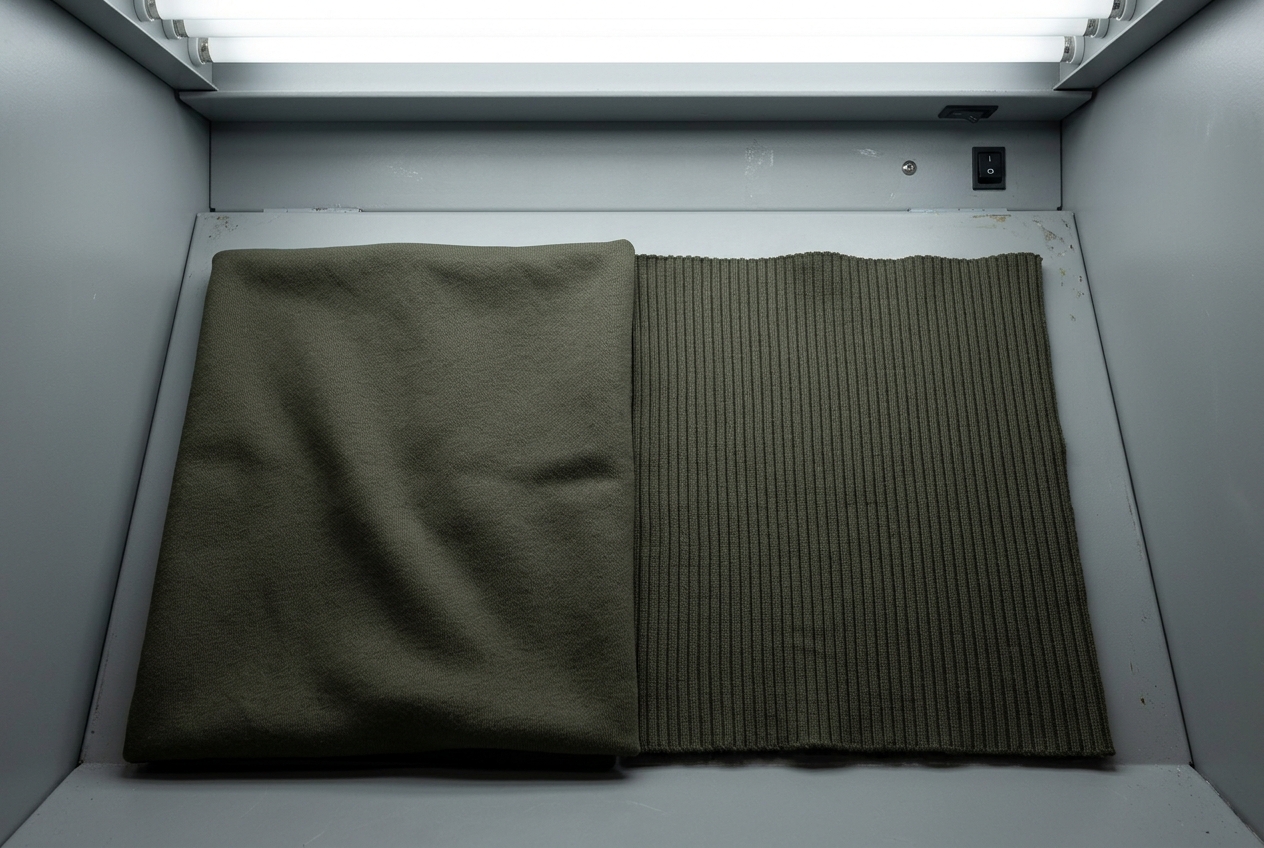
Even when dyed in the same factory, a 360 g/m² 80/20 CVC body fleece and a 440 g/m² 95/5 cotton-spandex 2×2 rib contain different fiber ratios and surface textures. If dyed in separate batches without recipe adjustment, the cuffs and waistband will look noticeably greener, redder or darker than the sleeves under retail store LED lighting (metamerism). Require the body fabric and matching rib to be dyed in the same dye vat (for 100% cotton body + cotton/spandex rib) or color-matched side by side under D65 and TL84 light boxes with a spectrophotometer tolerance of ΔE ≤ 1.0 before shipping.
Surface Pilling and Abrasion
Heavy hoodies experience constant friction under the arms and along the lower torso. Test the outer jersey face using ISO 12945-2 (Martindale) or ASTM D4970 for 2,000 cycles, requiring Grade ≥3.5 or ≥4. Using 32s or 21s combed ring-spun yarn on the face combined with cellulase enzyme bio-polishing removes the fuzzy surface hairs that tangle into pills.
Brushing Weight Loss and Finished GSM Variation
Because napping and shearing strip away 5–8% of the fabric’s mass, measure GSM using ASTM D3776 / ISO 3801 on a conditioned, relaxed cut taken at least 3 meters inside the finished roll—never from the stretched roll end. Set a PO tolerance of ±5% on finished GSM.
| Quality problem | Root cause in production | Standard test method | Recommended PO pass limit |
|---|---|---|---|
| Inner fleece shedding / linting | 2-end knit, short-staple pile yarn, over-brushing without shearing & dedusting | Adhesive tape / domestic wash transfer test with contrasting undershirt | Minimal loose fiber transfer after 1 wash; 3-end sheared construction mandatory |
| Lengthwise shrinkage & wavy zippers | High lengthwise tension during brushing not relaxed by open-width compacting | AATCC 135 / ISO 6330 (3 home washes) | ≤3.5% length & width (≤3.0% length for zip-up hoodies) |
| Body-to-rib shade mismatch | Different fiber uptake (CVC body vs cotton-spandex rib) or separate dye lots | D65 & TL84 light box visual check + Spectrophotometer (CMC 2:1) | ΔE ≤ 1.0 between body roll and matching rib roll; Grade ≥4–5 gray scale |
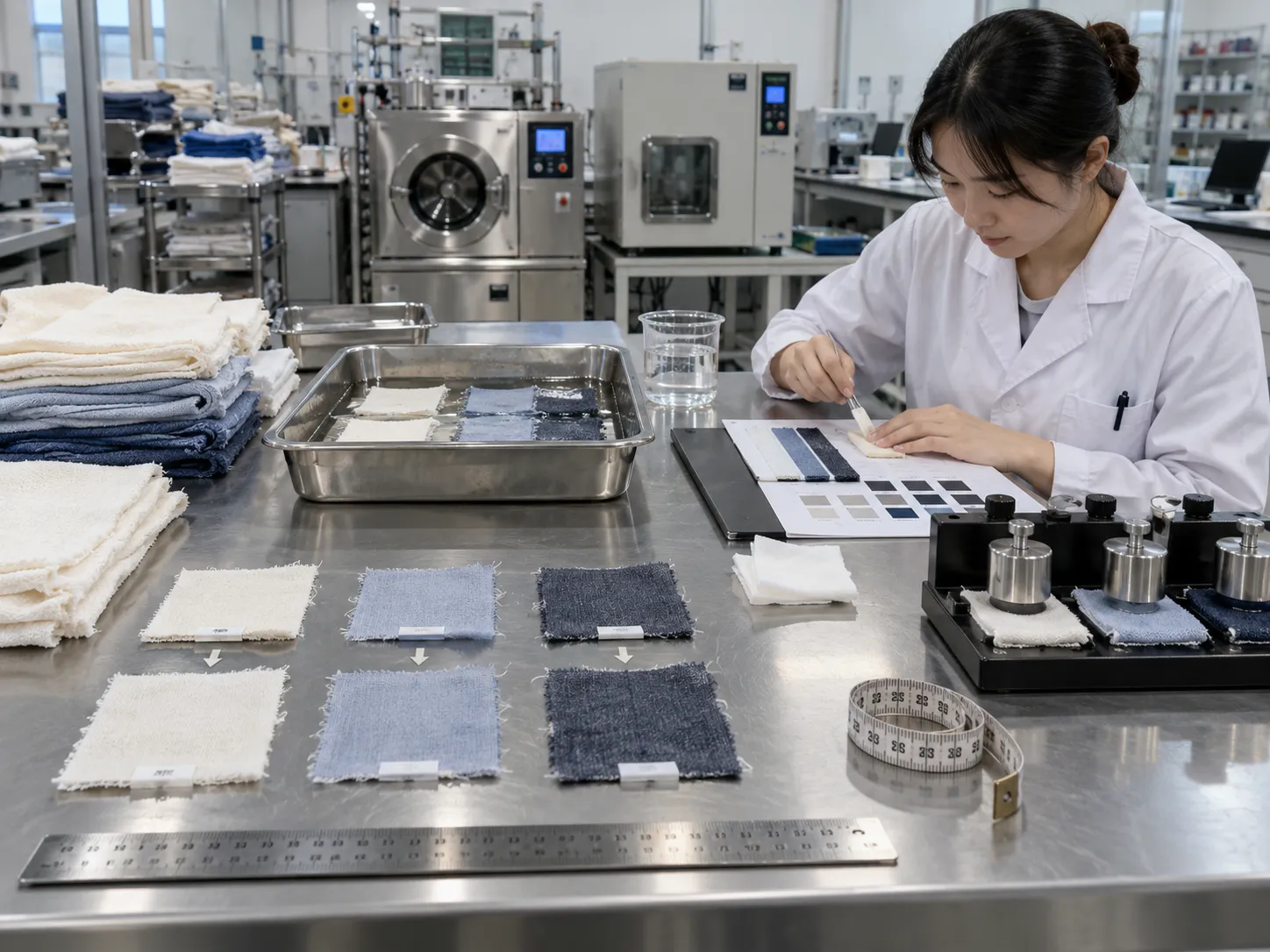
| Outer surface pilling | Carded/open-end face yarn, loose stitch density, skipped bio-polishing | ISO 12945-2 (Martindale 2,000 rubs) / ASTM D4970 | Grade ≥3.5–4.0 before and after washing |
| Spirality (side-seam torque) | Unbalanced yarn twist, circular machine feed skew, uneven stenter framing | AATCC 179 / ISO 16322-2 | ≤3.0%–4.0% on open-width compacted fleece/terry |
| Colorfastness to washing & rubbing | Unfixed reactive dye on dark shades (black, navy, burgundy) | ISO 105-C06 / AATCC 61 (wash); ISO 105-X12 / AATCC 8 (crocking) | Wash ≥Grade 4; Dry rubbing ≥Grade 4; Wet rubbing ≥Grade 3–3.5 |
For detailed laboratory procedures, see Cotton Quality Tests and Colorfastness Test Standards.
How Do Dyeing, Brushing and Finishing Affect Hoodie Fabric Quality?
Direct answer: finishing turns raw circular-knitted loopback into a stable, plush sweatshirt fabric. The sequence—enzyme bio-polishing, reactive dyeing, multi-pass mechanical brushing, rotary shearing, hydrophilic softening and open-width compacting—controls hand-feel, inner lint shedding, shrinkage and print ink adhesion. Specify the finishing route on the PO alongside the knit construction.
Mechanical Brushing (Napping), Shearing and Dedusting
High-grade 3-end fleece is never brushed in a single heavy pass. Dragging the loops across the wire rollers all at once snaps the yarn and creates bald spots. Instead, our finishing line runs 3 to 5 light, progressive brushing passes, gradually teasing out a dense, even micro-nap, followed by rotary shearing (which levels the pile height) and high-suction air tumbling to clear out loose lint. If you want a vintage “loop-and-nap” texture, you can also specify lightly brushed French terry (1–2 light passes).
Enzyme Bio-Polishing and Softener Selection for Print Programs
Before or during dyeing, a cellulase enzyme wash (bio-polishing) singes off microscopic cotton fuzz from the outer face yarn, keeping the jersey surface crisp and pill-free after dozens of washes. When choosing the final chemical softener, coordinate with your garment printer: heavy hydrophobic amino-silicone acts like a non-stick coating on the face yarn and can cause water-based DTG pre-treatment or plastisol inks to peel after washing. For print-heavy hoodie programs, specify hydrophilic silicone or mild enzyme softening.
Open-Width Slitting and Compressive Compacting
After dyeing and drying, the tubular roll is slit open along a drop-stitch guide line, optically straightened so the courses run perpendicular to the selvedge, and fed through a felt-belt or shoe open-width compactor. According to technical guidelines on knit shrinkage control from Cotton Incorporated, mechanical compacting compresses the stretched loops lengthwise so residual wash shrinkage stays stable without formaldehyde resins.
For a comparison of reactive, vat and pigment dye performance on cotton, see Cotton Fabric Dyeing Methods.
How to Specify Cotton Hoodie Fabric for Bulk Production (6-Step Guide & PO Template)
Direct answer: specify cotton hoodie fabric in six steps: define the silhouette and wash/print route, lock the 3-end yarn recipe and gauge, set finished post-brushed GSM and cuttable width, pair the matching rib GSM and weight ratio (12–15%), set shrinkage/shedding/colorfastness test limits, and approve matched body-and-rib bulk samples. Put both the body fabric and the rib trim on the same purchase order.
Step 1 — Define the Hoodie Silhouette, Season and Post-Sewing Route
Document whether the style is a spring pullover, an everyday retail crewneck, a zip-up hoodie, or a 440 g/m² boxy streetwear drop, and note whether it will be screen-printed, DTG-printed, embroidered or garment-dyed. Add required certifications (OEKO-TEX Standard 100 or GOTS) upfront.
Step 2 — Lock the Knit Construction and Multi-Yarn Recipe
Specify 2-end French terry, 3-end French terry, or 3-end brushed fleece, and write out all three yarn feeds plus the machine gauge—for example: 32s combed ring-spun cotton face + 32s cotton binder + 10s cotton pile, 20G.
Step 3 — Confirm Finished GSM and Usable Cuttable Width
State the finished GSM (±5%) measured after brushing, shearing and compacting, alongside both the full open width and the minimum usable cuttable width (for example: 185 cm full open width / 178 cm min cuttable width).
Step 4 — Specify Matching Rib Trim (Construction, GSM & Weight Ratio)
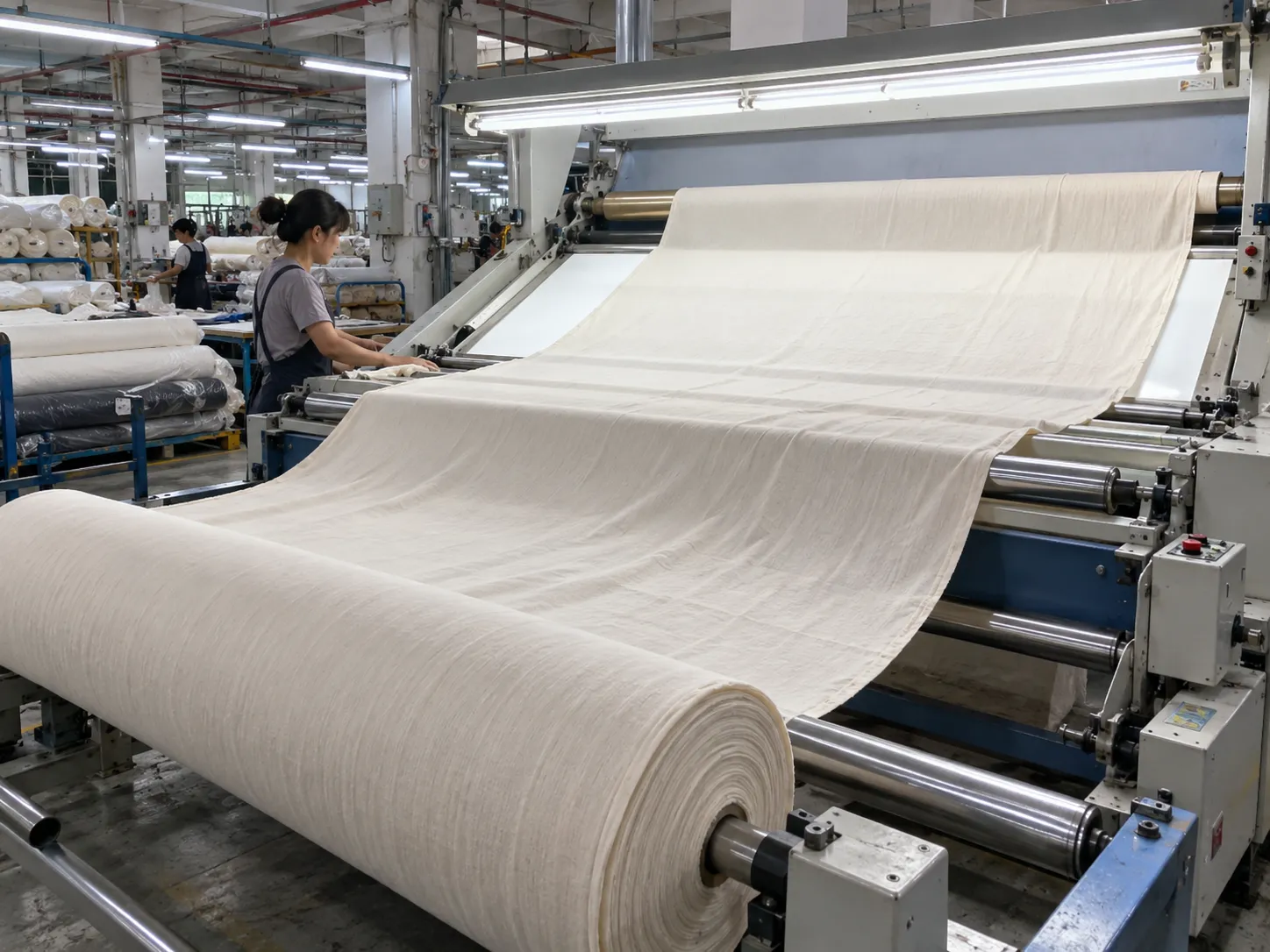
Add the cuff and waistband rib directly below the body fabric on the same spec sheet: for example, 440 g/m² 2×2 rib, 95% combed cotton / 5% spandex, shade-lot matched to body fabric under D65 (ΔE ≤ 1.0), ordered at 14–15% of body fabric weight.
Step 5 — Set Shrinkage, Shedding, Pilling and Colorfastness Limits
Write the exact test standards on the PO: shrinkage ≤3.5% L×W (AATCC 135, 3 washes), spirality ≤3.5% (AATCC 179), Martindale pilling ≥Grade 3.5–4 (ISO 12945-2), wash fastness ≥Grade 4 (ISO 105-C06), and sheared/dedusted low-shed inner pile.
Step 6 — Approve Matched Lab Dips, Counter Samples and Inspection Terms
Approve the body fabric and 2×2 rib lab dips together on one continuity card, test a 5–10 kg pre-production sample roll on your actual hoodie pattern and print line, and confirm the 4-point inspection standard, roll weight (typically 22–28 kg/roll) and packing.
| Specification field | Part A: Hoodie Body Fabric (PO Example) | Part B: Matching Cuff & Hem Rib (PO Example) |
|---|---|---|
| Knit construction | 3-End Brushed Fleece (or 3-End French Terry) | 2×2 Rib Knit (Tubular or Open Width) |
| Fiber composition | 100% Cotton (or 80% Combed Cotton Face & Pile / 20% Polyester Binder) | 95% Combed Cotton / 5% Spandex (Elastane) |
| Yarn count & gauge | 32s Combed Ring-Spun Face + 32s Binder + 10s Pile · 20G | 32s/1 × 2 Combed Cotton + 40D Spandex · 14G/16G |
| Finished weight (GSM) | 360 g/m² ±5% (relaxed, after brushing, shearing & compacting) | 440 g/m² ±5% (relaxed, finished) |
| Finished width | 185 cm full open width / 178 cm min cuttable width (−0/+3 cm) | 125–135 cm usable open width (or 60–65 cm×2 tubular) |
| Finishing route | Bio-polished face, 4-pass brushed, sheared, tumble-dedusted, hydrophilic soft, open-width compacted | Bio-polished, heat-set, compacted, matched hand-feel |
| Wash shrinkage | ≤3.5% length × ≤3.5% width (AATCC 135, 3 home washes) | ≤4.0% length × ≤4.0% width with ≥92% elastic recovery |
| Spirality & pilling | Spirality ≤3.5% (AATCC 179); Pilling ≥Grade 3.5–4 (ISO 12945-2) | Pilling ≥Grade 3.5–4 (ISO 12945-2) |
| Colorfastness & shade | Wash ≥4 (ISO 105-C06); Dry rub ≥4, Wet rub ≥3–3.5 (ISO 105-X12) | Shade-lot matched to Part A under D65 & TL84 (ΔE ≤ 1.0) |
| Certification | OEKO-TEX Standard 100 Class II | OEKO-TEX Standard 100 Class II |
| Order quantity split | 860 kg (~1,290 linear meters; ~35 rolls at ~25 kg/roll) | 140 kg (~14% of total 1,000 kg order, dyed per Part A shade lot) |
This is an engineering RFQ template for buyer reference, not a fixed stock sheet. Final shrinkage, brushing loft and body-to-rib shade matching must be verified on a physical production sample.
For our full supplier vetting and QC workflow, see the Cotton Fabric Sourcing Guide or browse our cotton fabric wholesale range.
How to Choose a Reliable Cotton Hoodie Fabric Supplier
Direct answer: evaluate a cotton hoodie fabric supplier on four production capabilities: multi-feed 16G–22G circular knitting machines, controlled multi-pass brushing and shearing lines, simultaneous body-and-rib shade matching, and open-width post-brushed compacting. A mill that knits loopback well but subcontracts brushing and rib dyeing without QC will struggle with lint shedding, shrinkage and cuff color mismatch.
Check 3-End Circular Knitting, Brushing and Shearing Capabilities
Ask which cylinder diameters (typically 30″, 34″ and 38″ for wide open-width fleece) and gauges (16G, 18G, 20G, 22G) the mill runs, and inspect their napping room. A reliable fleece mill controls the number of brushing passes, sharpens its rotary shearing blades on schedule, and runs suction/tumble dedusting so the inner nap is lofty but clean.
Verify Simultaneous Body Fabric and 2×2 Rib Dyeing
Never buy body fleece from one supplier and cuff rib from a market stockist if color consistency matters. Confirm that your supplier knits and dyes the matching 1×1 or 2×2 cotton-spandex rib alongside your body rolls, and ask to see D65 light-box continuity cards showing body-to-rib swatches side by side for every dye lot.
Request Post-Brushed, Compacted Samples and Lab Reports
Insist on testing a finished sample taken after the full brushing, shearing and compacting sequence. Check that the lab report states the exact test standards (ASTM D3776 for weight, ASTM D3774 for width, AATCC 135 for shrinkage, ISO 12945-2 for pilling) and that the usable width inside the stenter pin holes meets your cutting table’s marker width.
Cotton Hoodie & Sweatshirt Fabric Supplier Evaluation Checklist
- ☐ 3-end knitting capability confirmed across 16G–22G with wide cylinder diameters for 180–195 cm open width.
- ☐ Full 3-yarn recipe disclosed (face yarn count & combing grade, binder yarn fiber/count, loop/pile yarn count).
- ☐ Controlled brushing, rotary shearing and dedusting route verified on brushed fleece qualities.
- ☐ In-house or co-dyed matching 1×1 and 2×2 cotton-spandex rib (380–500 g/m²) with ΔE ≤ 1.0 under D65 light.
- ☐ Open-width compacting after brushing confirmed, with AATCC 135 / ISO 6330 shrinkage test reports (≤3.5%).
- ☐ Both full open width and minimum cuttable width (inside pin holes/unbrushed edges) guaranteed in writing.
- ☐ Print-compatible softener route (hydrophilic or enzyme finish) available for DTG and screen-printed programs.
- ☐ MOQ per color, body-to-rib ratio (e.g. 86:14), roll weight and 4-point inspection standard written into the PO.
Request Cotton Hoodie Fabric Samples and Bulk Pricing
Send us your hoodie or sweatshirt style brief, target GSM, knit construction (French terry or 3-end brushed fleece), yarn count preference, finished width, quantity and matching rib requirements. We will recommend the exact 3-end construction, ship a physical production sample with matching rib, and quote bulk pricing against your approved specification.
- Available Sweatshirt & Hoodie Knits: 2-end & 3-end French terry (loopback), 3-end brushed fleece, lightly brushed vintage terry, heavy double-knit interlock, and matching 1×1 / 2×2 cotton-spandex rib.
- Custom GSM, Yarn Count & Wide Open Widths: 240–500 g/m², 32s+32s+10s to 16s+21s+8s, 165–195 cm finished open width (with guaranteed cuttable width).
- Fiber Compositions: 100% combed/carded cotton (piece-dyed or PFD for garment dyeing), 80/20 hidden-binder CVC, 60/40 CVC, 65/35 TC, and 95/5 cotton-spandex.
- Sample & Bulk Lead Times: Free quality swatch samples ship in 3–5 days; bulk production is typically 20–30 days after lab-dip and sample approval.
Ready to match a cotton French terry or 3-end fleece to your hoodie program? Send your tech pack or target GSM and width. We will send a finished sample with measured GSM, cuttable width, shrinkage data and matching 2×2 rib swatch for your approval.
Cotton fabric wholesale · Request a quote · Why buyers order from us
Frequently Asked Questions About Cotton Hoodie & Sweatshirt Fabric
What is the best GSM for a cotton hoodie?
300–360 g/m² is the best all-round GSM for everyday retail hoodies and crewnecks, offering a balanced drape, durable warmth and a finished garment weight around 600–680 g. Use 240–280 g/m² French terry for lightweight spring hoodies, and 380–460+ g/m² 3-end fleece or loopback for heavyweight, boxy streetwear hoodies with self-supporting hoods.
Is French terry or brushed fleece better for hoodies?
Neither is universally better; choose by season and silhouette. French terry has uncut interior loops, breathes better, never sheds inner lint, and holds a cleaner, more structured drape—making it ideal for year-round wear and garment-dyed streetwear. 3-end brushed fleece has a mechanically napped interior pile that traps air, making it 30–50% loftier and much warmer for autumn and winter collections at the same GSM.
What is the difference between 2-end and 3-end hoodie fleece?
2-end knit uses only a face yarn and a back loop yarn; if brushed into fleece, the wire rollers damage the structural loops, causing heavy inner lint shedding and poor dimensional stability. 3-end fleece adds a middle binder (tie-in) yarn that locks the pile yarn securely and separates it from the smooth front face. Always specify 3-end construction for brushed fleece hoodies.
What yarn count is used for 350–400 GSM hoodie fabric?
Unlike T-shirt jersey, hoodie fabric combines three yarn counts (Face + Binder + Loop/Pile). For 320–360 g/m² hoodies, the standard mill recipe is 32s combed cotton face + 32s cotton (or 75D polyester) binder + 10s cotton pile on a 20G machine. For 380–440 g/m² heavyweight streetwear hoodies, mills typically use 21s or 16s combed cotton face + 21s/32s binder + 10s or 8s cotton back on a 16G–18G machine.
What fabric width is best for oversized hoodies?
185–195 cm finished open width (providing 177–187 cm usable cuttable width after removing stenter pin holes and unbrushed edges) is best for oversized and drop-shoulder hoodies. Because hoodie patterns include wide body panels plus four hood panels, long sleeves and a kangaroo pocket, 185–195 cm rolls eliminate column breaks and save 10–16% in fabric consumption compared with 160 cm rolls.
How many hoodies can 1,000 kg of 360 GSM fabric make?
At 360 g/m² and 185 cm open width, one linear meter of body fabric weighs 666 grams, yielding about 1,501 linear meters per 1,000 kg. In a realistic production order split into 860 kg body fabric (360 GSM) + 140 kg matching 2×2 rib (440 GSM), 1,000 kg total fabric produces roughly 930 to 1,030 adult hoodies depending on size grading and cutting waste.
What GSM rib knit should match a 350 GSM hoodie?
Pair a 340–360 g/m² hoodie body with a 400–450 g/m² 1×1 or 2×2 rib knit made from 95% combed cotton / 5% spandex (about 1.2× the body GSM). Allocate 12% to 15% of your total order weight to matching rib, and require the mill to dye the rib and body fabric to the same shade lot (ΔE ≤ 1.0 under D65 light).
Is 100% cotton or 80/20 cotton-polyester better for hoodies?
Choose 100% cotton if the hoodie will be garment-dyed, pigment-washed, acid-washed, or marketed as a pure-cotton luxury loopback piece. Choose 80/20 CVC 3-end fleece (with 100% cotton on the face and pile, and 20% polyester hidden in the middle binder yarn) for piece-dyed retail hoodies when you want a pure-cotton print surface with lower shrinkage (≤3%) and reduced inner lint shedding.
Why does my hoodie fleece shed fuzz onto T-shirts?
Inner fleece shedding happens when a factory uses a 2-end knit without a binder yarn, spins the back pile from short-staple waste fibers, or skips rotary shearing and suction/tumble dedusting after brushing. Specify 3-end combed-face fleece with shearing and tumble dedusting on your PO to stop inner linting.
Why do zip-up hoodie zippers wave or buckle after washing?
A wavy zipper occurs when the cotton hoodie body shrinks 5–7% lengthwise in the wash while the synthetic zipper tape shrinks near 0%. To prevent it, specify open-width compacted fabric with lengthwise shrinkage ≤2.5–3.0% (AATCC 135) and pre-shrink the zipper tape before sewing.
Still comparing constructions? Send us the style, target GSM, quantity and cotton hoodie fabric requirements. We will recommend a knit, 3-end yarn recipe and width, then send a finished sample with measured GSM, cuttable width, shrinkage and matching 2×2 rib for your approval.
Specification ranges in this guide are B2B sourcing references, not stock guarantees. Final composition, multi-yarn counts, finished GSM, usable cuttable width, shrinkage, pilling and body-to-rib shade matching must be confirmed by a production sample and test report for the specific construction and finishing route.